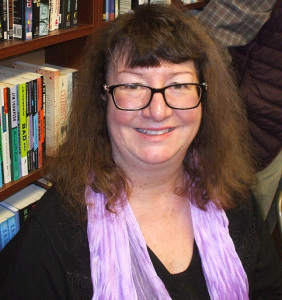
Mme Melissa Yi is a finalist in two categories in the 2025 CWC Awards of Excellence. Her short story, “The Longest Night of the Year”, published in Ellery Queen Magazine, Nov/Dec Issue, 2024, is shortlisted for Best Short Story. Her YA novel, The Red Rock Killer, is a finalist for Best YA/Juvenile Crime Novel.
It’s finally spring, and the Mesdames have come roaring back from winter with events, such as the Bony Blithe Mini-Con, a Festival of Authors, a major book launch, more publications, an acclaimed documentary, and, even better, terrific recognition from our writing and film communities!

CONGRATULATIONS
Mega congrats to three fellow Mesdames for being finalists on the 2025 CWC Awards of Excellence Short list. Huge congrats to Mmes Catherine Astolfo, Therese Greenwood and Melissa Yi for their nominations for the CWC Award for Best Crime Short Story:
Congrats to Carrick Publishing for publishing winning authors AND sponsoring the CWC Award for Best Crime Novella.
Fingers crossed for Thursday, May 29th, when the winners are announced!!
RECOGNITION FROM THE TORONTO STAR
Huge congratulations to Mme Melodie Campbell! Her latest novel, The Silent Film Star Murders, received a great review in the Toronto Star.
“Campbell does a good job recreating the kind of classic English puzzle mystery Agatha Christie excelled at, right down to the locked-room setting on board a cruise ship. Since this is the same setting as the previous book, some readers might cavil that the author is repeating herself, but her variation on a cozy whodunnit nevertheless sports a colourful cast of characters and a glitzy milieu with some well-placed commentary on class disparity and celebrity culture.“
Melodie Campbell
Congrats to Mme Cat Mills. She has been working on the TVO show, Unrigged, which has been nominated for a Canadian Screen Award. You may stream Unrigged on TVO and on YouTube. Trailer | Unrigged | TVO Original
ANNOUNCEMENTS
Book Launch! On Saturday, May 10, 1 p.m, Mme Melodie Campbell will be at A Different Drummer Books, 513 Locust Street,Burlington to introduce her latest crime novel, The Silent Film Star Murders. It’s a West GTA Double Launch with Vicki Delany and her new novel Shot Through the Book.
Lisa de Nikolits
Join Mme Lisa de Nikolits at the Appleby College Festival of Authors to celebrate the incredible work of Canadian writers on Saturday. May 24th. The festival runs from 10:00 a.m. to 3:30 p.m. at Appleby College, 540 Lakeshore Road W, Oakville.
TheCrime Writers of Canada have launched a newsletter, edited by Lorne Tepperman, and the Mesdames have articles published in it! Here’s the list:
May Issue: Mme M. H. Callway, Writers’ Groups – Are They Worth it?
May Issue:Mme Melodie Campbell,Murder at the Crime Writing Awards
April Issue: MmeMelodie Campbell,Four Things that Drive Writers Crazy
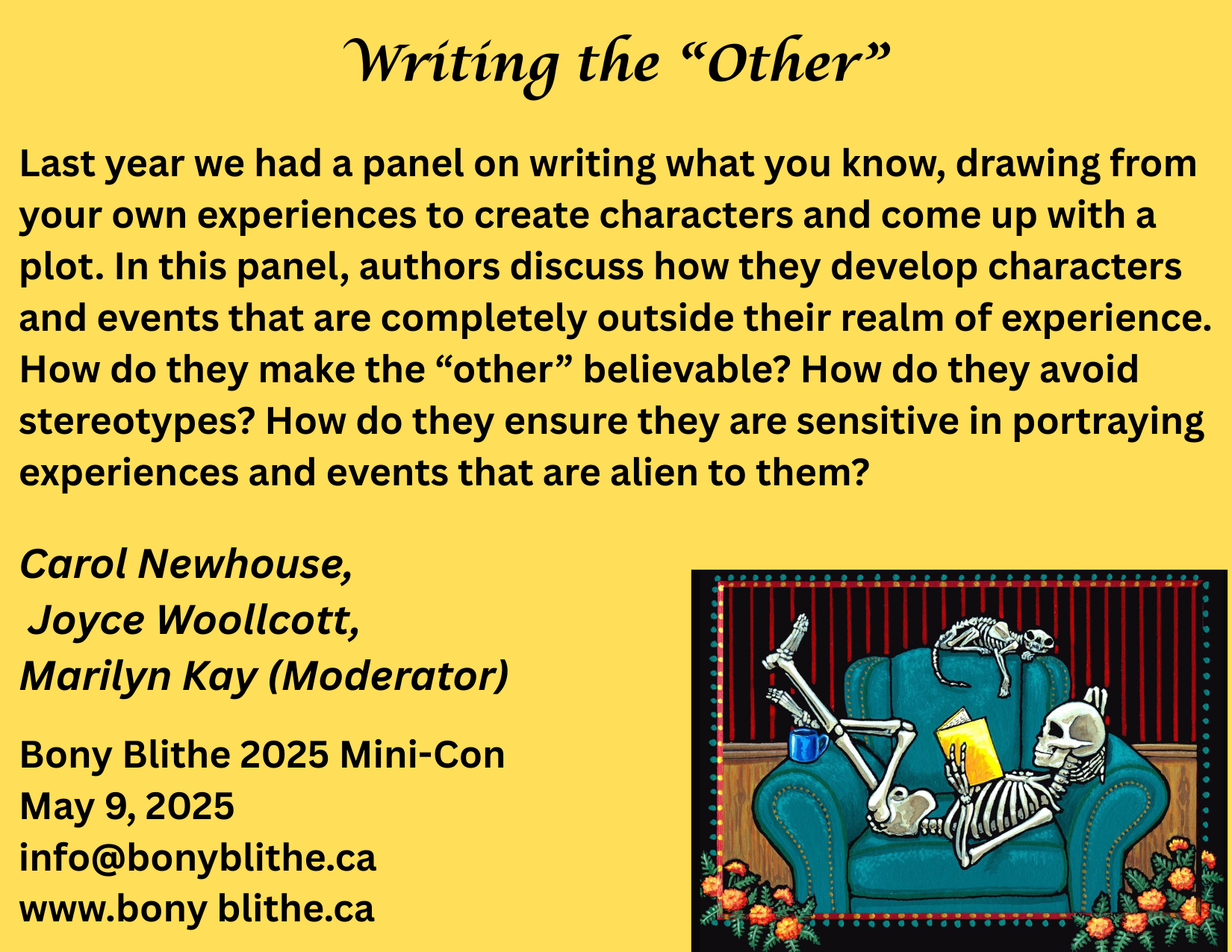
Bony Blithe Mini-Con
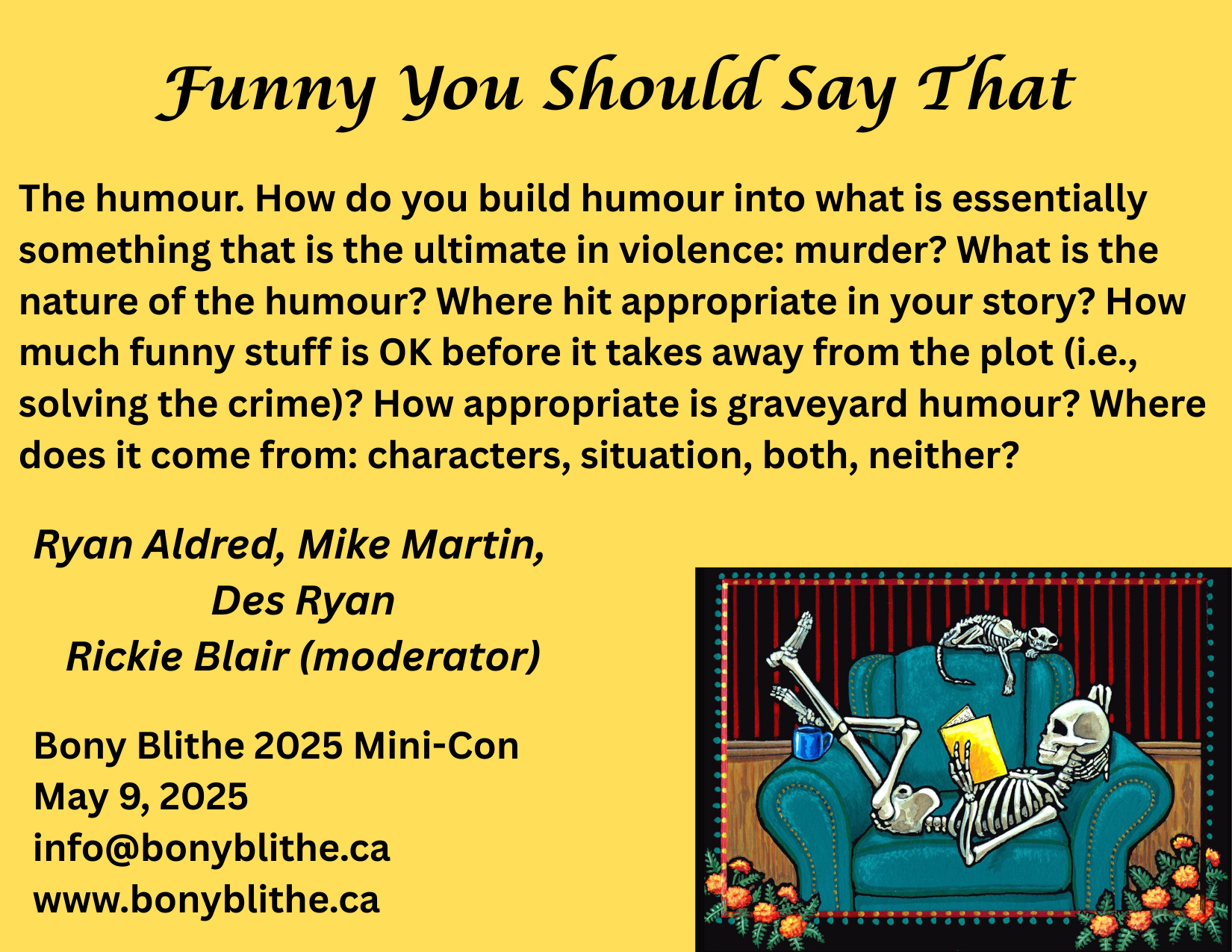
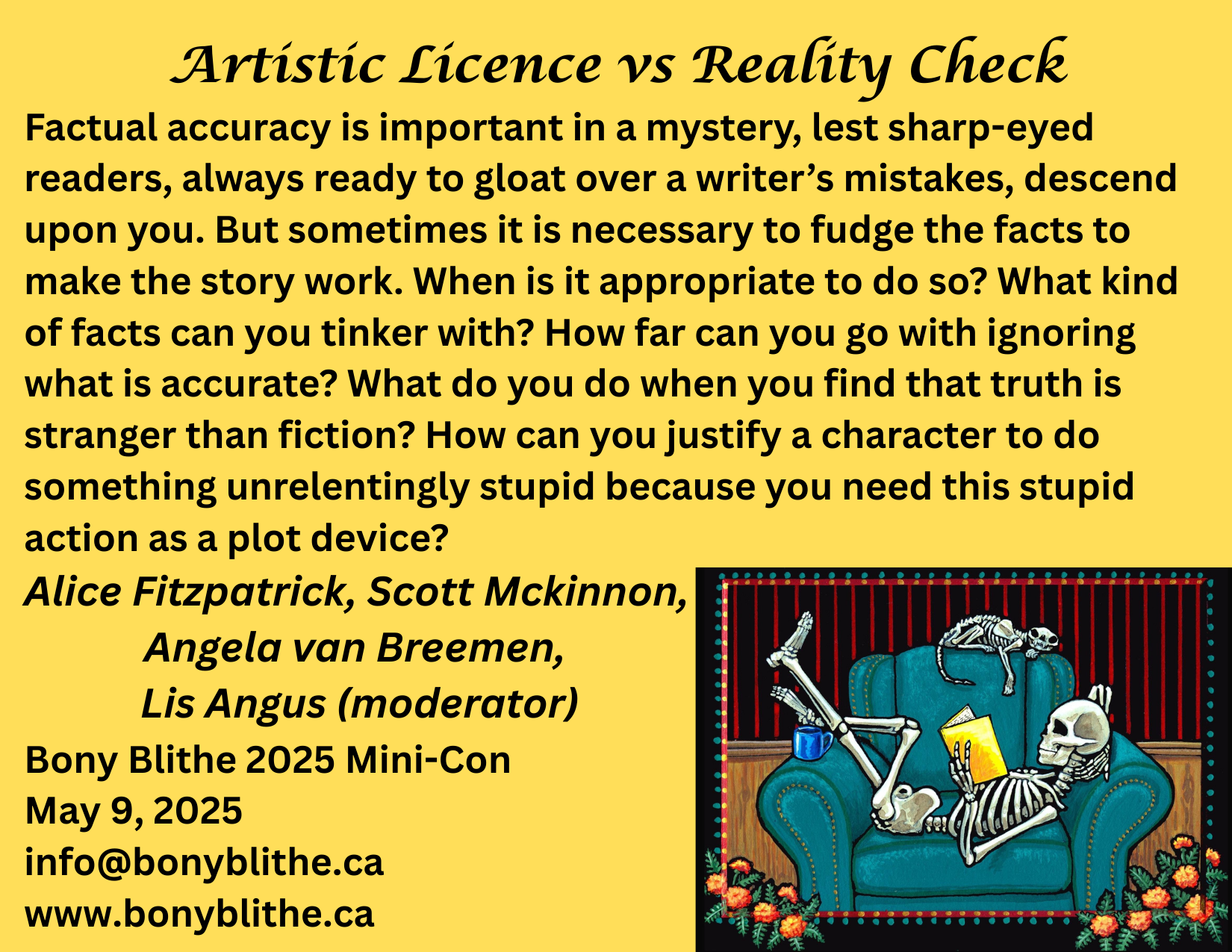
The Bony Blithe Minicon takes place on Friday, May 9 from 10 a.m. to 6 p.m. at The High Park Club, 100 Indian Road, Toronto, Mme Cheryl Freedman presiding! There’s still time to register if you want to join the fun. Visit http://www.bonyblithe.ca and scroll down for the link to the registration form and instructions on how to pay. See panel descriptions below.
Mme Melissa Yi is an emergency room physician and an award-winning author in several different genres: crime fiction, fantasy, speculative fiction, YA, poetry, memoir and most recently romance! She is the creator of the acclaimed Dr. Hope Sze series. Her work has been short-listed for a range of leading awards, including the Crime Writers of Canada Awards of Excellence, the Killer Nashville Silver Falchion Award for Best Thriller and the Derringer. In 2023, her crime fiction short story, “My Two Legs”, won the Derringer Award.She has also led the way by crowd-funding her new Dr. Hope series based on the seven deadly sins. Sometimes she sleeps!
Melissa’s fun story, “The Mob Bar Mob”, was written for the Mesdames and Messieurs’ 5th anthology, In the Spirit of 13, where “spirit” means “illicit liquor”!
THE MOB BAR MOB
A Dr. Hope Sze Mystery
by
MELISSA YI
“Open the book, Hope,” said Tucker.
He’d reserved a table for us at the Mob Bar, a retro speakeasy in the basement of Montreal’s Musée Mafioso. I was extra late because Tucker had forgotten to text me the password, so the doorman had refused to let me in.
Once I’d received and muttered the password, Zozzled, the doorman had checked off Dr. Hope Sze in a small, black notebook, tucked the notebook in the left breast pocket of his navy peacoat, tipped his matching retro police cap, and finally allowed me to enter.
I tiptoed into this dark cellar with low ceilings, brick walls, and a mahogany bar. My high heels clacked on the wooden floor, and I scanned past an elderly couple and a trio of drunk businesspeople before I spotted Tucker’s blond hair and green suit gleaming under the dim, yellow light.
Just before I sat down, facing the door, a female server in a discreet black dress placed a glass of ice cubes in front of me, with a blackberry on top of the topmost cube.
“Uh, thanks.” An empty glass?
She pressed a black book, titled The Snitch’s Diary, onto the dark, wood table, beside my right hand.
Tucker also received a book and a glass of ice.
I raised my eyebrows.
That was when Tucker told me to open the book. But the heavy hardback was stuck closed, and its pages were glued together. I sputtered, “This is a fake book!”
Tucker laughed, so I turned the book sideways and used my nails to pry open the lid. It was really a cardboard box made to look like a book. Inside lay a glass flask filled with clear liquid.
“Pretty neat, huh?” said Tucker. “You have to pour your drink yourself. They used to hide booze inside books during the Prohibition.”
The server smiled, and whirled away to serve the businesspeople at the next table, interrupting their chat about mergers and acquisitions.
I popped open the flask and tipped the strong-smelling alcohol into the glass. I might prefer books to booze, but I was willing to try it. “What did you order me?”
“The Hope Diamond Gin. I got the Bee’s Knees.”
I laughed. “They say that in the Archie comics. It means fantastic.”
“Yeah. They named the drink in honor of Bee Jackson, famous for dancing the Charleston, even though she probably ripped off an African-American dance called the Juba.”
I sighed to myself. Ain’t that always the way?
“Yeah. Gin, lemon, and honey sound good, even if it is cultural appropriation.” He started to open the box, but struggled even more than I did.
“Open the book, Tucker,” I said, with an innocent wink.
“I can’t. Mine’s, like, taped shut.” He picked up a sharp swizzle stick.
“Don’t hurt their book!”
“I’m not. The tape would hurt the book more than this stick.”
Tucker’s a family medicine resident like me. I know he’s got good hands. Still, I kept a nervous eye out for the server. I’m pretty sure they don’t want you damaging fake books at the overpriced 21st-century speakeasy.
Fortunately, the server seemed more interested in the old couple by the door. The man held up his glass, showing that he wanted a refill.
Meanwhile, the white businessman next to us grumped, “What about my moonshine?”
I glanced behind me. The bartender rolled up the cuffs of his white shirt and reached for a glass.
In other words, no one noticed Tucker’s surgery on the booze book. I breathed a little more easily—until Tucker opened the book and basically turned translucent. He doesn’t have the half the melanin in my Asian gene pool.
“What is it?” I mouthed at him.
He shut the book, fingers trembling. “It’s not mine.”
“What isn’t?” I whispered.
He texted to me instead of speaking. I’m guessing $20K.
I blinked at him. We went out for a drink and ended up with $20,000 in a booze book?
The doorman seemed like an obvious choice to tell, if only because of his Prohibition police uniform. But maybe I’d been fooled by his cap and double-breasted coat?
We couldn’t trust anyone.
I twisted in my chair to survey the room. The tall, tattooed, toothsome male bartender stared back at me; I counted two servers, including our own; the three businesspeople at the next table—who were the grumpy white man, a white woman, and a Black man; us; and the elderly white couple who looked like they might have survived the Prohibition, or at least been born in the same era as my grandma. None of them were obvious sources of twenty grand.
“Huh,” I said. “So, we should call the police?”
Tucker shook his head. “I don’t know that this is a crime.”
“Yeah, but money doesn’t fall out of the sky. Or out of a book.”
“Agreed. It’s just…I’ve never seen so much money before.”
Both of us were poor students. I don’t think anyone outside medicine has a clue that most of us graduate with at least $200,000 in debt. So free money was awfully tempting.
Tucker exhaled and said, “Okay. We have to figure out what to do with it. Let me go to the secret room.”
I started to ask, “What secret room?” But he’d already leaped out of his seat, the book tucked under his green suit jacket as he headed for the door.
I whipped out my phone to research Prohibition. When the U.S. banned liquor sales in 1920, people turned to speakeasies, or underground bars. Modern speakeasies tend to replicate secret rooms, if only so they can charge $20 a drink.
If Tucker had a second password, that doorman could probably find him a good hidey-hole.
I prayed that Tucker had that password.
“Where is it?” demanded the businesswoman with a sharp nose, and an even sharper voice, drawing my attention back to the neighboring table.
“I don’t got it,” snapped the oversized white businessman beside her.
I shrank down in my seat, remembered I was supposed to be cool, and stirred my drink instead. I didn’t dare drink it; I had to keep every last brain cell active.
“Ronald, where’d you put it?” the Black businessman beside him asked.
“In a safe place,” grumpy Ronald replied. “I told you that you could trust me, Rose,” he added to the sharp woman.
Okay. Ronald and Rose. Those should be easy to remember. At least they were both R names. I avoided their eyes. Both men looked ready to fight. Even Rose could probably smash me. She looked twice my age, but also gave off a vibe like she’d fight dirty.
“I told you to leave the money alone. Now, where is it?” Rose issued each word deliberately and viciously. Like a bullet.
Ronald shrank away. “I sent it to the back. I used a code word.”
“You idiot. What code word?” Rose snapped.
“Look, no one’s mad at you, Ronald, but we need the money,” said the Black guy.
Rose shifted closer to Ronald. “I’m mad at you. I’d cut your eyes out if Xavier here didn’t stop me.”
Ronald bleated back to her, “Bees.”
“What?”
“That’s the safe word. That’s how I know it goes to the right place. Bees.”
“You idiot. One of the drinks here is called the Bee’s Knees. In fact, I think that old lady ordered one.”
Uh-oh. They all turned to stare at the old lady by the door, who continued to chat with her white-haired husband. The doorman/policeman hovered in the doorway too, although I saw no sign of Tucker.
Rose smacked her glass on the table. “Only one way to find out.”
Oh, no. I couldn’t let her hurt that old couple.
I headed for the door, pretended that my feet were hurting in my stilettos (true story), and plopped in a seat at the empty table next to the oldsters so I could adjust my heels, letting the trio pass by.
“Good evening,” said Rose to the old lady. “We got our drinks order mixed up. Any chance you got the wrong book?”
The tiny, bespectacled, white-haired lady pointed to her drink. “It’s quite delicious, thank you.”
The elderly man looked up from his black notebook, where he was making notes. “Nothing wrong with my moonshine.”
“May I see your Snitch’s Diary?” Rose said, now displaying a tiny gun in her hand.
I dialed 911, and prayed under my breath that Tucker would hide in that secret room, far away from the door.
The doorman/fake cop took a step from the doorway toward the couple. “Hey, now.”
“Hey, what?” Rose turned the gun on him.
His hand twitched toward her, and she pulled the trigger, hitting him on the left side of his chest.
The blast reverberated through the basement, and the doorman collapsed with a heavy thump, making the wood floor vibrate under our feet.
“Rose!” Ronald gasped.
“Shut up and find my money, unless you want to go with him!”
Meanwhile, my cell phone speaker said, “Nine-one-one, how may I direct your call?”
“Man shot at the Mob Bar,” I whispered.
“I can’t hear your response, ma’am. Do you need police or ambulance?”
“Both!”
I didn’t dare say more, but I left the call live so that police could triangulate the Mob Bar’s location—if cell phone reception kept working in the basement, which was a big if.
“Now get his book, you idiot,” said Rose. “Xavier, you take care of everyone else.”
I cringed, scanning the room for weapons. My flask rested on my table. I could break it over someone’s head, but not three someone’s heads, let alone one armed with a gun. Chair—not great. My stiletto—same.
The old man rose to his feet. “Now, son, we can figure out another solution to this.”
“Shut up, Grandpa,” said Rose.
Grandpa yanked a gun out from under his suit jacket. “If you insist.”
What? Another gun? This is Canada!
Then Grandma planted her feet, and locked her arms, both hands bracing her own pistol.
A third gun? You’re kidding me.
I couldn’t outrun three guns. I hit the deck, banging my knees before I caught myself with my hands. Plus, I bit my tongue when my chin conked onto the floor. Still, I was alive.
Alive enough to hear sirens wailing outside.
“Is that the cops?” Ronald asked.
Cars screeched to a halt. Doors slammed.
“Kill them!” Rose shouted. “Ronald, take out the old biddies!”
“Don’t do it, Ronald!”
I flinched, recognizing Tucker’s voice from the hallway.
“D’you hear what I said?” Rose yelled.
“Killing them won’t bring back the money!” I shouted from the floor.
“Everyone shut up!” Rose screamed.
Feet trampled down the stairs, and the police—the real police—shouted at us to put our hands up.
I obeyed.
So did Rose and Ronald, especially once Xavier turned a fourth gun on them. Turned out he was an undercover cop.
As were “Grandma” and “Grandpa,” whose aging makeup didn’t hold up as well once the bartender turned up the lights full blast.
I rushed to check on the fallen doorman. He blinked, and met my eyes when I ripped open his navy peacoat and hauled up his white cotton undershirt,—revealing only an indented bruise on his left breast.
Don’t tell them, he mouthed at me.
He wanted to stay “dead” until the coast was clear. Smart man.
“But—” He wasn’t wearing a bulletproof vest. How had he survived Rose’s gunshot?
I yanked the coat closed. His black notebook thumped on the floor, a tiny bullet trapped in its back cover.
I almost laughed, but I buttoned his coat up until the police led Rose and Ronald out the door.
Author’s Note:Inspired by the true story of Constable Jeremy Snow, a New Zealand police officer whose notebook stopped a bullet aimed at his heart: www dot stuff dot co dot nz/national/4654409/Shot-officer-saved-by-notebook
Called the “Queen of Comedy” by the Toronto Sun, Melodie Campbell was also named the “Canadian literary heir to Donald Westlake” by Ellery Queen Mystery Magazine. Winner of 10 awards, including the Derringer and the Crime Writers of Canada Award of Excellence, she has multiple bestsellers and has been featured in USA Today. She is the past executive director of Crime Writers of Canada (CWC).
Melodie joins CWC’s Erik D’Souza for a chat about the issue of women’s rights in her latest novel, The Silent Film Star Murders, and also what makes a Canadian cozy, as opposed to those written in the UK or the US.
You can find the interview on CWC’s Buzzsprout or Apple Podcast, Spotify, Amazon Music and numerous other podcasts.
April not only opens awards season but also offers new opportunities for ways the Mesdames can reach out to youwith new publications, readings and festivals, opportunities to learn about publishing and the York Writers’ and Bony Blithe conferences.
CONGRATULATIONS AND PUBLICATIONS
Melodie Campbell
Mme Melodie Campbell’s The Silent Film Star Murders was released on March 22nd in Canada and will be available on April 12th in the UK and the US at all the usual suspects (Barnes&Noble, Amazon, etc.)
Mme Jane Burfield, a long supporter and loyal fan of CrimeFest, a terrific crime fiction festival held every year in Bristol, England, has a story in their fabulous anthology, CrimeFest, Leaving the Scene. Fellow Canadian author, Cathy Ace will be represented as well. There will be a foreword by Lee Child.
Sadly, this year’s conference from May 15 to 18th will be its last, and the anthology is in celebration of this last hurrah.
Leaving the Scene will be released on August 28, 2025. It is being published by No Exit Press, Bedford Square Publishers and all profits will go to the Royal National Institute of the Blind library.
MESDAMES ON THE MOVE
Mme Sylvia Warsh is reading at the Writers Union Open Mike Night on Tuesday, April 1st, at 7 pm. She will be joined by Jass Ajula, CWC’s Ontario rep and friend of the Mesdames and Messieurs of Mayhem. TWUC members must pre-register for the event here: https://us06web.zoom.us/meeting/register/tZEpf-iuqTIuHtdCIWuITBDzWm_Rp8nWJxE-
Mme Lisa de Nikolitis is presenting The A-Z of Publishing on Sat. Apr. 19, 2025 from 1:00 p.m. – 3:00 p.m. at the Agincourt Public Library, 155 Bonis Avenue, Toronto, Program Room.
Participants will learn how to traverse the full landscape of writing from story creation to writing to editing to finding a publisher and staying published. We will also look at social media and the necessary relationship between authors and the online experience.
In addition, he program will look at the hurdles women face in the world of publishing versus those of men.
Registration is required. Please call the branch at 416-396-8943 or come in-person to register.
If you identify as a person with a disability or as a person who is Deaf, and require accessibility accommodation to participate in this program, please contact Accessibility Services by email, accessibleservices@tpl.ca or voicemail, 416-393-7099, to make a request. Please contact them at least three weeks in advance.
Mme Melodie Campbell is Guest Speaker at the Mason’s convention in Burlington, Ladies program, on April 28. Melodie will talk on her life as a comedy writer and professor of writing, centering on humour.
This presentation includes original research on male/female, British vs American humour, and shows how she includes humour in her own books.
YORK WRITERS’ CONFERENCE
Come meet Mmes. Rosemary McCracken,Madeleine Harris-Callway, Lynne Murphy, Sylvia Warsh and Madona Skaff who will be selling books, meeting new writer friends and enjoying the seminars at the York Writers’ Conference: D-mystifying the Publishing Processon Saturday April 26, 9:00 a.m. to 5:00 p.m. at the Optimist Youth Centre, 55 Forhan Ave. in Newmarket.
Madeleine Harris-CallwayMadona Skaff
Rosemary McCrackenSylvia Warsh
Lynne Murphy
DON’T MISS!
On April 1st the voting starts for the Derringer for Best Anthology. Vote early, vote often! You must be a member of Short Mystery Fiction Society to cast a vote.
Friday, April 25, the shortlists for the Crime Writers of Canada Awards of Excellence will be announced. Fingers crossed.
BONY BLITHE MINI-CON
Just over a month till the 2025 BONY BLITHE MINI-CON, an all-Canadian conference where writers and readers can meet, schmooze, buy books, attend panels, and more. Lunch and nibblies included, plus very reasonable bar prices. And all for the low price of $85.
IMPORTANT NOTE TO AUTHORS
We’re going to start working on panels and panel assignments in a couple of weeks. So if you haven’t registered yet and want to be on a panel, we suggest you register right away. If you have an idea or ideas for a panel, let us know when you register.
THE REST OF THE DETAILS: The mini-con is on Friday, May 9, from 10 a.m. to 6 p.m. at The High Park Club, 100 Indian Road, Toronto. This year, they’re on the first floor, which is fully accessible.
TO REGISTER, visit the Bony Blithe Website at http://www.bonyblithe.ca. Do remember that you need to fill in the registration form as well as pay to be registered. And new this year: DEM BONES, Bony Blithe’s monthly newsletter, with articles, games, columns, news about our registered authors, and more – all things criminous and bookish. They welcome contributions from both authors and readers; just write to them with your idea(s) at info@bonyblithe.ca.
Mme Lisa de Nikolitis, will bepresentingat theAppleby College Festival of Authors on Saturday, May 24th.
Celebrate the incredible works of Canadian writers, meet your favourite authors, and explore their creative journeys during this unique literary experience. From fiction to memoirs, thrillers to YA, there’s something for every reader.
Sylvia Maultash Warsh was born in Germany to Holocaust survivors. She is the author of the Dr. Rebecca Temple mysteries. The second book in the series, Find Me Again, won the Mystery Writers of America Edgar Award for best Paperback Original and was nominated for two Anthony Awards at the Bouchercon World Mystery Convention in 2004. Her fourth novel, The Queen of Unforgetting, was chosen by Project Bookmark Canada for a plaque installation in Midland, Ont., in 2011.
In addition to her novella, Best Girl, Sylvia has published numerous short stories, many of which, including “The Ranchero’s Daughter”, have been short-listed for the Crime Writers of Canada Award for Best Short Story. Her most recent book, the YA historical mystery, The Orphan, was published in 2024.
THE RANCHERO’S DAUGHTER
by
SYLVIA MAULTASH WARSH
My father, the famous psychiatrist, Sebastian de Aguilar, was dying at the age of 62. I had taken over his patients in the sanitarium he founded on the rancho 30 years ago. Our family still kept horses, cows and hens that wandered freely among the banana plants, to the delight of the half dozen patients. They helped in the care and feeding of the animals, an integral part of the treatment at our facility. My father understood that it soothes the mind to think about someone other than oneself.
He was a pioneer in this kind of therapy, where patients and animals are brought together for the benefit of both. I myself was cheered by a tiny dog who adopted me on the street a few years ago. She was too straggly to have an owner, and though hesitant at first—she was not a man’s dog—I took her home. I named her Luz, since she was a light in my life. I have a tendency toward melancholy, which she alleviated with a touch of her diminutive paw.
My father called me into his bedroom in the evenings to check on his patients’ progress and give me direction. He would sit up in bed, leaning back against his pillows, while I pulled a chair to his bedside. My little Luz lay curled at my feet. I glanced at the old photo of my mother on the night table, the dark eyes moist despite the radiant smile. She had died when I was three.
My father’s concern for his patients lasted several months. But as his illness progressed, he began to divert from this path and wandered into memory. He would relate milestones in his career: his studies in psychotherapy in Vienna, the autopsies of the nervous system he conducted in New York, his positions in the Ministry of Health at home.
One time he began in the same way, dredging out from dim memory the names of old physicians who had taken him under their wing in Zurich and Berlin. Then he stopped, the soft white curls on his head trembling. I had never seen him so weak. The disease was gnawing away at his identity, leaving behind a stranger.
“Mateo, you were not yet born when a ranchero in the neighboring valley started having trouble with his beautiful but insane daughter. He was a rich landowner from a distinguished Spanish family who had come to Honduras in the 1700s. Now, 200 years later, the family was in danger of disappearing, with the girl the last offspring. The ranchero’s wife had died, so the girl lost her beloved mother and became even worse. The stepmother could not control her and came to hate her.”
This was not my father talking! He had never demeaned himself with gossip.
“The girl was a beauty, but completely mad. One never knew what to expect from her. She whirled around when there was no music. She talked to the horses and cows, and claimed they talked back. She would scream for no reason, as if someone were killing her. They could not keep maids because the girl would curse them and prick them with a fork, threatening to eat them.”
My brilliant father was disappearing. In his debilitated state, his low raspy voice arrived slowly, between halts.
“Such a beautiful girl, with long black hair and dark green eyes like a forest. The only creature she truly loved was her Chihuahua, Conchita, a demanding little dog who ate the shredded beef out of the girl’s tortillas. She had the seamstress sew a special pocket in all her skirts so she could carry the dog around, its ugly little head poking out.”
With effort, my father sat up and glanced at the Chihuahua lying at my feet. Luz lifted her fawn-colored head, alert. “Your dog could be her sister, they’re so much alike.”
I tried not to take offense at the comparison, and steered his mind back to the practice of medicine.
“Did her father take her to see a doctor?”
“In those days, they did not understand mental disease as we do now. They thought she was possessed by spirits. Because her father was rich, everyone pretended to overlook her behavior, but they murmured behind his back. He had his heart set on his daughter marrying the handsome son of a nearby ranchero. However, this family would not hear of it, having witnessed the girl’s madness.
“While she was a child, her father went to the church in town every Sunday to pray for the spirits to leave her. When she turned 18, at his wit’s end, he announced to the world that he would bequeath half of his land to the person who could cure his daughter’s insanity. You can imagine that this offer brought all sorts of schemers to the rancho to try their luck. A woman came from far away who claimed to have psychic abilities. After a few hours, she gave up, saying the devils were too strong in the girl. A man who was famous for his powers of hypnosis arrived. When he put her under his spell, she became quiet and peaceful. Her father rejoiced. But as soon as the hypnosis wore off, she started to scream that someone was trying to kill her dog.”
My father’s voice had become so quiet I had to lean forward to hear.
“Men appeared from far and wide, their common attribute the conviction that their charm alone would break the spell of her madness. Two young men distinguished themselves from the others. One was a musician of medium height but well-muscled, who arrived carrying his guitar. Black hair and black eyes, he sang ballads of honor in war in a passionate voice that made even the lizards stop and listen.
“The other young man couldn’t have been more different. Tall and fair, with well-formed limbs, he was a poet who recited his stanzas about the sky and the stars from memory. While the musician thrilled the girl with his ardent voice, the poet left her spellbound with his soft words that were laden with longing and regret. These two young men vied with each other to bring soundness to her mind, one with passion, the other with peace.”
I had become absorbed in the story when heavy shoes sounded in the hall. Beatriz gave a knock at the open door. “El Doctor should have some tea.”
A young boy whose parents worked on the estate carried in the tray. Beatriz could carry nothing but herself since, as a child, she had contracted polio, which destroyed the muscles in her legs. She moved awkwardly into the room on her crutches, pushing along her useless legs encased in leather braces that ended in solid shoes.
One of my father’s first patients, Beatriz had arrived as a young woman soon after the sanitarium opened, her family not knowing what else to do with her. She was normal in every other way, though her upper body was muscular from the labor of pulling herself around. Not pretty so much as interesting, with wide nostrils and brown eyes that tended to protrude. But her small face was animated, softening the sum of the parts.
Though my grandmother, my abuela, had assumed the running of the household when my mother died, her severe nature precluded any affection. Beatriz took pity on a lonely child, and loved me. She was as close to a mother as I would ever know. I was the only one she had allowed to strap her into her braces, an intimate procedure that required access to her thighs. Once I was 12, we both shied away from the physical contact, and she had to struggle, herself, to lift the dead weight of her legs into the torturous contraptions.
Her brow creased as she gazed at my father, whom she worshipped. “He is tiring himself out.”
I stood up, Luz suddenly awake on her tiny feet. “It’s my fault.”
Standing at the foot of the bed, Beatriz gave me her sardonic smile. “He enjoys your company.”
I bent to kiss her on the cheek before I left the room, her powder scenting my lips. Now in her 50s, she was still vain enough to apply makeup.
The next evening, my father continued the story of the ranchero’s daughter. By this time, I knew he was failing quickly and was content just to listen to his voice.
“The girl could not make up her mind between the two young men. The musician excelled at throwing knives and twirling the lasso, while the poet milked the cows with much success, the animals entranced by his words and responding with more milk than usual.
“Both young men made a show of treating the dog with deference, knowing the girl’s attachment to her. Neither of them knew the reason for the attachment—the girl had somehow come to believe the spirit of her dead mother lived in the dog. When she asked Conchita for advice, people didn’t understand that she was talking to her mother. When she gave Conchita the best pieces of meat from her plate, she was feeding her mother. And the dog was a lifesaver. Once, when the girl didn’t recognize her father and thought he was the devil, Conchita kept her from attacking him with a knife.
“It happened to be the season of banana fruiting. The poet had never witnessed the harvest and was loath to chop off the heart that sits beneath the banana clusters. You have seen its magenta blossom that resembles a heart, heavy with unopened flowers of baby plants inside. The new green bananas grow from it in clusters above, like a crown. But the energy required to open the unborn flowers within the heart keeps the new bananas hard and green. The old heart must be chopped off to allow the bananas to ripen. Just as I must die and you shall continue in my place.”
Before I could respond to this he went on.
“The musician had no qualms about cutting off the heart of each plant with his sharp knife. The magenta blossom fell into the dry banana leaves littering the ground below, clear sap dripping from the stalk.
“The girl was greatly agitated by the keen competition between the two young men, and paced along the rows of banana plants, lamenting to Conchita. They saw the girl bent over her skirt, conferring with the dog, finally clapping her hands with pleasure at some resolution. The dog, it seemed, had an idea which the girl thought brilliant. She told the two young men to stand six feet apart in front of her amid the dry banana leaves. Then she lifted Conchita from her pocket with one hand, placing her on the ground. ‘Conchita will choose between you. With her dog instinct, she can see into your hearts better than I.’ The two men were shocked that their future was to be determined by a dog!
“Then the musician started addressing the Chihuahua in his sing-song voice. ‘Here, Conchita, you know I’m the best one. I’ve seen you sway to my music.’ He waved his hand at the dog to approach. She sniffed the air, then pranced toward him, her tail raised high. When he put his hand out to pick her up, she opened her little jaws and bit down hard. He held up his bloody hand, screaming, ‘You bitch! You’re just as crazy as she is!’
“With blood dripping down his arm, he lifted the little dog into the air by her neck and proceeded to choke her with his good hand. She yipped a few times, then her tiny eyes closed.
“The girl shrieked. She thrashed around in the huge dry leaves on the ground and found the musician’s knife. With strength beyond her size, she plunged it into his heart.
“Immediately, he dropped the dog. He stared at the girl in silence before sinking to the ground.
“The poet was appalled and relieved at the same time. The girl bent beside the lifeless dog, weeping, inconsolable.”
Luz gazed at me, her bulging brown eyes fraught with terror. How could she know what was being said?
“The poet lifted the tiny body of the dog, laying it in the crook of his arm. He pressed his fingers down on her chest rhythmically, once a second for a minute. Then he opened her muzzle with one hand and bending over, blew gently into her mouth.
“Time stood still. The girl held her breath. Conchita’s furry little chest moved. She opened her eyes and blinked. She tried to yip but only a squeak came out. She was alive!”
Luz growled in her throat with relief.
“The poet buried the musician in an overgrown field on the estate. When the girl’s father asked where the musician was, she said he had gone home because she had chosen the poet. She was not cured, but was quieter because she loved the poet and knew he loved her.”
My father stopped. He leaned his head back against the pillows, his face ashen.
Beatriz pulled herself into the room on her crutches, alarmed. I had been so enrapt by the story I hadn’t heard her heavy shoes in the hall.
“Sebastian,” she whispered near his ear. But he could no longer hear.
I held his hand while he slipped away. I wept into my pillow all night, Luz whimpering beside me.
***
After the funeral, when the visitors had left, I found Beatriz crawling on the floor in the hall near my father’s room. I placed a warning hand on Luz, whom I was carrying in one arm.
I had not seen Beatriz creeping along the floor for years. When I was young, she would sometimes get into a funk about the braces and how they chafed her skin; it was easier sometimes not to put them on. But then she was reduced to crawling on the ground like a lizard. She didn’t care that a child saw her pulling her dead weight along with her arms. Now I was embarrassed for her.
She was heading back to her room. I waited until she reached it. When I heard her door close, I gave her a moment before putting down the dog and knocking.
She called for me to enter. I found her upon the settee, her face flushed from the exertion. I brought her braces toward her, but she shook her head.
“I loved him, you know.”
I sat down on the edge of the bed nearby. “I know.” Luz jumped onto the settee and began to lick Beatriz’s face. A large tear rolled down her cheek.
“The story he was telling you—” She bit her lip. “It was not just a ranchero’s daughter. It was Adelita.”
“Adelita! But that was my mother’s name.”
“Yes. Your mother.”
I blinked at her, not comprehending.
“She was a beauty. But quite mad.”
“My mother?”
She nodded.
“Then—the story was about her?”
She just looked at me and I understood. My head was spinning. I thought of the photo of the beautiful young woman on my father’s night table, how little I knew about her. He had never talked about her. I racked my brain, trying to recall the details of the story.
“Then—who was the poet?”
She shook her head as if I were blind. “It isn’t so difficult.” When I didn’t respond, she said, “Your father.”
I sucked in a breath and started to cough.
“He had no more time for poetry after the ranchero sent him to medical school in the city. The ranchero knew your father had a gift for seeing into people’s hearts. When Adelita danced to the music in her head, your father danced with her. I think after a while he heard it too. She seemed at peace when she was with him, and the ranchero thought your father could do more for her if he studied. Your father loved her more than life itself and would do anything for her. When he finished medical school, he opened the sanitarium here. He thought she was improving. You were born, and she loved you very much.”
Dear little Luz could see my distress. She jumped down from the settee and stood in front of me, begging to be picked up. When I obliged, she lay down on my lap, not taking her eyes off my face.
“But she was afraid of what she might do to you. She couldn’t always control herself, and she was terrified that she might… well, she had killed a man once. She was always whispering to Conchita—in her mind, her mother—for help to restrain herself.
“But when Conchita died, an old dog at 17, Adelita beat her breast as if her real mother had died again. She feared for you, that there would come a day when she would look at you and see the devil, and there would be no Conchita to keep you safe from her.” Beatriz stopped.
“Please go on.”
She shook her head.
“Please.” I dreaded what she would say.
She took in a deep breath. “I envied her that she could walk, but she was more broken than me. One day she walked to town, climbed up to the steeple of the church…and jumped off. She did it to protect you.”
A sob caught in my throat. I had lost not only my father, now I was losing a mother I had never known. I tried to compose myself. “He told me she died from heart disease.”
“He could not tell you the truth.”
Tears coursed down my face. Luz gazed at me with moist brown eyes. I was stunned to find they were not dog eyes, but glistened with a mother’s tears, a mother’s love. A shiver skipped across the back of my neck. My mother had sacrificed herself for me. Such love vanquished time, transfiguring flesh and bone, to land before me.
Little Luz finally lay her head down on her paws and let herself sleep, now that I understood. Such a tiny body, such a towering spirit.
Mme Lisa De Nikolits has two new events coming up in March. She is the breakfast speaker at WEN, Writers and Editors Network of Toronto on Saturday March 15th where she will talk about her stories in the anthologies, Imagine (Windtree Press, 2024) and Devouring Tomorrow(Dundern, 2025) as well as her upcoming novel , That Time I Killed You, (Level Best Books, 2026).
And best of all, Lisa will be talking about the Mesdames and Messieurs latest anthology, The 13th Letter!
There’s a new venue for readers, hosted by Emily A. Weedon. Drunk Fiction takes place at the end of every month in the fabulous Scottish pub, The Caledonian, 856 College. St. Lisa has been invited to read on Wednesday, March 26th at 6 pm. She’ll be sharing her work in Devouring Tomorrow and of course, giving a big shout-out to The 13th Letter!
March is upon us and excitement is in the air. As all await the winter thaw, we have new books, a capital talk about the dark world of crime and the prospect of a Dem Bones newsletter to accompany the May Bony Blithe Mini-Con for you to explore.
Lady Lucy Revelstoke and her pickpocket-turned-maid Elf are once again embarking on a transatlantic crossing. Also on board are Renata Harwood, star of the silver screen, and her bitter rival, Stella Burke. Roy Armitage may be Renata’s husband, but he used to be Stella’s man.
Everyone expects these leading ladies to serve up delicious drama at dinner, but things take a tragic turn when Renata’s little sister goes missing. Then Elf’s friend, stewardess to the Harwoods, is found brutally murdered.
Lucy is determined to investigate, proving once again that sometimes it takes a savvy woman to unravel the intricate relationships that lead to murder.
Mme Melissa Yi’s Glengarry Guards series of ice-skating romances; Fire and Ice, Icing Down, Just the Tip of the Iceberg and Icing on the Cake are available on Kindle at Amazon.
Radiant Press has taken over the publishing arm of Inanna Press, which had closed down due to financial difficulties. Radiant Press will release MmeLisa’s latest book in September/October 2025.
EVENTS
Mme Lorna Poplak will be guest speaker at the March meeting of Ottawa-based Capital Crime Writers at 7:00 p.m. on Wednesday, March 12, 2025. In her virtual presentation entitled “My plunge into the dark world of true crime”.
Lorna will discuss her circuitous journey as a writer and the importance of research in her work. She will also share stories and images of the Don Jail, and reveal how she copes when things get really dark.
Mme Lisa de Nikolits will be reading her short story from Devouring Tomorrow, the Dundurn published anthology edited by Jeff Dupuis and A.G. Pasquella at The Caledonian,856 College Street,Wednesday, March 26 at 6 p.m.
DON’T MISS!
The Bony Blithe Mini-Con, Saturday, May 9th at the High Park Club, from 9 a.m. to 5 p.m.
It’s nine weeks to the Bony Blithe Mini-Con (have you registered yet?), but less time than that to the first issue of Dem Bones, the official BB monthly newsletter.
Dem Bones will have something for everyone: author announcements, writing tips, articles, games and puzzles and amusing bits and bobs.
What would you like to see in Dem Bones? Maybe you have an idea for a panel that we don’t have time for at the mini-con, but that would make a good article for Dem Bones. What would you be willing to write about or contribute your wise words to? Let us know at info@bonyblithe.ca.
Whether you’re a published author, an aspiring author, or a voracious mystery reader, we want your input for Dem Bones. The first issue is coming out in March.
So what are you waiting for, my criminous friends? Register now by visiting http://www.bonyblithe.ca, send us your suggestions for Dem Bones, and join us at the con.
The Derringer Awards. If you’re a member of SMFS don’t forget to vote! Voting for Best Anthology begins on April 1, 2025.
Wow! What a Year 2024 Part 2. It’s coming in early March.
THIS MONTH’S STORY
Our story for March is by Mme Sylvia Warsh. “The Ranchero’s Daughter”, first appeared in the Mesdames’ third anthology, 13 Claws, Carrick Publishing, 2017. This wonderful story was short-listed for a CWC Award of Excellence for Best Short Story AND was listed in “Other Distinguished Stories: in Otto Penzlar’s Best American Mystery Stories, 2018.
Kevin lives in Fort McMurray, Alberta, the town that burned down in 2016. He now works as a writer and editor, having been a contractor for the Canadian military, a soldier in Africa and a worker of such peripatetic habits that he is now on his fourth continent and his many-eth country.
An accomplished Sherlockian, Kevin also writes poetry and multi-genre short stories. He has been a finalist in the Crime Writers of Canada awards seven times, and was honoured with the Literature ‘Buffy’ award in his hometown.
UNDER THE LAMPLIGHT
By Kevin P. Thornton
“Under the Lamplight” first appeared in In the Key of 13, by the Mesdames and Messieurs of Mayhem, Carrick Publishing, 2019.
Later, Armstrong remembered the broken sequence of events.
There was the request for Canadians of German background. Nothing official, all word of mouth. But everyone knew what it was—spying—which Armstrong despised. In his world, if you confronted a criminal, you did it face-to-face. Spying seemed like cheating, and he would have no truck with it.
He spoke some German, thanks to his Bavarian mother. Not enough, but even if he had been fluent, he wouldn’t have volunteered. Sergeant George Armstrong did everything by the book. Even the other members of the detachment joked that Armstrong slept at attention, ramrod straight. Honorable, upright, the epitome of a Mountie.
Still, when one of their own had applied, Armstrong had supported his request, despite his professional and personal misgivings. He had been encouraging, even enthusiastic. They had worked together, the two of them, trying to fill in the parts where the military briefings seemed sparse. Privately, Armstrong thought the idea was a bit amateurish, and he worried his constable was being cast into the unknown, with no means of escape.
“It’s a good career move,” he’d said. “And after, who knows?”
“It’s dangerous,” Armstrong had replied. “You can’t afford to make a mistake.”
“You worry too much. I’ll be fine. My German is near perfect. I’ve been completely briefed, and I think I can do this. Before you know it, I’ll be in and out, and life will be back to normal. We’ll be keeping the peace, wearing the red serge and always getting our man.”
***
They had tried to prepare him thoroughly, but there were so many unknowns. They’d told him, “Your back story is the best our intelligence can create. Your papers belong to a real soldier killed on D-day plus one. He was chosen because he came from a small German village wiped out in a bombing raid, five miles from your family’s original home. Your accent won’t give you away, and there’s no one in the camp who will know you. You will be safe.”
***
The telegram from Edmonton had asked Armstrong to attend to the death of a policeman at a POW camp. It also said: “There’s a strong suggestion it’s Rudy.” So he’d been prepared, as prepared as one could be.
His body was lying in the mortuary attached to the clinic. Prisoner of War Camp 139, Fort Clearwater, Alberta. It was January 12, 1945. Inside, the room was clinical and cold. Outside, it was -40°F, and the wind was picking up.
Armstrong looked at the corpse on the table. He lifted the clipboard. Name and rank: Unteroffizier Rudi Hertzen. Date of birth: February 25, 1920. Died: January 11, 1945. Age at time of death: 24. Cause of death: exsanguination by way of a neck injury. There was more, and George read it all, absorbing the details, numbing himself to the reality.
He looked at the paperwork again, anything to avoid looking at the body. Rudi Hertzen. They’d let him keep his first name, at least, as they’d funneled him into his undercover role. Of course, they’d changed the spelling, using the German Rudi instead of Rudy. Armstrong hadn’t known where they had sent him, had imagined he was overseas. What a horrible irony that he had ended up here, at Camp 139, so close to home.
***
The coroner’s report seemed competent and professional. The words on the official government forms had been carefully chosen. The coroner would have been cautious. Sometimes a death in a camp wasn’t treated the same as a civilian murder. They were prisoners of war, after all, the enemy. This one was different. The victim was one of their own. And there was only one suspect.
“Where is the prisoner?” Armstrong asked.
“In the guardroom,” a corporal replied. None of the officers had escorted him, a lowly sergeant in the RCMP. Armstrong was used to the tension between the services. In any event, he preferred the company of the corporal, a member of the Veterans Guards and likely a First World War soldier.
“Where did you serve?”
“I was at the Somme,” the corporal said.
“You were lucky, then,” said Armstrong, “to have survived. My dad served, as well.”
“Where?”
“Ypres first, then Amiens.”
“Was he lucky, too?” the corporal asked.
“No. He never came home.”
The corporal nodded, then seemed to be about to put his hand on Armstrong’s shoulder. Armstrong would have liked that.
Instead, the corporal drew himself to attention. “Where to now, sir?” The sir was unnecessary, but it had the weight of the untouched shoulder in it, and Armstrong was momentarily comforted.
“Let’s meet the suspect,” he said.
***
The wind had died down, so the cold didn’t slice through his body. Instead it settled on him, weighing him down, permeating his clothes and feeding on exposed skin.
The camp had been built in 1943, as the tides of war shifted. It was five miles outside Fort Clearwater, and was about as far north as one could go before Alberta became the Northern Territories.
As Armstrong and the corporal walked across the parade ground, they passed the main hall, and Armstrong could hear singing. It was a familiar tune, muffled by the cold.
“What’s that?” he asked.
“The prisoners’ choir,” the corporal answered. “They’re really rather good actually, they even stretch to a bit of Wagner and Mozart when the mood takes them. That’s one of their favorites, though. ‘Lili Marlene,’ it’s called. It’s very popular with the soldiers on both sides.”
“I recognize it,” Armstrong said. “It’s been on the radio.”
Which may have been true, but it was the recording by English singer Anne Shelton he remembered. They had borrowed it from the radio station after some bright spark from the army sent a telegram suggesting that learning the words to the song would be useful for the cover story they were creating for Rudy.
Armstrong had been angry at the sheer amateurishness of the command. “Where in the hell does he think we are going to get that in northern bloody Alberta? Does he think German sheet music just grows on trees?”
Along with the recording, they had commandeered a German-English dictionary from the school. They sat in front of the detachment gramophone, transcribing the words from the song before translating them into German. Armstrong had thought it a waste of time, but he had been carried along by his constable’s enthusiasm.
The holding cell was small, fronted by an even smaller office. Armstrong stopped there first, taking off his layers, exposing his uniform. The lieutenant at the desk looked like a teenager, newly promoted, trying to fill out his uniform. He had large owlish glasses with thick lenses that told Armstrong why he wasn’t serving in a more active role.
Armstrong picked up the paperwork, glancing over it. Feldwebel Pieter Schmid, the suspect, having lost part of his foot, had been captured in Normandy in July 1944, and shipped back to the prisoner of war camps in North America. There wasn’t a lot of information about him; prisoners were only obliged to give their name, rank and service number. Schmid had been in the camp for only a month, which raised questions in Armstrong’s mind. Even with his injury, why had it taken six months for Schmid to get here, and where had he been?
As Armstrong walked back to the cell, he heard the lieutenant pick up the phone and dial.
Feldwebel Schmid lounged on a cot in the cell, smoking a cigarette. It was a standard military folding cot, the same ones they used at police training. If you knew where to kick it, the cot’s legs would collapse. Armstrong did so, and Schmid fell to the floor, his dignity and cigarettes scattered.
“Next time I walk into your cell, you stand to attention,” Armstrong said in German.
Schmid looked surprised, then said, “I speak English.”
“Good. Then tell me why you killed Hertzen.”
“What makes you think I did?” Schmid said. There was a slight air of confidence about him, unwarranted given the report Armstrong had read.
“You were seen by one of the guards.” Armstrong looked at his notes. “Tower 7 has an excellent view of the only door to the building. Prisoner Rudi Hertzen was seen entering the entertainment storeroom at 16:30 hours. It was snowing, and his were the only footprints into the building until 16:48, when you went in. You came out again at 16:52, leaving your fresh prints in the snow. At 17:14, the guard realized he hadn’t seen Hertzen leave the building, so he raised the alarm. They found Hertzen, dead, stabbed in the throat. They arrested you 47 minutes later. Any questions?”
“They couldn’t identify anyone from Tower 7,” Schmid said. “It was dark.”
“There’s a lamp above the door. You were recognized.”
“By a retired soldier from 80 yards away? They can’t even see beyond their noses.”
“There are only a handful of prisoners with authorized access,” Armstrong said, “and you are the only one with a pronounced limp.” He closed his notes. “I’d like your written confession, if only to save you the embarrassment of telling the court how incompetent you were. In all my years as a policeman, I have never seen such a ham-fisted murder. You really thought you could get away with this in one of the most closely guarded camps in the country?”
Still looking surly, Schmid remained silent.
Armstrong was angry, angrier than he had ever been. He wanted to knock the sullenness off Schmid’s face. It was a rage he had never before felt on the job. He clenched his fists. No, that’s not the way. The book. Do things by the book.
“The good news is that you will be tried for murder in Fort Clearwater and not in a military court, so it will be quick. No hiding behind the Geneva convention for you.”
“And the bad news?” Schmid said.
“He’s a hanging judge, so whichever way this war ends, you won’t be around to see it.”
Armstrong had the satisfaction of seeing the terror on Schmid’s face. Then he felt guilty about that satisfaction, as if he had not maintained police procedural standards of impartiality.
He was also confused by Schmid’s behavior. It was as if Schmid had believed, up until that moment, that he was going to get away with it. But how? It was the easiest murder case Armstrong had ever had to handle. He had no doubt that Schmid would see the gallows before summer.
“Sergeant!”
Armstrong turned at the voice behind him. It was the duty lieutenant.
“Sergeant, the colonel wishes to see you immediately.”
***
The same corporal led him to the commanding officer’s building.
Judging from his ribbons, Colonel Drummond was a veteran of several wars. They were a proud record of Drummond’s service, and a storyboard that Armstrong could read as well as any soldier. In addition to medals from the First World War and other campaigns, Drummond had the Queen’s South Africa Medal for service in the Second Boer War. That had ended in 1902, so this was a man with nearly 50 years in uniform. Armstrong was impressed.
“Did he do it?” the colonel asked.
“You know that I don’t have to share the results of my investigation with you.”
“Indeed. How far do you think you are going to get in this camp—my camp—without my permission?”
Armstrong bristled, but the colonel went on. “Come, come,” Drummond said. “Sit down. And please, answer my question. It is of the utmost importance.”
“Very well,” Armstrong said. “Feldwebel Schmid may be the dumbest murderer I have ever met. He is the only suspect and until I told him he’d likely be hanged by July, he seemed to be oblivious to his situation. If I cared enough, I would say he is mentally incapacitated.”
“In some ways, it’s worse than that,” Drummond said. “Here, read this missive from HQ. It will explain everything, including Schmid’s hubris.”
It was a short message. Armstrong read it in silence, horror mounting within him. He flung it at the colonel and raced for the door, running through the cold to the guardroom.
***
“Tell me who you are.”
“Feldwebel Pieter Schmid, service number—”
Armstrong turned to the lieutenant. “Get out. This interview is now classified.”
“But—”
“Get out now or so help me I will throw you out the window.”
The lieutenant left as rapidly as his dignity would allow.
“Now,” Armstrong said, “Tell me who you really are.”
“My name isn’t important, but I’m a captain, undercover, from U.S. Army Intelligence. I was injured during the invasion, sent home and given this assignment.”
“Hence the limp,” Armstrong said. The injury also explained Schmid’s whereabouts since D-day.
“It’s less of a hindrance here than in the infantry.”
“And your mission?”
“You are not cleared for that.”
“I am cleared for anything I want,” Armstrong said. “Even though our countries are allies, you are a foreign spy dressed in enemy uniform. You have no legal protection under the Geneva Convention, and you have just murdered a Canadian policeman.”
Armstrong wasn’t sure about that last detail, but he bet that Schmid knew even less about international law than he did.
“Unteroffizier Rudi Hertzen was actually RCMP Constable Rudy Becker, a colleague and a friend,” Armstrong said. “I should shoot you myself, save the hangman’s time. Now, I’ll ask you once again. What was your mission?”
“Can I sit down, at least?”
Armstrong dragged two chairs into the cell.
“I was given my cover last year,” Schmid said, “and inserted into the prisoner system along with about a dozen others. We were all German-Americans, and we didn’t know where we were going, I swear it. We were all supposed to be in the States. Six hundred prisoner of war camps on this side of the Atlantic. What are the odds I’d end up in Canada? Typical military SNAFU.”
“What’s a SNAFU?”
“Military slang. Situation normal, all, er, all fouled up.”
“The mission,” Armstrong said. “Get to the mission.”
“Nazi hunting. We’re trying to identify who the Nazis are.”
“Why?”
“There are stories coming out of Europe of atrocities being committed. Really bad stuff, like you couldn’t even imagine,” Schmid said. “The war is going to end soon, this year definitely, and the high command doesn’t want the Nazis getting away. There’s talk of trials after the war for murder and even worse. They are calling them war crimes. The Germans have been trying to exterminate all the Jews in Europe, as well as gypsies, homosexuals, the insane, socialists and many more.”
Schmid paused to take a drag from his cigarette. His raspy voice gave credence to his story. “We don’t want any of them to get away, and it’s not just us. The Brits started infiltrating their own people into their camps nearly two years ago, and I guess Hertzen was part of the same for you guys.”
“And?” Armstrong prodded him.
“And it was working for me. I grew up speaking German. I’m from Little Germany on the Lower East Side. So I sound the part, and my cover story was good. When I arrived, I joined the choir as members get special privileges. They can move around the camp easier, they have access to all the prisoners.
“In just over a month, I’ve identified a hundred men who are hard-core Nazis, and I have names and details. These records are going to be important. I kept notes of the things they said, where they’d served, their organizations, the work they had done. They trusted me, thought I was one of them. I was doing well. I had the evidence to nail them. And then Hertzen arrived.”
“What happened?”
“He stuck out like a sore thumb. Whoever briefed him…”
Schmid paused, wiping his brow with the back of his hand. He looked at Armstrong, half-sad, half-defiant.
“I’m Jewish. Half my family is German, but on my Mother’s side they’re Ukrainian, and her family escaped the pogroms in Russia. I’ve heard all the stories from back then, but what the Nazis are doing to the Jews now is far beyond anything this world has ever seen. Which makes this work vital. My notes are needed. After the war, they have to be held accountable.
“So when Hertzen blundered in, looking like a Boy Scout, it didn’t take long before people started getting suspicious. Not just of him, of anyone who seemed too friendly.”
Schmid paused to light another cigarette. He was chain-smoking now, the rhythm of his actions punctuating his story.
“It was at choir practice yesterday. I heard some of them, the Nazis, talking about Hertzen. They said they knew he was a spy, and they were going to get him during the night, make him talk. After practice, I watched him go to the storeroom and followed him in. I told him what they were saying, what they were threatening to do to him. He didn’t believe me, and he attacked me with a shank.”
“He attacked you?” Armstrong didn’t believe Schmid, could sense the cover-up starting to fall into place. Schmid had been protecting himself. He hadn’t cared who Rudy was.
“He attacked me. I defended myself. He died.”
“Where is the shank?”
“Somewhere out there in the snow. I don’t know where.”
His story rang false in Armstrong’s ears, but it was good enough to keep Schmid from ever seeing the inside of a courtroom. The Canadian government would not risk the wrath of the Americans by putting one of theirs on trial.
***
Armstrong stood, defeated. He was never going to be allowed to arrest Schmid, regardless of what he’d done. He would try, but he knew how this would play out. They’d escort him off the base, he’d write a report, send it to RCMP headquarters in Edmonton along with his findings. And it would be buried, or maybe returned with a recommendation that Sergeant Armstrong be posted to Tuktoyaktuk.
“Just one last question. How did they discover he was a spy?”
Schmid laughed. “I told you he hadn’t been prepared. During choir practice, he started singing the wrong words to ‘Lili Marlene.’”
“What do you mean?”
“Hertzen didn’t know the German lyrics. It sounded like he was singing a translation of the English words. I tell ya, the Nazis were near killing themselves laughing at how incompetent he was.”
***
Armstrong saw Drummond before he left. He wanted to tell him that a good man had died, and he would do all within his power to have Schmid arrested.
Drummond allowed him to rage on for two minutes before he stopped him.
“We are at war,” Drummond said. “I don’t know why the undercover American killed the undercover Canadian, nor do I care. The reason why I don’t care is there is nothing I can do. This is a Grade A first-class mess. We should have known the American was here. If we had we could have separated them so they didn’t get in each other’s way.”
He sighed and rubbed his hand over his bald head, as if to erase the memory of it all.
“The Americans will never admit they made a mistake, and by the time you get back to Fort Clearwater and write your report, I’ll wager that Schmid will be on his way home,” Drummond said. “I’m sorry for your loss, as well as the loss to the RCMP. Any man who is prepared to do what Constable Rudy Becker volunteered for is a brave man.”
“Yes,” Armstrong said. “He was very brave.”
***
The wind started up again as he rode back to town. He had Rudy’s personal effects strapped to the motorcycle and he could feel the box nudging against his back.
At the detachment, he sat in the cabin he’d shared with Rudy. As a sergeant, he’d rated separate accommodation, and it had been logical for Rudy, as the senior constable, to use the other bedroom.
Armstrong walked into the room. It was sparse, Rudy had never owned much. In the morning, he would pack it all up and send it to the family. Rudy had a younger sister. She was engaged to a mining engineer in Calgary and had been planning a summer wedding. Rudy had wanted Armstrong to go down with him to the wedding.
“You’ll like her,” he’d said, “and they’ll like you.”
The side table next to the bed held some papers. Armstrong picked them up. They were the translation of “Lili Marlene” they’d worked on together.
“This is on me,” Armstrong said aloud. “This is all on me. Oh Rudy, my Rudy. What will I do?”
Then he started to cry and sat down on the bed in Rudy’s room, the bed they’d never slept in because Armstrong’s room had more space and his bed was bigger.
He cried for his loss, his heart-wrenching loss, and he cried because he felt responsible for Rudy’s death. Rudy, so brave yet so foolish.
Mostly though, he cried because this was the only place he could.
Dear Readers, We’ve got lots of fantastic reading coming your way this February. Books, anthologies and more ways to reach out to you, including Open Mics, a book launch at MOTIVE, an online workshop and Substack.
CONGRATULATIONS AND PUBLICATIONS
Exciting news!
The 13th Letter is short-listed for the Derringer Award for Best Anthology! WOW! This is the first year anthologies have been a category.
Really cool, too: Murder, Neat: A SleuthSayers Anthology which contains Mme Melodie Campbell’s story also made the cut. As did fellow Canadian, Judy Sheluk’s Larceny and Last Chances.
Lisa de Nikolits
Mme Lisa Nikolits’s story “Time to Fly”, will be published in Devouring Tomorrow, an anthology of speculative short fiction imagining our world in a food-insecure future. In “Time to Fly”, Lisa imagines how centrifuge equipment can be used to induce the sensory experience of reliving the food of one’s youth after the larders of the world are depleted and nature can no longer support human life. Devouring Tomorrow is now available for pre-order here: https://bit.ly/3DLi5yv
Mme M.H. Callway is delighted that her noir thriller story, “The Lost Diner”, has been accepted for publication by Pulp Literature magazine, date TBA. Pulp Literature is a Canadian quarterly literary journal based in British Columbia that loves great storytelling in genre fiction.
Mme Melissa Yi has started 2025 with a blast. Her story, “Evil EX, Silly Whys and the Hole of DOOM” appears in Through the Portal, Tales from a Hopeful Dystopia. In her tale, Melissa imagines having the superpower of silliness. Amazon.ca : through the portal tales from a hopeful dystopia
Mme Rosalind Place is happy to announce that Dastardly Damsels, the anthology that includes her story “ Too Close to the Edge”, won Best Anthology in the Critters Annual Readers Poll 2024. The Readers’ Poll honors print and electronic publications published during 2024 in a wide variety of categories. https://critters.org/index.php
Melissa Yi
Mme Melissa Yi has started 2025 with a blast. Her story, “Evil EX, Silly Whys and the Hole of DOOM” appears in Through the Portal, Tales from a Hopeful Dystopia. In her tale, Melissa imagines having the superpower of silliness. Amazon.ca : through the portal tales from a hopeful dystopia
Her first poetry pub of 2025, “Deviance” is in Polar Borealis, editor, Richard Graeme Cameron. Download is free here: POLAR-BOREALIS-32-January-2025.pdf.
Melissa was also interviewed on Season 9, Episode 21 of Crime Café by NYT bestselling author, Debbi Mack. Here’s the audio link: Crime Cafe – Season Nine – Debbi Mack
Also check her out on Substack where she writes about Magic, mystery and moxy and where you will find The KamikaSze Newsletter.
And if she isn’t already busy, Melissa has started a new hockey romance novella series set in her hometown.
Available January 10
Available January 31
Available February 21
MESDAMES ON THE MOVE
Mmes M. H. Callway will be on The Writers Union of Canada’s Open Mic on Tuesday, February 4, at 7 p.m. This Zoom event is open to members of the TWUC. Mme Sylvia Warsh will be on Open Mic in April.
Madeleine Harris-Callway
Sylvia Maultash Warsh
Mme Lisa de Nikolits has moved her review site, “The Minerva Reader”, now titled “A Turn of Phrase”, to Substack. The site is free and you can subscribe or follow her by clicking the down menu from the three dots. All support would be greatly appreciated. Here is the link:
Join Lorna Poplak on Saturday, February 15 at 2 p.m. for this free online presentation, where she will discuss the history of capital punishment in Canada. She will speak to the stories of two inmates of the Huron Historic Gaol: the public execution of Nicholas Melady and the egregious case of teenager Steven Truscott.
It’s Flashback February in the County—Prince Edward County
In this virtual presentation at 6 p.m. on Wednesday, February 19, 2025, Lorna Poplak will be discussing the grim history of the death penalty in Canada. A comparison of 2 murders in Prince Edward County, the first in the late 1800s and the second 20 years later, will highlight the inconsistent application of the death sentence.
Tickets are available at a suggested price of $10 through the Visit the County website at https://tinyurl.com/4r746zcz
Mme Melodie Campbell will be a featured author at MOTIVE Crime and Mystery festival this year, following publication of her 18th book, The Silent Film Star Murders. MOTIVE (sponsored by the Toronto International Festival of Authors) will take place June 27-29, on the campus of the University of Toronto. More details to come.
Melodie Campbell
Mme Jayne Barnard is co-leading an online session for the Northern Ontario Writers Workshop on February 13 at 7 p.m.
“Shaping Sherlock and Making Moriarty” is an online workshop for the Northwestern Ontario Writers Workshop and the Sudbury Writer’s Guild
Taking (some) of the mystery out writing mysteries, Jayne Barnard, award winning author of the Falls Mystery novels, and Darrow Woods, finalist for a Crime Writers of Canada Award of Excellence for his debut mystery The Book of Answers, will be your guides to exploring key aspects of the mystery genre. and trying your hands at creating compelling heroes and killer villains.
Monthly crime fiction readings are happening at Brews and Clues on Thursday, February 13, at 6: 30 pm at Stout Irish Pub, 221 Carleton Street. Hosted by Des Ryan.
The Capital Crime Writers annual short story contest for the 2025 Audrey Jessup Award is open to writers living in the Ottawa region and all members of the CCW. Deadline is April 1st. Submission rules information is here: www.capitalcrimewriters.com
BONY BLITHE IS BACK!
Time to say to hell with winter and think ahead to the spring…and specifically to Friday, May 9 and the 2025 Bony Blithe Mini-con. And you can register right now by visiting the Bony Blithe Website www.bonyblithe.ca and following the directions there for filling in the registration form and then paying.
New this year is Dem Bones, Bony Blithe’s monthly newsletter featuring mini-con info, crime- and writing-related articles, info about our authors, games, and other fun stuff.
The 2025 Bony Blithe Mini-con will give you a day of delight and edification…to say nothing of lunch, nibblies, books to buy, signings, schmoozing, and more.
The mini-con will again be at the High Park Club, 100 Indian Road, Toronto. This year, due to popular demand, we’re back on the fully accessible first floor of the club.
We’re currently talking with a book dealer about coming, so authors will no longer have to sell their books themselves and can participate fully in the fun. More about that to come.
The mini-con will run from 10 a.m. to 6 p.m. The cost is $85 per person, and lunch and morning and afternoon snacks are included. You can pay with Paypal/Visa/Mastercard ($85 + $3 service charge) or with an e-transfer (sent to info@bonyblithe.ca).
So register now for a mysteriously grand time with our bony, bonny girl. See you on May 9 at the con.
Authors, register early so we can include news about your new books, upcoming events, awards, etc. in Dem Bones. Send your news to info@bonyblithe.ca with “Dem Bones” in the email subject line.
For more info about anything con-related, contact us at info@bonyblithe.ca.
FEBRUARY STORY
We are back to doing free short stories every month! This month’s story is by M. Kevin Thornton. “Under the Lamplight” is from our 4th anthology, In the Key of 13. Lamplight is from our 4th anthology, In the Key of 13 (Carrick Publishing).