WHY THIRTEEN: AN ANTHOLOGY OF CRIME FICTION?

Greeting readers!

The Mesdames of Mayhem are coming up to their first anniversary so I thought it was timely to reprint my guest blog from Mme Rosemary McCracken’s website. What’s even more exciting is that Rosemary’s story, The Sweetheart Scamster, is a finalist for this year’s Derringer award! And Mme Mel Campbell’s novella, The Goddaughter’s Revenge, is a finalist in the novella category.

As we all know, the publishing business is going through a seismic shift. Digital books are the future and we must embrace them or disappear. The new age of publishing is both liberating and terrifying. We have the freedom to publish our own books, but we can also sink without a trace in an ocean of indie authors.

As former management consultant, I’ve learned the immense power of team work. Teams accomplish far more than individuals. And to master our new environment, what better way than to find out by doing?

For many years I’ve belonged to two vibrant writing critique groups. Together we are fifteen established crime writers and editors, many of us winners or finalists of prestigious awards like the Edgar, the Arthur, the Debut Dagger and the Bony Pete. I asked myself, what if we authors banded together? What if we promoted our own work and the work of our friends? That way we’d tap into our own network and the networks of fourteen other women. And we’d have fifteen times the knowledge, experience and support to draw on.

I floated the idea by my friends – and they loved it! And so The Mesdames of Mayhem were born. In short order, we had our own website, Facebook page and Twitter account. And thanks to artist, Sara Carrick, we have a distinctive brand.

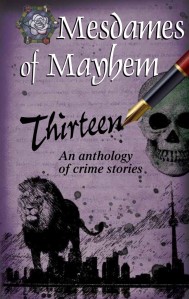
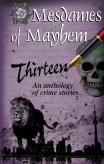
Our anthology, Thirteen, is a collection of crime stories by thirteen of the Mesdames. Its main purpose is to showcase our writing. In one book, readers get a chance to sample the writing of thirteen writers – and the links to their websites and other books.

Thirteen also built us as a team. Nothing focuses a team as much as a goal and deadline. And nothing rewards a team as much as a tangible product at the end.

We decided to produce Thirteen in both digital and print form. In that way we became, what The Writers Union of Canada calls “hybrid authors”. For practical reasons, our e-book was published first.

Marketing a digital book is entirely different from a print book. To generate sales, you must cause ripples in cyberspace. The cyber launch for Thirteen sold books to readers all over North America. For a time, it was Number Two on Amazon’s best seller list for mystery anthologies. Another strategy that continues to work well is a sale – a deeply discounted price that Amazon allows us every few months.

Thirteen, an anthology of Crime StoriesBlatant plug here: Thirteen will be available in Kindle edition Free from March 20thto 24th!

With regard to the print edition of Thirteen, we’ve had excellent support from book stores, cafes and libraries. Our print launch at Sleuth of Baker Street was a huge success. What has been especially exciting are the joint ventures with community theatre. We promoted two mystery plays through our members and website – and the companies arranged for us to sell Thirteen and our books at the theatre.

It’s been quite a ride and we have many readings at libraries and book clubs to look forward to. And the Arthur Awards Shortlist Event is coming up on April 24th – fingers crossed! Check our website for updates!

Posted in Uncategorized | Tagged , , , , , , , , , , , | Leave a comment

Michael Innes, my favourite mystery author ~ Lynne Murphy

Lynne MurphyMichael Innes is the author of some 50 mystery novels or books of short stories and I own 40 of these. When I chose to blog about him as my favourite mystery author, I didn’t realize that I was going to have to reread most of these books. Over the years, the plots have run together in my mind, understandably since plot is never the strong point of an Innes novel. He is incredibly erudite which can get in the way of the action. But ultimately, I like him because he makes me laugh.

Michael Innes is the pseudonym of John Innes Mackintosh Stewart, born in Edinburgh in 1906, Oxford educated and author of a number of literary novels and works of criticism. As Innes he wrote 37 books in the John Appleby series, four featuring an art connoisseur named Honeybath and ten stand- alone mysteries. As Stewart he wrote literary novels and books of criticism. In 1987 he published a memoir, “Myself and Michael Innes”. He died in 1994.

The writer Julian Symons has described his writing as “an over-civilized joke which makes it a literary conversation piece with detection taking place on the side.” He also refers to the style as “rather in the manner of Peacock strained through or distorted by Aldous Huxley.” And another critic says his writing combines “Jamesian characters’ speech, the intellectual precision of a Conradian description and amazing coincidences that mark any one of Hardy’s plots.” So you can see he wouldn’t be every reader’s cup of tea.

In case you have forgotten your English studies, Thomas Love Peacock was the friend of Shelley, who wrote the comic novels “Nightmare Abbey” and “Headlong Hall.” I quote from his satirical poem, “The War-Song of Dinas Vawr”.

“We there in strife bewildring
Spilt blood enough to swim in.
We orphaned many children,
And widowed many women.”

But I digress.

The first Michael Innes novel is “Death at the President’s Lodging”, published in 1936. Inspector John Appleby comes to Oxford from London to investigate the murder of the president of St. Anthony’s College. It is a bit tedious , one of those puzzles where everything hinges on whether a telephone call was made at 11:20 or 11:23. Since most of the characters are Oxford dons, someone is always throwing in a literary quotation which Appleby always recognizes. I had forgotten that he had been up at Oxford, eight years before the events of the novel. He is obviously the right sort (though his grandfather was a baker) and fits in well. Stewart was an Oxford don himself so he would know.

“Hamlet, Revenge”, published in 1937, involves a murder during a private performance of “Hamlet” at Scamnum Court, home of the Duke and Duchess of Horton. Innes dearly loved a Lord and the gentry and the aristocracy feature prominently in his books.

“Stop Press”, published in 1939, is interesting because the main character is a writer who, oddly enough, has written 37 books about a criminal turned good guy, called The Spider. The author is getting sick of his creation and wants to kill him off but too many people depend on the industry he has created. Appleby’s sister, Patricia, is one of the main characters here but I haven’t come across her again.

With the coming of World War Two and later the Cold War, Innes wrote a number of novels involving spies, secret formulae, and prolonged chases across England, Scotland, and Ireland in the manner of John Buchan , a fellow Scot. He described one of these books, “The Journeying Boy”, as “not wholly unsuccessful” which gives you an idea of his self deprecating style. It is a favourite of mine though Appleby is not a character in it.

Mesdames Lynne ApplebyAnother of my favourites is the very funny “Appleby’s End”, where the detective meets Judith Raven, a sculptor, on a train. She comes from a county family and all her relatives are completely dotty. She and Appleby spend a night in a haystack, get engaged within twenty-four hours, and marry two or three days later. Judith appears in many of the later Appleby novels, very much her own woman. She continues with her artistic career while producing a number of children. One of them, Bobby, is the detective in a few later mysteries but he never takes off like his father did.

The Honeybath novels give Innes a chance to show off his knowledge of art (he had a special fondness for Vermeer) but Honeybath is not as plausible a detective as Appleby. Like the creator of The Spider, Innes kept trying to get rid of his hero but no one else could take Appleby’s place.

You may have seen the Disney film, “Candleshoe”. Innes wrote the book “Christmas at Candleshoe”, on which it is very loosely based. Disney bought it as a vehicle for Jodie Foster and changed the boy hero into a girl along with practically everything else in the story. Incidentally, Christmas in the title has nothing to do with the season. He is a celebrated artist in wood, on the lines of Grinling Gibbons. (You read enough Innes and you start imitating his style.)

One of the great mysteries about John Appleby is his career in the police. When he married Judith, he was going to retire and become a farmer—a gentleman farmer of course. Innes wrote a number of stand-alone mysteries during this time. Then Appleby reappears as Assistant Commissioner of Police at Scotland Yard and he has been kinighted. Innes was somewhat bemused by this himself and described it as an unusual career path. In “Appleby Plays Chicken” we learn that Sir John did something secret during the war so perhaps that explains his promotion.

While I was doing this research on Innes I came across an amusing error. One of the files I Googled mentions that Stewart had married his landlady while a lecturer at the University of Leeds. For such an intellectual and social snob this sounded unlikely. When I read his memoir I realized that this was a misreading of the text. He actually married a fellow lodger, a medical student, who later qualified as a doctor. As I’m sure you all know, not everything you read on the Internet is true. But at least my admiration for Michael Innes is sincere.

Thirteen, an anthology of Crime StoriesLynne Murphy studied journalism at Carleton University and worked as a reporter on the now defunct “Ottawa Journal” and then as an editor for CBC Radio News. (It was in the sixties and Lynne was the first woman editor they ever hired.) It was there she learned to “write tight”.

Lynne has sold articles through the years, but “The Troublemaker” in the Sisters in Crime anthology The Whole She-Bang is her first published work of fiction.

The Mesdames are proud to feature Lynne’s story “Saving Bessie’s Worms” in our 2013 crime anthology titled THIRTEEN.

In 1992 Lynne helped found the Toronto Chapter of Sisters in Crime and is proud that it continues to thrive.

Posted in Uncategorized | Tagged , , , , , , , , , , | 7 Comments

Standalones vs. Series ~ Vicki Delany

Vicki DelanyThere are, basically, two types of mystery novels: standalones, in which characters appear once, never to be seen again, and series, in which characters feature in book after book.

As a reader as well as a writer, I am torn as to which I prefer. I believe that in real life a person, unless they’re a secret agent or bodyguard to a crime boss, has only one great adventure in them. Police officers will tell you that the job’s pretty boring most of the time, and crimes, even murders, are mundane things, easily solved.

A standalone novel gives the protagonist that one opportunity to achieve great things; to have that grand adventure; to meet the everlasting love of their life; to conquer evil, once and for all. In a standalone, the characters face their demons and defeat them.

Or not.

My first books were standalone novels of suspense. In Scare the Light Away the main character confronts, for one last time, the debris of her traumatic childhood. In Burden of Memory, the protagonist faces down the ghost of a past that is not hers, but is still threatening what she holds dear.

I then switched to writing series books, but returned in 2012 with a standalone gothic thriller, More Than Sorrow, about a woman attempting to recover from a Traumatic Brain Injury caused by an IED explosion in Afghanistan. The focus of the novel is on Hannah Manning’s attempts to recover her life while she experiences visions and fears she is losing her sanity. Her inability to explain where she was and what she was doing (even to herself) when a woman disappears, puts her in the cross-hairs of an old enemy.

Not a story line you could drag out over a series of books. How many old enemies can a woman realistically have?

As Barbara Peters, owner of the Poisoned Pen Bookstore in Scottsdale says. “In a standalone the reader has no safety net. The reader knows it is possible the main characters may die. You can assume in a series they will not.”

Now I’m back to Constable Molly Smith, Sergeant John Winters and the town of Trafalgar, B.C. with the sixth book in the series, A Cold White Sun. (Coming in April: Under Cold Stone) Series novels present different problems. The central character, or characters, confronts their demons, but they do not defeat them. Their weaknesses, all their problems, will be back in the next book. In each story the series character stands against, and usually defeats, someone else’s problem or society’s enemy, but she or he moves only one small step towards the resolution of their own issues, if at all.

It can be a challenge to keep the main character interesting and growing and changing (and not dying) but to do it so slowly that the reader’s interest in the character can be maintained over several books and several years.

In the Constable Molly Smith novels, set in a small town in the mountains of British Columbia, Molly is haunted by the death of her fiancé, Graham. It was a meaningless, preventable, tragic death and, even in her grief, Molly knows that returning to the small town in which she grew up and becoming a cop won’t help her to make sense of Graham’s death. But she does anyway, and as the series unfolds, Molly is able to confront the gulf that Graham’s death has left in her life and, eventually, move on. By the time we get to the sixth book in the series, A Cold White Sun, Molly has put Graham’s death behind her, and said her good-byes. Now she has a new man in her life, Constable Adam Tocek of the RCMP. But new problems arise.

A Cold White SunWas Tony flirting with her? He certainly was. It felt nice. He was a good-looking guy; he obviously found her attractive. He was a good skier. What could it hurt? She thought about Graham, her fiancé, dead for almost five years now. She thought about Adam. She thought about putting in a twelve-hour night shift and how she’d feel following that.

“I won’t be here until around one.”

He gave her a huge smile. “What a coincidence. So will I. Probably hanging around at the top of Hell’s Vestibule.”

“Molly, are you coming? I’m starving!” An exasperated Glenn said.

“I’m coming. Don’t be so impatient.” They carried the laden trays to their table.

Molly Smith knew Tony’s eyes were following her.

A Cold White Sun by Vicki Delany

Which do you prefer, standalones or series?

I suspect that, like me, you’ll vote for both.

Vicki’s latest books are A Cold White Sun from Poisoned Pen Press, and Gold Web: A Klondike Mystery from Dundurn. If you’d like to read the first chapter, please go to: www.vickidelany.com.

Vicki can be found on FaceBook and Twitter: @vickidelany. She blogs about the writing life at One Woman Crime Wave.

Posted in Uncategorized | Tagged , , , , , , , , , , , , , , , , , , , | 1 Comment

Sex in Fiction – Part III: An Author’s Perspective on Doing The Nasty, by Lisa de Nikolits

“Half the bloggers we approached aren’t interested in your book.” – blog tour host

“Why not?” – baffled author

“Too much sex.”

“Too much? In this day and age of fifty shades of erotica?”

“We were surprised too but there’s nothing we can do.”

Sigh.

It wasn’t as if I planned to write a novel with sex in it, I wasn’t trying to tap into some trending topic ju jour, it just happened.

Yeah, right. You just happened to write a book that you have banned your mother and sister from reading — that book just happened?

I swear it did! Much like a minister without a portfolio, I am a writer without a genre and I never know what book is going to pop up next and a few catalysts intersected and the result was the sex-filled A Glittering Chaos.

Young lady, you’ve got some ’splaining to do… what catalysts?

I had just finished promoting West of Wawa, and everything had gone very well. The book had been extensively featured on the Chatelaine book club but a criticism had been offered, one that stuck like a burr under a saddle; there weren’t any sex scenes and the book club felt that there should have been. That was the first catalyst.

The second was my husband’s and my trip to Las Vegas, which is where my husband bumped into a woman in the elevator who couldn’t speak any English.

A Glittering ChaosWhen he told me about his encounter, it was as if a lightbulb went off in my head and in a way, the whole novel was just there, and it was a perfect vehicle for me to address Chatelaine’s sex-scene critique! I admit I had been a little upset by Chatelaine’s comment; did they think I couldn’t write sex scenes? Of course I could! I never had, mind you, but I was certain I could, and I was going to show them!

Once the novel was written, to my mind (and my publisher’s mind), the sex wasn’t the main focus of the story. The key theme of the novel was empowerment and self-realization, both of which can come later in life than one expects, if in fact it ever comes at all.

Melusine, protagonist, had no idea that her life was lacking until she went to Las Vegas. Her inability to speak English felled the first domino and from that followed a dramatic unfolding of events; her affair, her husband Hans’s ever-increasing foot fetish, his autoerotic asphyxiation, his preoccupation with his vanished sister, the ‘helpful’ assistance by a psychic and his subsequent crazy spiral into madness.

As Caro Soles pointed out in her post (Mesdames of Mayhem, 3rd December), “novels are all about people, and sex is a part of who we are. What a character does in bed may show something about him or her that no other scene could properly convey” which is exactly why there was sex in A Glittering Chaos – it was in no way gratuitous ornamentation, it was key to Melusine’s emotional development, and it was also key to Hans’s mental breakdown.

I would in no way consider myself the writer of sex novels. My fourth novel will be launched in April of this year, The Witchdoctor’s Bones, and, of the four, the only novel with sex is in A Glittering Chaos – it was simply the novel for it!

Using sex in writing can be very effective without having graphic description of the act; sexual orientation, as well as who’s doing who and why, can a very handy tool in plot development; affairs, relationships, predilections, misunderstandings, reasons for murder and even, plot resolution.

Thirteen, an anthology of Crime StoriesIn Thirteen, which is a wonderful anthology of short stories by a collection of brilliant writers, Joan O’Callaghan’s Sugar ’N Spice offers an excellent twist in the tale, proving that a prime suspect couldn’t have been the murderer, by virtue of his sexual orientation.

I use sex similarly in my next novel, The Witchdoctor’s Bones. While there are no sex scenes per se in The Witchdoctor’s Bones, there is a lot of sexual obsession, romance and affairs of the heart, which helped shape the plot and define the characters.

If there’s one rule I employ when writing, it’s this; never sanction anything. I let my brain go anywhere it likes, to the darkest corners of the human psyche, to the most abhorrent of behaviours. I might edit bits out later, but when I am penning that first draft, I let the darkness spread its wings and fly!

The Witchdoctor's BonesOriginally from South Africa, Lisa de Nikolits has been a Canadian citizen since 2003. She has a Bachelor of Arts in English Literature and Philosophy and has lived in the U.S.A., Australia and Britain.

Her first novel, The Hungry Mirror, won the 2011 IPPY Awards Gold Medal for Women’s Issues Fiction and was long-listed for a ReLit Award. Her second novel, West of Wawa won the 2012 IPPY Silver Medal Winner for Popular Fiction and was one of Chatelaine’s four Editor’s Picks. West of Wawa is available in bookstores and online.

Her third novel, A Glittering Chaos, launched in Spring 2013 to reader and review acclaim, and is about murder, madness, illicit love and poetry.

Her fourth novel, The Witchdoctor’s Bones will be launched Spring 2014. The Witchdoctor’s Bones is a thriller about the darkest secrets of African evil; the novel seamlessly weaves witchcraft and ancient folklore into a plot of loss, passion and intrigue and a holiday becomes a test of moral character.

All books published by Inanna Publications.

Links:
www.lisadenikolitswriter.com (website with reviews, photographs and reader comments)
twitter: @lisadenikolits
FaceBook
http://www.goodreads.com
http://pinterest.com/lisadenikolits/

YouTube readings:
http://bit.ly/1e4g8ZR Melusine is fired
http://bit.ly/1ahnDIU Hans’ Medicine
http://bit.ly/1eFSp0K Hans and Melusine

Posted in Uncategorized | Leave a comment

Selling the Book ~ Joan O’Callaghan

Joan O'CallaghanWhen my first books, Amazing Days and Places to See, People to See, Things to Do, All Across Canada, were published in the 90s, marketing them was easy -I didn’t have to do a thing! My publisher, Scholastic Canada, did it all – sent out review copies, saved reviews for me etc. My job consisted of filing my reviews, cashing the royalty cheques, being interviewed by my local weekly, and answering “fan mail” from two youthful readers in Labrador who felt I had given that part of the country short shrift.

Ah! The changes wrought by the passage of time! Authors no longer have to search for agents and publishers willing to take them on. The computer has put paid to all that, creating a book bonanza on the internet for readers. This has resulted in a seismic shift in traditional publishing, as these companies struggle to cope with fundamental changes to their industry. Among the changes is the way promotion and marketing is now handled.

Regardless of whether an author has signed on with a big press, a small press, or has decided to go it alone, there is a new onus on him/her to promote as well as write. Traditional publishers are now embedding marketing requirements into their contracts and watching closely to ensure that their authors are adhering to their agreements.

One needs to have a purpose for marketing. In the case of the Mesdames, it is exposure. And so by forming a collective, we hoped to pool our resources, skills and audiences to increase our reach. So what do we do?

Social media is the first and most obvious place to start. A Facebook page, Mesdames of Mayhem, Twitter account @MesdamesMayhem, and a website and blog are de rigeuer, along with tweet teams and blog tours to help spread the word.

Being alert to opportunities can also result in some exciting and non-traditional venues. This has been the case with the Mesdames’ anthology, Thirteen. With help from Friend of the Mesdames, Jane Coryell, we entered into two promotional opportunities with theatre groups who were staging mystery productions. In return for using our website, Facebook page and Twitter account to promote their production, we were given permission to have a table at the theatres in question, sell our books, and be given a boost in the printed programs.

While at the theatre one evening, Madame Madeleine and I noticed a bookstore at the corner. We walked in, introduced ourselves, and handed the owner a bookmark and a book. He immediately told us he would take some on consignment and invited us to do a signing at the store. The local newspaper was on hand to photograph and interview us at the signing.

We contacted several Ontario wineries and invited them to contribute wine to our launch. Most didn’t express an interest, but one sent us a lovely letter wishing us well and enclosing a gift certificate for 10 people to tour the vineyard and enjoy a tasting – this contact has resulted in a reading at one of the winery’s evening events, likely next fall.

The Mesdames have bookings with several libraries in Ontario, to read and discuss the process behind creating and selling Thirteen. We have been invited to participate in some book clubs as well.

There are other irons for the Mesdames in the proverbial fire, but these will keep for another day. In the meantime, we continue to look for opportunities to showcase our wonderful book and our very talented collective of writers.

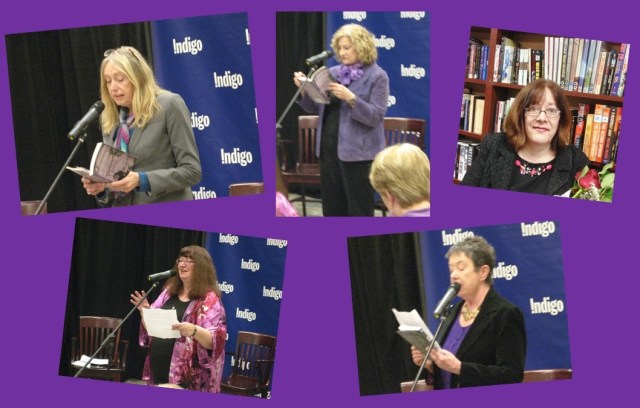
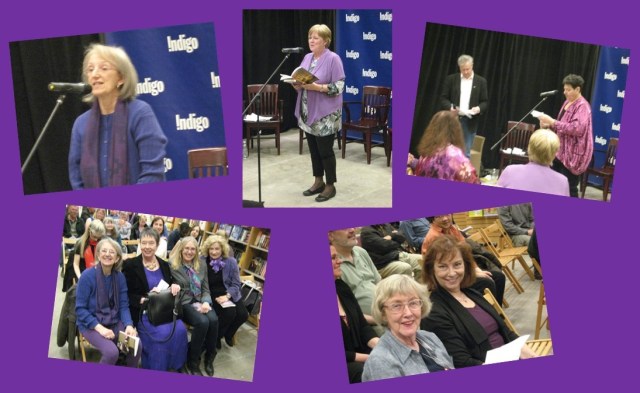
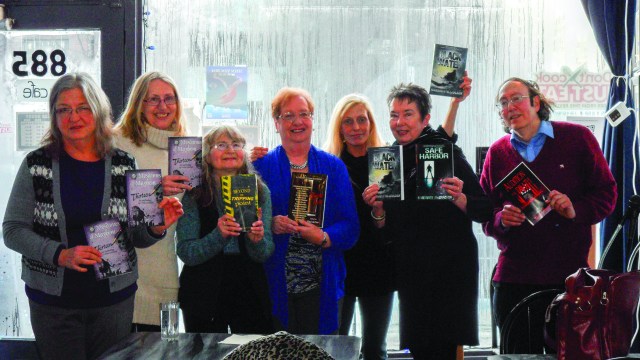
Several Mesdames joined hostess Cynthia Carpenter of Pickwick Books for a signing in Waterdown on February 1. Pictured here: M.H. Callway, Rosemary McCracken, Melodie Campbell, Cynthia Carpenter and our own Marketing guru, Joan O’Callaghen!

Posted in Uncategorized | Tagged , , , , , , , , , , , , , , , , , | Leave a comment

Sex in Fiction – Part II: the powerful intimacy of words… ~ Donna Carrick

Donna CarrickThe notion of sex in fiction is one that has ‘stirred’ authors, especially during the past 100 years.

Of course, sex and its corresponding representation in the literary arts dates back long before that, but it’s within the last century that openly expressed sexuality and sexual situations have been accepted as permissible in the mainstream arts.

Prior to that, only more taboo authors would dare to make room on the page for graphic sexual descriptions. The rest of us, mainstream authors in every genre, found it necessary to rely on metaphors for the sexual act, or, when all else failed, our scenes would simply “fade to black”.

Those days are gone…and while some of us mourn the more genteel half-expressions of sensuality, many authors are grateful for the creative freedoms currently granted.

Within our own beloved Crime genre, we still face the question:

How much is too much?

Our stories primarily involve crime, and the human situations that arise in the wake of criminal acts.

My rule of thumb is simple: If my characters find themselves in an intimate situation, then I, as author, will explore that situation with them.

We are sexual creatures, and a large part of what motivates us to carry out both noble and evil deeds is our innate desire for sexual expression and connection.

Embarrassed3Still, many authors find the act of writing about ‘the act’ to be awkward, even, at times, embarrassing. So how does one overcome those inhibitions, and free oneself to express sexuality on the page?

I take my inspiration from our fellow-artists, those who paint, act or sing. I’ve often noticed that the greatest of these, especially actors, are able to tap into a well of commonality that we share. When faced with a role that must convey true intimacy, they immerse themselves fully in that character, his needs, his desires.

So it is when I write about intimacy.

To do justice to the sexuality of my characters, and to touch readers on a meaningful level without resorting to gratuitous pornography, I imagine what my character’s needs and desires might be within a situation,

As writers, unless we are very comfortable with drawing on sensuality, we probably should avoid putting our characters in those situations. On the other hand, like most skills required in our craft, it does help to push ourselves beyond our current ‘comfort zones’.

When I choose to explore that deeply human aspect of my characters, I first step into my character’s heart, and from there I express his or her needs.

Words, as we know, hold great power. When we reach out through the page and touch our readers, there can be no greater intimacy for an author.

Donna is the author of 3 mystery novels: The First Excellence ~ Fa-ling’s Map, Gold And Fishes and The Noon God.

All titles are available in paperback as well as Kindle versions. Her first collection of 5 mysterious short stories titled Sept-Iles and other places is available for Kindle. Her second anthology, titled Knowing Penelope, features brand new sexy & sassy PI Penelope Canon.

Posted in Uncategorized | Tagged , , , , , , , , , , , , | 1 Comment

And Then There Were None ~ West End Studio Theatre, Feb/2014

Joan O'CallaghanThe Mesdames of Mayhem are joining forces with the original Madame of Mayhem, the wonderful Agatha Christie via the West End Studio Theatre (W.E.S.T.) in Oakville, for their forthcoming production of And Then There Were None.

In this superlative mystery, statuettes of little soldier boys on the mantel in a house on an island off the coast of Devon (UK) fall to the floor and break one by one as those in the house succumb to a diabolical avenger. A nursery rhyme tells how each of the ten “soldiers” met his death – until there were none. Eight guests, who have never met each other or their apparently absent host and hostess, are lured to the island and along with the two house servants, marooned. A mysterious voice accuses each of having gotten away with murder and then one drops dead – poisoned. One down and nine to go!

Murder, mischief and mayhem!! This production has it all!

Mesdames Blog AndThenThereWereNone-FacebookCover-850

The Mesdames of Mayhem, who never miss out on a good mystery if they can help it, will be on hand at the theatre. Drop by our table in the lobby to chat and browse through the books for sale. How better to warm up these frigid winter nights than to curl up with your favourite beverage and a good mystery!

And Then There Were None
Performance Dates and Prices:

Thursday, February 6……8 pm……$28
Friday, February 7……. 8 pm………$28
Saturday, February 8……8 pm……$28
Sunday, February 9……..2 pm…..$22
Wednesday, February 12….8 pm…..$22
Thursday, February 13…….8 pm……$28
Friday, February 14………..8 pm……$28
Saturday, February, 15…..8 pm…..$28
For tickets, contact the Oakville Centre for the Performing Arts
130 Navy Street
Oakville, ON L6J 2Z4
905-815-2021 or 1-888-489-7784 or book online at http://www.oakvillecentre.ca

Mesdames Blog AndThenThereWereNone-Facebooktext-850

Posted in Uncategorized | Tagged , , , , , , , , , , , , | Leave a comment

The Three C’S to Publication ~ M.H. Callway

​What happens after you are shortlisted – or even win – the Debut Dagger or the Unhanged Arthur? Will you finally get published? The answer, based on my personal experience and that of my friends, is definitely YES.

​That said, your journey to publication may still be a long and arduous one. Mine certainly was. After countless near-misses and setbacks, my novel, re-titled Windigo Fire, will be published by Seraphim Editions this fall. It was a DD finalist in 2009 under its original title, The Land of Sun and Fun, which makes it five years from short-list to publication.

​My advice to aspiring writers is to rely on three C’s: Confidence, Commitment and Courage.

​First of all, being short-listed for the Debut Dagger or the Unhanged Arthur should give you Confidence in your writing. Your entry has topped dozens, if not hundreds, of others. For example, in 2009, the year I entered, the Debut Dagger received 800 entries. The following year, when my friend, Mme Rosemary McCracken was short-listed even more writers gave it a try.

​One of the benefits of the DD is that The Crime Writers Association circulates all short-listed entries to agents. One or more agents may then contact you directly. Or if you decide to attend the Harrogate conference in person, you may meet agents more informally. Louise Penny literally bumped into her future agent in the buffet line. Other DD finalists never find an agent this way, or indeed at all, but this did not prevent them from getting published.

​To be published by a large, well-known company like Penguin or Random House, you must have an agent. But signing on with an agent is only the first step. There is no guarantee that your agent will manage to sell your book or even to take interest in your work. A friend of mine only learned by chance that her agent had retired – without telling her clients! If you are lucky, your agent will love your work and fight like mad to ensure it gets published.

​In the end, I had far more success by approaching publishers directly. And, yes, I believe that being a finalist for DD and the UA certainly helped to open the door. Just the same, I really had to rely on the second “c”: Commitment. It meant carefully studying the submission guidelines on publishers’ websites and sending my manuscript out, while tempering patience with practicality. Many publishers are overwhelmed and take a long time to get back to authors, if at all. It’s even more disheartening to lose time through “near-misses”.

​ That is why writers need the third “c”, Courage, most of all. It means weathering rejections and sending that manuscript out again and again. Still, when Seraphim accepted my book, I had to read and re-read their email to convince myself I wasn’t dreaming. And I keep a framed copy of that email in my office to inspire me.

Posted in Uncategorized | Tagged , , , , , , , , , , | 3 Comments

Murder by the Book — the mystery of playwriting, by Mat Kelly

Blackmail, greed, jealousy, a body in the library, and a locked door. Recently one of my plays, about a murder that takes place in an all-women’s mystery writers club was put on by the Village Theatre in Waterdown. The Mesdames of Mayhem found out about it and asked if I wanted to be a guest contributor and discuss writing for the stage.

The best piece of advice I can give to someone who is thinking about writing a play is also the most obvious. If you are going to write plays, go see plays, and read plays. That is the best way to get used to the medium. It will teach you how to format your play, how things work, and what is possible.

One thing you need to think about is economy of characters and locations. I’m reminded of something Neil Gaiman said about writing the screenplay for the fantasy film, Stardust. His heroes were trapped on a cloud and he needed something to rescue them. He had them picked up by a flying pirate ship. A few months later he was given a tour of the workshops and he saw an army of workers designing, building, and painting the flying pirate ship he took two minutes to write. Neil Gaiman said he felt like apologizing to everyone in the room.

In theatre you want to keep your characters and locations to a minimum, because every character you write is another actor on stage, and every location is a set that needs to be built and brought on stage somehow. Most theatres don’t have huge budgets, or acres of space. A professional theatre may not feel they can afford to put on a show with more than six characters. If you have a character that gets killed in the first five minutes, that’s an actor who has to spend the rest of the play backstage doing nothing.

Community theatres are volunteer based, and therefore may be willing to do a show with more characters, but they may not have the manpower or the technical expertise to pull off a complicated multi-set show. If you are going to write a play, it’s not a bad idea to do a bit of research on stagecraft. I studied technical theatre in university and have spent many years volunteering for various community theatres. When I write, I try to figure out how I would pull off a technical feet. If I can figure out how to do it, I know a creative director and designer can pull it off even better.

Keep things active and visual. I admit, I have trouble with this. I have far too many things being simply talked about. Not very interesting for the audience. When I have people read over my plays, at least once every script I get a comment along the lines of, “Oh, so the ageing starlet was caught kissing the young husband of the victim just before the murder? Maybe that’s a scene the audience would like to see.”

If you write short stories or novels, you are probably used to being master of your world. The look, the feel, how your characters act and react, is entirely up to you and the words you use. When you write for theatre, you are part of a team. It is your job to write the story and words your characters will say. The actors, director, and designers will then take what you’ve written and interpret it in the way they think is best. Trust them. Don’t try to do their job for them by adding in a lot of stage directions, descriptions, and writing how lines should be said.

Often one of the first things a director will do is take a marker and black out all of the extraneous notes. I base my stage directions on Shakespeare. All he ever wrote were entrances, exits, “They fight”, and the occasional, “Exit pursued by a bear,”. Trust that the dialogue you give your characters will be enough to tell the actors who this person is. Trust that your story is clear enough that the director will know what to do.

Personally, I find it a lot of fun seeing how other people interpret what I write. I once heard Canadian playwright John Lazarus tell a class, “There may be only one way you imagine a line to be said, but there are many right ways to say it,” and I believe that.

Theatre is collaborative. I find play readings a helpful part of the writing process. Because I have connections with local community theatres it’s easy for me. I simply ask one of my director friends to get a cast together. A month later I find myself sitting in a theatre with about thirty other people watching a group of actors reading my script in what can be described as nothing less than a mini production. It’s important to hear your lines out loud. It helps you find out what works and what doesn’t. You find out how other people see your characters. It is an invaluable source of feedback.

For those of you who do not have actor and director friends, a play reading is still easy to do. Just put out some wine and cheese and have a bunch of friends over to read the play. It’s usually not that hard to find volunteers. One of my friends described play readings as all the fun of a production with none of the stress and very little time commitment

Writing plays may not be for everyone. You have to be willing to put your work in the hands of strangers and hope for the best. Personally I find it very rewarding to see my words come to life. If you would like to learn more about my plays and I, please visit my website, www.matsmysteries.com.

Mat Kelly, author of Murder by the Book

Posted in Uncategorized | Tagged , , , , , , , , , , , , , | 1 Comment

See You Later, Alligator ~ Joan O’Callaghan

Joan O'CallaghanIf there is anything the recent ice storm has taught us, it is how helpless we can be when confronted with the forces of nature. And while there is much to be said for the traditional weaponry when plotting a murder, I find myself drawn to the natural world to do my dirty work.

In my novel, Tooth and Claw, Nola Jensen, an attractive wealthy woman with a past and some strange predilections, travels to New Orleans for a business conference. There her past catches up with her. What should have been a peaceful and enjoyable cruise on the Louisiana bayous turns into her worst nightmare, when she is pushed overboard and into the jaws of a very hungry alligator.

Although I have vacationed in New Orleans, one of my favourite cities, and have in fact, enjoyed a bayou cruise, I was not that familiar with alligators, so some research was necessary. While visiting my friends Janice and Larry Hatt at their West Palm Beach condo, I prevailed upon them to take me to see alligators. We went to a place in the Everglades called Shark Valley. Why it is named Shark Valley is a mystery to me since it is not a valley and there was a noticeable absence of anything resembling sharks. But there were alligators galore, and after, wandering off on a trail during a break in the tour and nearly stepping upon one – fortunately for me fast asleep – I wisely stayed in the tram for the duration of the outing.

Alligators continue to fascinate me, albeit from a safe distance. Genetically, they are linked to dinosaurs and have been around for some 230 million years, without evolving much. And while human beings are not part of their usual diet, they are considered opportunistic feeders, which means they will eat anything that comes their way. In 1995, a nuisance alligator was killed. The ‘gator, estimated to be about 50 years old, had seven dog collars in its stomach, one from a dog that had been missing for 14 years.

The jaws of the American alligator can exert 3000 pounds of pressure per square inch- enough to crunch bones. They generally kill their prey by rolling until the prey drowns. They then stash the kill in a muddy bank or underwater cave until it is putrid enough for the alligator to tear off pieces.

Alligators were hunted almost to extinction for their skin which is made into fashionable leather goods – shoes, handbags and belts, until they were declared an endangered species. However in recent years, their numbers have increased dramatically, and there is now an annual hunt in the bayous. Hunting licences are required for this. The recent series, Swamp People, on the History Channel, documents the hunt.

The supremacy of ‘gators in the Florida Everglades is now threatened by pythons. While not native to this part of the world, the giant snakes have found the Everglades to be an ideal home with no natural predators. The pythons are thought to number in the hundreds of thousands. An urban myth is that people adopted the snakes when babies as pets, but as they got bigger and threatened small children and family dogs and cats, the owners irresponsibly released them into the Everglades. A more plausible theory is that the snakes originally escaped from a breeding facility that was damaged in a hurricane. Winters in Louisiana tend to be about ten degrees colder than Florida which is too cold for the pythons and probably explains why the Louisiana alligators have not been threatened by the snakes.
If history stays the course, the alligators will prevail and continue on for many more millennia.

Joan O’Callaghan is a recipient of the Golden Apple Award from Queen’s University Faculty of Education for Excellence in Teaching; named Professor of the Year by OISE/UT Students Council, as well as Most Engaging English Instructor and Most Inspirational Instructor.

She is the author of three educational books as well as two e-shorts: George and For Elise (Carrick Publishing).

Her short story Stooping to Conquer appeared in the 2012 Anthology EFD1: Starship Goodwords (Carrick Publishing)

Visit Joan at her FaceBook Page
or Tweet with @JoanOcallaghan

Posted in Uncategorized | Leave a comment