It’s winter solstice and the Holidays. What’s more wonderful than snuggling up with terrific new books and stories by the fabulousMesdames and Messieurs of Mayhem?
Whether you love cozy crime, thrillers, whodunnits, noir, Sherlockania, romance or speculative fiction, we have something here for you. Enjoy, have the best holiday ever and wishing you the best for 2025!
The New Year will be exciting for the Mesdames and Messieurs. Stand by for terrific news about our upcoming book and story publications and for exciting events in 2025.
THE MESDAMES ANTHOLOGIES CELEBRATING CRIME FICTION!
OUR LATEST! M IS FOR MESDAMES, MESSIEURS , MAYHEM AND…MURDER!Featuring 22 stories by leading Canadian crime authors from outrageous comedy to deepest noir.
Spirits, mostly evil!
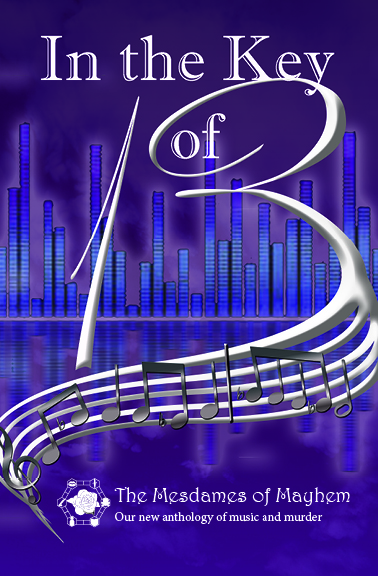
Music, mayhem and murder!
Cathy Astolfo’s CWC Award Winner!
Our Take on Father Time!
Our very first book!
FABULOUS NEW BOOKS!
Salty tales from an uncompromising Irish dame!
Critically acclaimed historical YA mystery
Exciting YA mystery
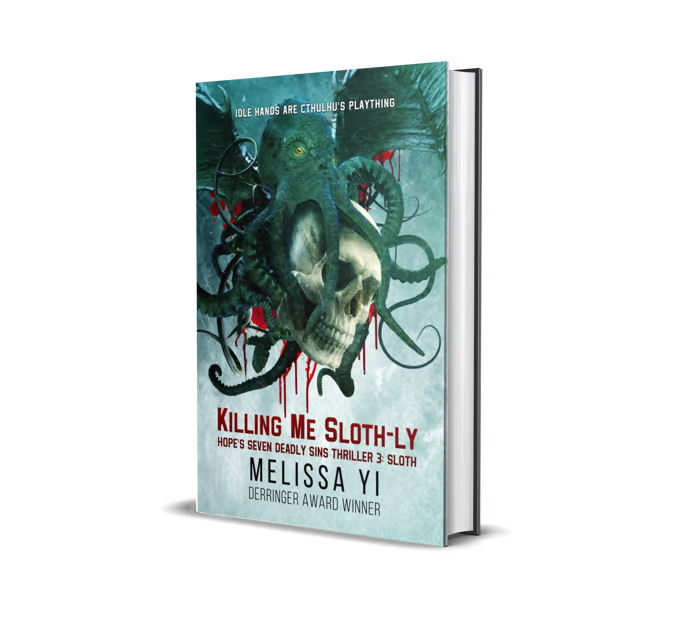
Book 2 in Hope Sze’s Seven Deadly Sins thriller series
TERRIFIC RECENT RELEASES!
Cozy murder mystery comedy
Collected crime fiction from comedy to noir by M. H. Callway
Book 1: New Dr. Hope Sze series
Amazing Anthologies!
“Too Close to the Edge” by Rosalind Place
“The Watching Game” by Lisa De Nikolits
“The Mob, the Model and the College Reunion” by Melodie Campbell
“King Larp” by Jayne Barnard
“Number One: Enduring Across Time” by Madona Skaff
“Evil Ex, Silly Whys and the Hole of Doom” by Melissa Yi
Mayhem in Magazines!
“The Longest Night of the Year” by Melissa Yi
“The Crocodile of Lachine Canal” by Melissa Yi
Alfred Hitchcock Magazine’s podcast of Melissa Yi’s “Blue Christmas”
For Fans of Sherlock Holmes
All with stories by Kevin Thornton. More coming in 2025!
TWO Stories by Kevin Thornton: “Tracks Across Canada” and “Tracked Across America”
New publications, book readings, podcasts and more. December looks to be a busy and festive time for our Mesdames and Monsieurs. We hope you can join us!
CONGRATULATIONS AND PUBLICATIONS
Lisa de Nikolits Book Deal
Mme Lisa De Nikolits has signed a contract with Level Best Books for her new novel, That Time I Killed You, a twisted tale of iced cakes and murderous intent… the publication date is set for 2026.
Big congrats to Mme Jayne Barnard for her story, “King Larp”, in Sisters in Crime West’s new anthology, Crime Wave 3: Dangerous Games.Jayne is also one of the Senior Editors.
Congratulations to Mme Melissa Yi for her latest story “The Longest Night of the Year”, published in the 2024 November/December issue of Ellery Queen Mystery Magazine.
Melissa Yi
READINGS
Mmes Lisa De Nikolits and Lynne Murphy are reading at The Noir Before Christmas, hosted by Jeffrey Round and Hope Thompson. Wednesday, December 4th, at 7 p.m. at the Black Eagle Bar, 1st floor, Back Room, 457 Church Street. Black Eagle Toronto.
Lisa de Nikolits
Lynne Murphy
Mme Jane Burfield is reading at this month’s Brews and Clues, Thursday, December 12, at 6:30 p.m., Stout Irish Pub, 221 Carleton St. Hosted by Des Ryan. STOUT IRISH PUB Cabbage Town, Toronto, Ontario
PODCASTS
The Mesdames and Messieurs podcast with Erik D’Souza for Crime Writers of Canada is scheduled for December 12th, with Mmes Jane Burfield, M. H. Callway, Donna Carrick, Rosemary McCracken, Lynne Murphy, Lorna Poplak, Melissa Yi and M. Blair Keetch, (time to be confirmed). Crime Writers of Canada – Home
Jane Burfield
Madeleine Harris-Callway
Donna Carrick
Rosemary McCracken
Lynne Murphy
Lorna Poplak
Melissa Yi
M. Blair Keetch
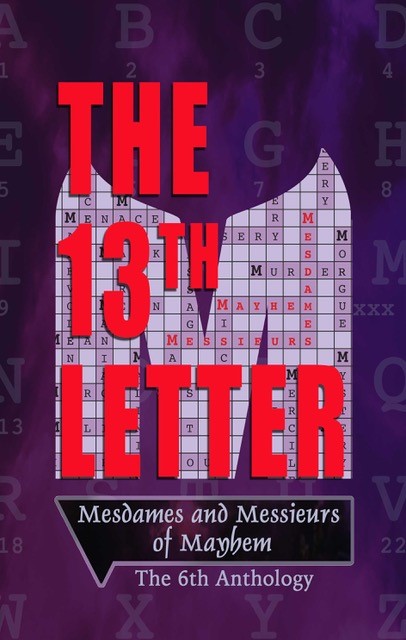
THE 13TH LETTER
Big thanks to Maureen Jennings for her wonderful review of our new anthology, The 13th Letter. Maureen writes:
Another great outing by the Mesdames and Messieurs of Mayhem. This 6th anthology is a wonderful variety of stories; some very funny; some sad; some even a little troubling. All engrossing. Well done.
Maureen Jennings. (Murdoch Mysteries/ Tom Tyler series/ Paradise Café series.)
UPCOMING
Stand by for the Mesdames and Messieurs’ Year End Book Review to be published shortly. Books make excellent prezzies for the holiday season!
Sisters in Crime Toronto’s Holiday party is on Thursday, December 19th, at 6:00 p.m. at Hot House, 35 Church Street. This event is for members and guests only.
The deadline for submissions to the CWC Awards of Excellence is December 15th. All submissions are electronic so no need to worry about the postal strike. Crime Writers of Canada – Home
THANKS TO…
Remember the fabulous photographer who took our iconic photograph at the Darling Mansion?
His name is Henry Vanderspek. Whether in city streets of North America and Europe or the dusty roads of rural East Africa, Henry finds joy in capturing vibrant local atmosphere and drawing the viewer in to celebrate the many ways people live a full life.
About Henry:
His images have been published in TheGlobeandMail.com, BlogTO, CBC Toronto, CTV Ottawa, Vice Canada, CNN.com and several local Canadian newspapers. In 2021 he worked with East End Arts and GreekTown on the Danforth BIA to document and celebrate Humans of the Danforth. Other notable exhibits featured Old World Shoes, which won “Best in Exhibition” in the 2022 DesignTO Festival and Taxi Drivers of Toronto, in the 2017 Contact Photo Festival. His images have won awards and been displayed in Toronto City Hall offices. Each year Henry exhibits his art images in several outdoor art shows, such as the Queen West Art Crawl, Toronto Outdoor Art Fair, and Danforth East Arts Fair.
Apart from being a wonderful philanthropist and photographer, Henry has a range of lovely products that might be just what your Christmas stocking needs (we all deserve a self-gift after this year!), or maybe you’ve got a hard-to-please relative or Secret Santa that you need the perfect gift for.
Book Lovers tote bag For example, how about this fabulous Book Lovers tote bag? The image on the bag is from the “World’s Biggest Book Store”, formerly located on Edward Street in Toronto. For his products, check out CultureSnap and all the links below. You can order by email to arrange pick-up or delivery, which is very handy too.
He’s also available for photojournalism assignments, to document your organization in images and words, for event photography and creative portraits, and is always looking for interesting venues to display his work.
Contact details:
Henry Vanderspek www.CultureSnap.ca 416-655-9922 X: @culture_snap Instagram: @culturesnap Facebook: CultureSnapPhotography
Caro Soles is an author, editor, creative writing teacher and the founder of Canada’s first national crime writers conference, Bloody Words. She is a master of multiple genres as well as literary fiction: crime, speculative fiction, historicals- and gay male erotica! Her work has been shortlisted for the Lamda Literary Award, Aurora Award and Bram Stoker Award.
In addition to her distinguished literary career, Caro is an active and dedicated member of Canadian Dachshund Rescue.
THE MOONLIGHT SONATA
by
CARO SOLES
I have never lived in such an elegant place as this. It’s like being in another world here, with the gold-braided doorman and echoing black-marble vestibule. Up we go, Mother and I, in the golden cage to the fourth floor where more marble awaits. Two large vases stand on either side of the entrance, holding huge ostrich plumes more suited to be waved in front of some Egyptian pharaoh like Tutankhamen. There’s even a second floor inside the apartment, with wide banisters and a curving stairway with shallow carpeted steps. The red runner has brass rods holding it in place. I stare at them sometimes, almost hypnotized. The rooms here are large and filled with shadows, the long windows hung with heavy lace and velvet drapery. There are oil paintings, suspended by long ropes, on the walls.
Of course, this isn’t our apartment. We could never aspire to anything this grand. It belongs to my Aunt Esmé and Uncle Robert. We’re just the poor relations. When Mother ran away with an Italian musician years ago, she was disowned, but now that he’s dead in the war and I am so good at what I do, it seems much can be forgiven, if not forgotten. “If only he had been an officer, like Robert,” Aunt Esmé would say, “you would have been taken care of.” Everyone knows Uncle Robert was never anywhere near the front, but Mother says nothing, just bites her lip the way she does and then changes the subject. Mother swallows her grief for me, so that I can perform during their musical evenings. Perhaps someone will notice and remember me, and take me away to study and perform elsewhere. And bring her with me. I spend a lot of time practicing on the square grand piano my aunt and uncle are so proud of. It is lovely to look at with its mother-of-pearl inlay, but its tone leaves something to be desired, a fact I keep to myself. It is, Mother says, the ship that will sail us out of bondage. She says things like that sometimes.
Today Aunt Esmé swept out the door in a formidable velvet hat with a tassel hanging down on one side like a bell pull. Mother thought her dress shockingly short, halfway to her knees, but Aunt Esmé says this is the fashion now. She is meeting her lord and master for lunch at The Club. At least that’s what she says. I followed her one time a few weeks ago when she said the same thing and found out The Club was not her true destination. But I digress. Mother went out as well on some errand or other for my aunt, so there is no one here but the maid and Cook. My shoulders gradually relax as I start up the stairs.
The grandfather clock in the marble foyer wheezed into its job of striking the hours and was followed in short order by the French clock on the mantel in the main salon, the Ivan Mezgin Russian monstrosity and all the other lunatic timepieces so beloved of Uncle Robert. The man was obsessed with time, or perhaps only with timepieces, since he hired a clockmaker to come once a week to look after them all. Amusingly, he claims not to have the time himself, but I think he does not have the patience. I was upstairs and out through the French doors onto the terrace before the clamor ceased.
Out here, the extravagant blooms have died in their cement urns, trailing skeletal remains over the edges. No one has come to clean the dead leaves from the stone floor. I walk through them to the low railing, leaning over to greet the leering gargoyle I can just make out over the entry. If I lean over far enough, I can see into the neighbor’s apartment that joins this corner, forming the small courtyard. They’re new here, having moved in with all their goods and chattels a mere few weeks ago. I had watched as every settee and sideboard, hamper full of crockery and roll of Persian rug, Tiffany lamp and pier glass made its way inside. Last, but not least, came the grand piano, a real Bösendorfer. A girl began to practice on it the very next day.
She was lovely, this girl, with long dark-gold hair almost to her waist, held back from her face with a huge hair ribbon that never seemed to go limp. She was like an illustration in an old book. I watched her every move avidly, drinking in her grace, the dimple in one cheek, the way she tossed back her hair with one hand as she played. She came to the window one time, and I saw she had eyes the color of lavender. Her mouth smiled, as if she saw me and liked what she saw.
I soon discovered that I could see and hear her even better from our music room if I pulled the drapes way back and opened the window. I began to spend a lot more time there. No one but the maid ever came into the music room, so no one but Mother noticed. When I heard her at the door today, I jumped down from the wide window seat and slid onto the piano stool.
“A little chilly in here, isn’t it?” Mother closed the window and pulled the drapes closer together, the brass rings rattling like a rebuke to my ears. “We don’t want them complaining about the heating.” She sat down on the ottoman near me and folded her hands. I noticed she was wearing one of Aunt Esmé’s old dresses, which she must have altered, since she was smaller than her big-boned sister.
“I know things are not easy for you here,” she began, and I tensed. “You must study and practice and do well, my dearest. It is our only chance of getting away from here. You are my lodestar, my hope.” She looked at me in that intent way she had, and I felt my insides turn over and my heart swell with love.
“I will,” I promised, tears in my throat.
“Esmé is having a big dinner party next week, and she wants you to play beforehand. Nothing too modern, mind.”
“Don’t worry. No Russians, I promise.” I grinned, trying to make her smile.
“Thank you, dear.” She reached over and patted my hand. “Now I must go. Esmé wants me to help with the flowers.”
I sat there for a long time after she left, thinking about how things used to be, in our small walk-up apartment that was always full of music and laughter. No one here laughed much, I noticed, and the only music was provided by me. And that wonderful girl next door. I got up and opened the window again.
At once the flowing strains of the Moonlight Sonata filled the dim room. I laid my head against the wooden casement of the window and pulled my legs up to my chin. The melody was like a balm to my heart, although her technique was far from perfect. Somehow, the erratic slowing of the chords or speeding up when she felt more confident was endearing. “What is your name?” I wondered.
When she stopped, I closed the window again and began to practice. At first, just for fun, I played the Moonlight Sonata, like a distant echo of the girl across the way, only slightly faster as it should be, and I played the whole thing. Then I began to practice in earnest, thinking hard about what pieces I should choose for next week. Beethoven? Chopin? Perhaps just a little Scarlatti for a change of pace? A lot depended on who would be there, so I decided to prepare enough that I could choose seemingly on the spur of the moment—opting for technical difficulty, feeling, interpretation, depending on the audience.
I kept pestering Mother to find out who was invited, but she was not very forthcoming. So, I waited, and practiced, and watched for another appearance of my golden muse. I dreamed about her sometimes. In the dreams, we were playing duets and laughing together. In reality, it nearly happened one day when I left the window open as usual and she was playing Für Elise. I joined in and we finished together, but in truth, I’m not sure she was even aware of our shared performance.
The days passed, and I was getting anxious. I had performed for these parties before, but Mother said this one was special. For one thing, it was bigger than usual. For another, Aunt Esmé had started calling it a musical soirée, which was a bit alarming. It meant there might be other performers. It also meant there might finally be someone important in the audience who might mentor me.
At last Mother confessed. She had been in charge of writing most of the invitations, so she had added three of the musical luminaries of the city: Godfrey Rider the impresario; James Untermeyer, the music critic for the Herald; and Carlo Sanders, the talent agent.
“What will you say to Aunt and Uncle if they come?” I asked.
“That they were friends of your father. After all, he did play in the orchestra in several theaters Rider does bookings for. And he did meet Sanders one time.”
“They won’t come,” I said glumly.
She smiled at me knowingly. “I think they will,” she said. “I enclosed a short note in each one.”
I stared at her, but she refused to tell me what was in the notes.
“Don’t be nervous,” she said, just as she was leaving. “The others are just amateurs, and you are my star.” She blew me a kiss.
The next day, she appeared again to reassure me about the competition. “Cousin Sally will sing, I’m sure, and the Samson brothers will do their clever patter songs. Fred Lynley will recite some amusing drivel, just as usual. But you will have a chance to really shine in front of some people who matter.”
I breathed a sigh of relief. The more amateurish the others were, the better I would sound.
The day came. The house began to fill with flowers and the chatter of extra housemaids preparing the silver and dishes. The kitchen was a steamy place of mouthwatering magic, and Cook chased me out with a shout. Although I’m sure she had done this many times before we arrived, Aunt Esmé seemed to need Mother by her side at every turn. It occurred to me for the first time that Mother had been used to all this as a girl, that she had arranged flowers and ordered the maids about, inspected the laying of the table and sparkle of the crystal. She had loved my father, Francesco Martino, enough to leave all this luxurious servitude behind her. And she expected another Martino, me, to take her away from it all again. Maybe even tonight.
I straightened my shoulders and went to inspect my new clothes. I don’t really enjoy dressing up as many do, but admit it does make one feel that the event is more of an occasion. And this event truly was. Even as I finished getting dressed, I could hear the tinkle of glasses, the scrape of chairs as the guests took their places, the buzz of conversation, the bass tones of the men droning an accompaniment to the lighter voices of the women.
I went down the stairs slowly, gathering my thoughts. They had moved the piano into the grand salon, where all the tuxedoed men in their sparkling patent leather shoes and satin striped trousers sat with their ladies, strings of pearls draped over their chests and feathers in their bobbed hair. I was glad Mother had not given in to this latest style and still had all her lovely long hair that Father used to love to brush when he came home from a job late at night and they thought I was asleep.
As I walked through the door, I almost stumbled. There she was. My dream girl. My muse. Standing in the front row, leaning against a stylishly flat-chested woman I assumed to be her mother, her long pale mauve dress with the wide, low sash echoing the color of her eyes. She was even more beautiful close-up than seated at her piano 30 feet away.
No one paid any attention to me as I hung back in the shadows. I had meant to take an inventory of the crowd, look carefully to see if any of the three people of importance to me had actually come, but seeing her there had thrown me. I suppose it was sensible to invite the new neighbors. My aunt and uncle might even have known them before they moved here, for all I knew. They might even be great friends. I hadn’t thought of that. I never thought of her in relation to anyone but me. When I saw her, she was always alone, with only occasionally the shadow of her music teacher in the background.
The evening proceeded along the lines that Mother had predicted, people chatting together softly during the singing and recitations, the occasional laugh smothered by a lady’s hand, until Aunt Esmé stood up and introduced me, “without whom no musical evening would be complete.” That was warming, but the fact she used an anglicized version of my last name was not. I was not Martin, but Martino! I glanced at Mother as I stood by the piano, but she gave a slight shake of her head and her eyes warned me to ignore the slight. Carry on, they said. You are my star.
I sat down, shook out the tension from my hands and swept into the Scarlatti, my fingers rippling along the runs, bringing out the brilliance of the melody. After that, I had planned on Chopin, Nocturne Opus 9—much slower, with a depth of feeling to show I was not all technique.
I stood to acknowledge the applause, caught Mother’s eye and saw she was smiling a genuine smile that made my heart sing. Then I saw the smile fade as Aunt Esmé rose to her feet.
“Very lovely, but before you go on, I would like to invite our young neighbor Lillian to sing something for us. Her mother tells me she is quite talented musically. You could accompany her, if you will?”
I smiled and sat down again, glad that I at least still had control of the piano. She would sing, and then I would continue.
Lillian seemed quite self-possessed as she came to the piano and asked me if I knew “Annie Laurie.” I tried not to look insulted and asked her what key. That gave her pause but only for a moment.
“The right key for me,” she said, and her dimples flashed.
I felt a flash of annoyance, but everyone else was laughing so I smiled back and made a stab at what I thought it might be. I had heard her sing it, after all.
As it turned out, I was right, and she sang it with a purity of tone that was quite lovely. The audience was very enthusiastic, more than her rendition deserved, I thought, but she was very sweet and pretty.
I was flexing my fingers to continue with my program, when she spoke up, her voice high and childish, carrying to the back of the room.
“I would love to play the opening of the Moonlight Sonata for you, too,” she said, her childish hands pushed against her flat chest. Even before she had finished speaking, she was moving around to the keyboard, looking at me pointedly, expecting me to move.
What could I do? “That would be lovely,” I said, getting to my feet. But I did not move far.
“Lillian is preparing for a recital soon,” her mother said, smiling indulgently.
I gritted my teeth as she began the opening, much too slowly. In her excitement, she seemed to have forgotten it was supposed to be pianissimo. None of the first movement ought to be more than piano. It was a poem that should linger in the mind, but this interpretation should be forgotten as quickly as possible. I noticed the tip of her tongue appear between her sharp little teeth in concentration as the piece went on, her hands slowing even more from time to time as she focused on reaching the right notes. I sat down against the wall and looked at the audience. They were all smiling tolerantly. I sighed. At least this travesty wouldn’t take long. I had never heard her play the whole first movement all the way through and suspected her teacher, that shadowy presence I had never seen, had suggested the cuts.
When she finished, the whole room stood up and applauded, led by my aunt and uncle. Of course, Mother had to stand as well. What would it look like if she had not? I stood, too, and moved my hands as if I were clapping, but I made no noise. My hands did not even touch. She was doing a pretty curtsy now, her cheeks unusually pink from pleasure.
My hands clenched. Lillian had, in effect, stolen my night. She had a recital coming, to which her family would invite all the swells and cognoscenti in the world who might help her. This was supposed to be my night! My mother had connived and even lied (if only a few little white lies) to get three people here who might help me. Me. Someone who had no wealthy parents to pay for a musical debut, no influence to put me on any program where I might be seen and hired. I had this one night. She had stolen it.
Everyone was chatting now, taking champagne from the maids passing though the room, the ladies using their fans to punctuate their conversations and flirt. Lillian stood alone, still by the piano.
“Were you very nervous?” I asked, moving to her side.
She nodded. “I was. I really was. But you know, I was also really happy at the same time.” She looked straight into my eyes. “Isn’t that strange?”
“I think we feel the most happiness when we’re doing something really difficult, and doing it well,” I added, giving her what she would deem a compliment.
Sure enough, she blushed in pleasure.
“I’ve been listening to you play for a while now, you know,” I said, watching her.
“No,” she said. “You can’t have.”
“But I have. Do you want to see how?”
She nodded and took the hand I extended to her.
We went up the stairs side by side, leaving the chattering and laughter behind us. I was only a little taller than she was, I noted. I felt so very much older that this discovery was a surprise.
“You have a terrace,” she exclaimed as I opened the door and the cool breeze touched our faces. “We have a balcony but it’s over the street. Funny, I never noticed this.”
I suspected she was not one to notice anything that had no relationship to her.
“Look,” I said, leading her to the low stone balustrade. “See?” I pointed to the window of the room where her beautiful piano sat in the shadows.
“Is that the right room? Really?”
Above us the moon slid into view, sending a shaft of moonlight into the courtyard, where the shadow of the gargoyle crept into sight.
“There! Now you can see.” I slid my arm around her waist as she bent over, her long blond hair falling over one shoulder.
“Yes! I see it now! And your window is just kitty-corner?”
“Lean over a bit more. There. See?”
“Yes, but––let me go!”
And I did.
As she slid into the night below, the moon ducked back behind the clouds. I left the terrace door open a crack and went back downstairs. I noticed that people had moved around, some changing their seats to sit beside another friend. They were settling down now, almost ready to listen again. Mother still sat in her place. She nodded to me, her smile gone. Your time is running out, her nod said. You are going to lose them.
I sat down at the piano and quickly scanned the room. I still couldn’t tell if the big three were here. It didn’t matter. I would play for them anyway. For them and for my mother. As soon as there came a brief lull in the conversation, my hands crashed down on the keys, and I rushed headlong into the last movement of the Moonlight Sonata. The one filled with passion and dark fire and breathless hope. The one Lillian could never play.
The Mesdames and Messieurs began November with the fabulous launchof their new anthology, The 13th Letter, at their favorite bookstore, Sleuth of Baker Street. They’ll also be the guests at this month’s Brews and Clues, hosted by Des Ryan. And lots of great publication news to celebrate this often cold and stormy month.
The 13th Letter Book Launch
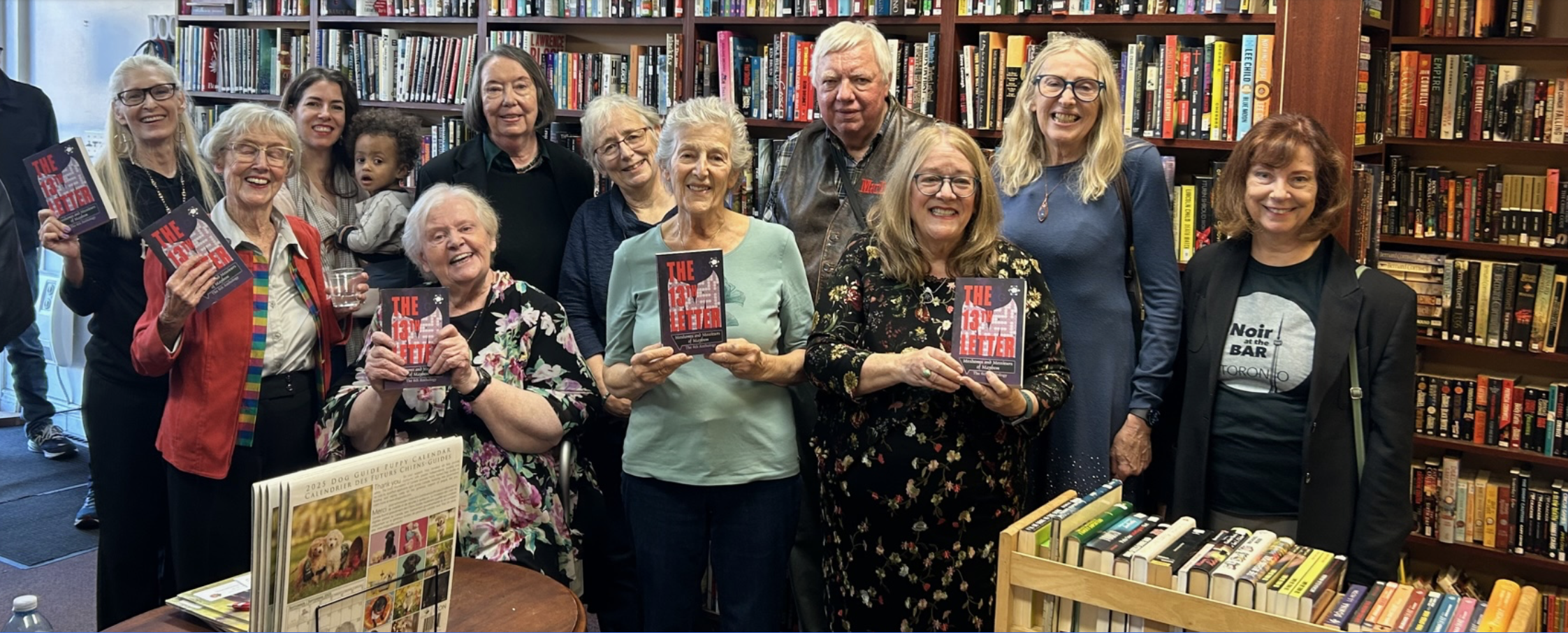
The Mesdames and Messieurs of Mayhem launched their 6th anthology, The 13th Letter (Carrick Publishing, 2024) on Saturday, November 2nd at their favorite bookstore, Sleuth of Baker Street.
Each of the authors shared a teaser of their story with the full house of readers and supporters. Even better, we sold out all the copies of our book! Nibblies and coffee were served. The homemade cookies proved especially popular, including Mme Lynne Murphy‘s rosemary shortbread, which plays a pivotal role in her story, “Scamming Granny”.
The Mesdames and Monsieur celebrate the launch of The 13th Letter.From L to R: Lisa de Nikolits, Lynne Murphy, Cat Mills, Jane Burfield, Rosemary McCracken, Roz Place, Lorna Poplak, Ed Piwowarczyk, Donna Carrick, M. H. Callway, Sylvia Warsh.
Each author had a few minutes to read from their story. Enjoy Lisa sharing her dark thriller, “In a Cold Country”.
The 13th Letter is now available in e-book, paperback and hardcover.
Mme Lisa Nikolits’ piece on The 13th Letter will appear in Kings River Life magazine on November 6th. KRL actively promotes short crime fiction authors and their work. https://kingsriverlife.com/
Mme Lynne Murphy was at the Crime Writers of Canada inaugural Pub Nite on Thursday, October 24th. CWC established the pub get-togethers for CWC members to share publication news. Thanks to Lynne for promoting The 13th Letter.
The CWC is planning regular pub nights. The next one is scheduled for January 25, 2025. Check the website for details. https://crimewriterscanada.com/
CONGRATULATIONS AND PUBLICATIONS
Mme Lisa de Nikolits’ story “ The Watching Game” appears in Imagine: a Windtree Press Anthology
Imagination. It is a word that conjures up so much and can cover so many emotions. In this collection of nine unique stories and a poem, you will cross centuries, hang in suspense, chuckle and perhaps even laugh, and wonder did the character imagine that or not.
Imagine is available in both E-book and paperback.
The Red Rock Killer is the Winner of the ITW BIPOC Scholarship judged by R.L. Stine. It was the Killer Nashville Claymore Award Finalist for Best Juvenile/YA Manuscript and won the International Thriller Writers’ Best First Sentence Contest judged by Allison Brennan.
A 13-year-old vs. a serial killer. What could go wrong? Here’s the winning excerpt:
This summer, I want to find the Red Rock Killer. Wild, right? We should game, eat dumplings, and read up on the Civil War while we’re only 13 and too young to work .But when my two best friends make me hike the Red Rock Canyon outside Las Vegas, we stumble across a barrel that puts me on the police’s speed dial. Now the Red Rock Killer feels personal. I need to know who terrorizes Sin City. No matter how much it scares my mom. Or me.
Melissa was also interviewed by Crime Writers of Colour. Watch her interview here:
The Mesdames and Messieurs of Mayhem will be Des Ryan’s guests at Brews and Clues, the monthly crime fiction readings held at Stout Irish Pub, 221 Carlton Street, on Thursday, November 14th at 6:30 pm.
DON’T MISS
The deadline for submissions to the Crime Writers of Canada Awards of Excellence is December 15th. Everyone is reminded to check the submission rules carefully as some of them have been updated. Here’s the link: Crime Writers of Canada – Submission Rules
Submissions to Superior Shores Press new anthology, Midnight Schemers and Daydream Believers, opens on November 15th. Closing date January 31, 2025 or until 75 submissions have been received. Midnight Schemers & Daydream Believers | Judy Penz Sheluk
THIS MONTH’S STORY
Caro Soles
Our November story is “The Moonlight Sonata” by Caro Soles from The Mesdames’ fourth anthology, In the Key of 13.
Mme Lisa De Nikolits is reading at the the Halloween “Spooktacular” event by Minstrels and Bards this Tuesday, October 22nd, 6:30 to pm. Costumes encouraged! The event takes place at the Southern Cross, Tranzac, 292 Brunswick Avenue, Toronto.
Roz Place
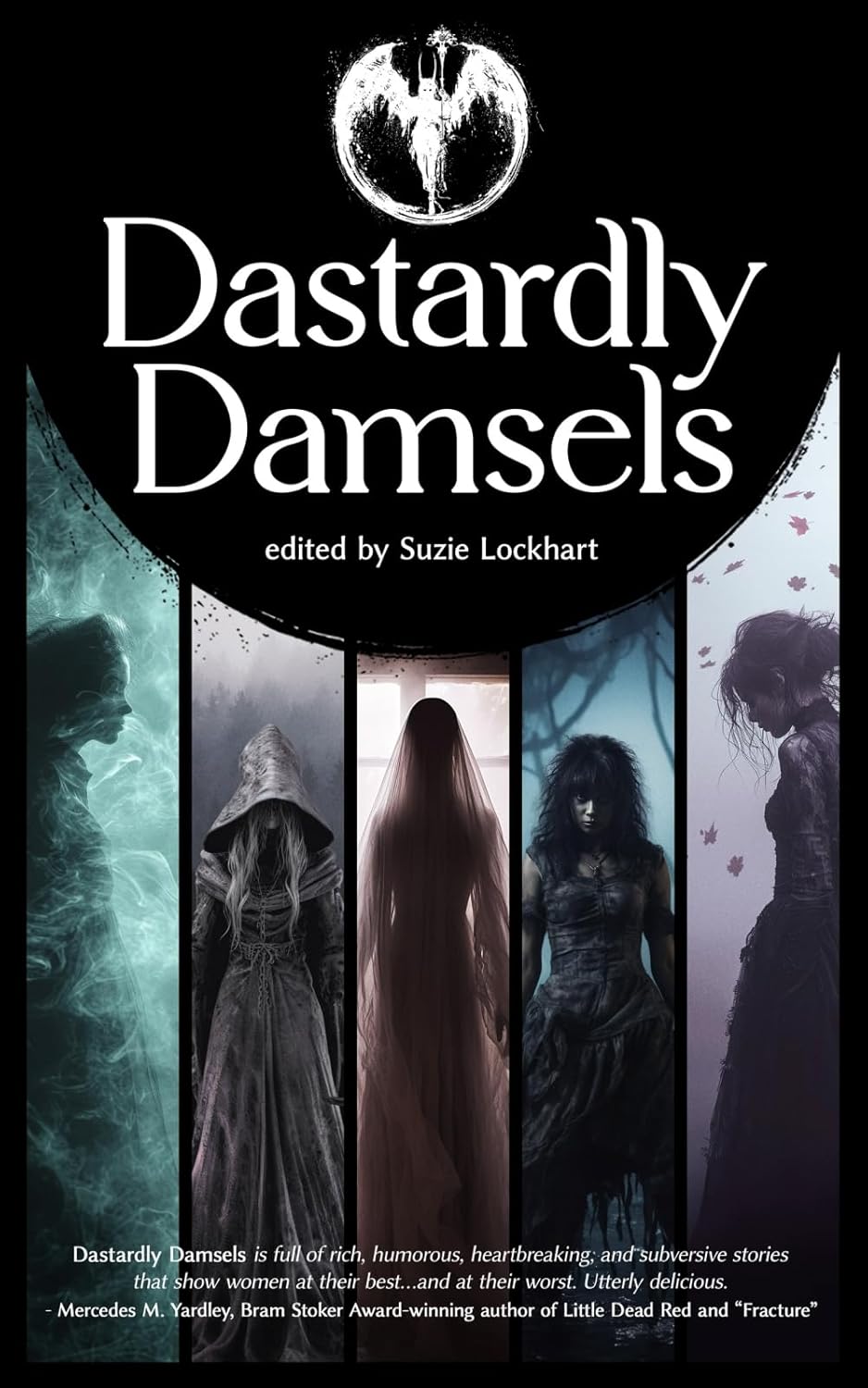
And Mme Ros Place’s story, “Too Close to the Edge”, is now available in the ghostly anthology, Dastardly Damsels(Crystal Lake Publishing).
Madona Skaff uses her scientific background to create her crime and speculative fiction. She is the author of the Naya Investigates series about a young woman disabled by multiple sclerosis who turns sleuth to solve crimes as well as several mystery and science fiction short stories. Her SF thriller, Shifting Trust, set 25 years in the future, tells the story of military operative who disobeys his orders to rescue a kidnapped scientist.
Madona is especially fond of her continuing character, ex-conman, Lennie, who discovers he really can talk to the dead. He turns to solving murders – with the help of the victim. This week’s story is Lennie’s first adventure, “Soul Behind the Face”, which appeared in the Mesdames’ 4th anthology, In the Key of 13.
SOUL BEHIND THE FACE
By
Madona Skaff
The Great Leonard sat motionless on the wooden chair. Shoulders back, his arms rested comfortably on the Plexiglas table before him. He controlled his breathing and the relentless need to scratch at the electrodes attached to his chest and scalp. He resisted the urge to fiddle with the oxygen monitor on his left index finger. The four researchers, wearing intense expressions, watched him from outside the glass-enclosed booth.
He closed his eyes and tried hard not to laugh.
After 10 years of pretending to be a psychic, life was good. Profitable. Comfortable. And boring.
So when he heard about a northern university’s research study to verify psychic abilities scientifically, he volunteered to be a test subject.
Leonard pictured the headline: Psychic Is Real Deal, Scientific Tests Show. He’d be famous—and filthy rich.
He’d fooled the eggheads for three days, graduating to today’s final, most rigorous stage.
Late at night, when he’d first arrived, he’d sat in his car in the parking lot to hack into their computers to download the tests. This one consisted of a series of numbers he’d have to “see.” With so many sets of numbers and no way to tell which he’d be assigned, he’d memorized them all, thanks to his only legitimate talent—a great memory.
It took four to five numbers before he knew which set the researchers were using. He threw in random wrong answers to make his “vision” seem legit. He smiled inwardly. Took a dramatic deep breath for the last answer.
“Fifty-nine!”
He opened his eyes, expecting to see expressions of surprise and awe.
You didn’t need to be a psychic to realize that something was horribly wrong. The techs stood there, staring at him. Finally, the head technician, Stanley, came into Leonard’s booth, holding something behind his back.
“The Great Leonard,” Stanley mocked. “Proud of how well you did?”
Leonard’s eyes narrowed slightly. “Yes.”
“You really sailed through every test. Even passed this last one. My personal favorite.”
Then with a magician’s stage-show flourish, Stanley revealed a laptop hidden behind his back. He tossed it on the table. It bounced once.
Leonard’s mouth went dry. He recognized the computer as his.
“Look at the great confused psychic,” Stanley gloated. “Halfway through this test, I switched to a new set of numbers. But you happily continued on the first.” He leaned forward on the table and tapped the computer with his index finger. “You really should lock your car.”
With a laugh bordering on maniacal, Stanley left. Another technician came in to remove the electrodes. Leonard winced as a couple of chest hairs were yanked off in the process.
Leonard stood, buttoned up his shirt and squared his shoulders. His face calm, he slipped his laptop under his arm and, with head held high, left the lab. He ignored the cackles behind him.
Stiff-legged, Leonard returned to the parking lot, opened the door of his navy Mercedes and pitched the laptop onto the backseat. Then he collapsed into the driver’s seat, panting with suppressed anger.
What a way to end a lucrative career. Debunked by a bunch of geeks. Maybe it was time for The Great Leonard to return to plain Lennie. Life had been simpler then.
All he wanted right now was the quickest route out of this place, but of course the GPS was useless out here. He tossed his cell onto the passenger seat and pulled out a map.
With the car’s tires squealing, he roared out of the university parking lot. Within minutes, he was on a washboard gravel road with occasional potholes. The unnaturally straight road and the flanking trees created a claustrophobic tunnel effect. That, along with the groans of his Mercedes shuddering over the rough surface, soon irritated him. He turned on the radio hoping for some distraction. Static. Damn stupid northern town. Did anything work here? He punched Autoscan.
Then something up ahead that wasn’t a tree caught his attention. A roadside memorial. He’d always zipped past those shrines on his way somewhere. He didn’t have to be anywhere now, so he pulled over.
The memorial was a wooden cross, about three feet high, with pots of brilliant flowers at the base. There was a simple inscription on the cross: OCT. 4. No name. No year.
Today was Oct. 2.
He shut off the engine and got out for a closer look. As he came around the car, he doubled over with intense nausea. He gagged and leaned against the car, managing to stay on his feet. He swallowed the acrid taste in his mouth.
Lennie had felt like this once before—when he was nine at his grandfather’s funeral. As he walked deeper into the cemetery, he’d felt a bit dizzy and queasy. Without warning, the air thickened and forced itself down his throat into his lungs. He sputtered as if he were drowning. Fists of pain had pounded on his chest. Knocked him to the ground. He’d come to and saw his mother’s tear-streaked face looking at him. His parents had described it as a seizure. The doctors had agreed.
He’d never set foot in a cemetery again.
The stress of being unmasked today and being strung out on too much coffee had triggered the memory. Nothing more, he told himself as he wiped sweat from his forehead with the back of his hand. Enough sightseeing. He just wanted to get home and set up his next scam. He returned to the driver’s side of the car and pulled on the door handle.
Locked. With the keys in the ignition. Damn! He punched the roof of the car with both fists. He rested his head on his fists and closed his eyes to hold back burning tears of frustration.
He heard a loud rustling in the woods, jerked his head and scanned the forest in wide-eyed panic. With his luck, it would be a bear. He’d bought the gun a few years earlier, after receiving threats from the furious husband of the woman who’d been cheating on him. Lennie had that gun with him now—safely guarding the glove compartment.
When nothing arrived to eat him, he relaxed and reached for his cell to call for roadside assistance. Then he laughed bitterly; his cell sat on the passenger seat. He’d have to walk back to the main road and civilization, such as it was. This was the last place where he’d want to be walking in the dark. He looked up to see the sun hugging the treetops. Best to get moving.
After walking for a while, he got tired of his brisk pace and glanced at his watch. Only 3:30? He squinted searching for the turnoff in the distance. How fast had he been driving to get so far? He glanced over his shoulder and saw…
His car! A few yards away. Impossible. He’d been walking for…how long, only to be back to where he had started?
He turned to face the vehicle as thick, humid air rushed into his lungs. Pressure pounded on his chest. A heart attack! Here? All alone? With all his strength, he sucked in long, deep breaths. The pain eased.
Time to get the hell out of here. Now! He rushed to his car and yanked on the door handle.
“Damn!” He punched the roof of his car. “Calm down, Lennie. Relax. Think!”
Locked car? No problem, with the universal key. What he needed was a rock. The only ones big enough were holding up the cross.
“Sorry.” He picked one up. “I’ll bring it right back.”
A shadow hovered over him, and he spun around. He lost his footing and fell back, knocking the cross over and breaking several flower pots. He cried out in pain as a sharp piece of ceramic pierced his hip. He held up his arms to shield his face, expecting to be attacked by some animal. He was alone.
He checked the wound and removed the fragment. He’d live. He started to get up, but was pushed back down by some unseen force.
Brain racing, he lay still. It felt like a hand on his chest. He gasped as a shadow moved overhead. Nothing there. He tried to sit up and was forced down again. Less gently. Another attempt. This time, a powerful punch to the chest knocked him flat. He lay on the destroyed shrine as images and sounds enveloped him. He shut his eyes, but couldn’t block out the vision.
Lennie holds a beautiful, dark-haired woman in a loving embrace before driving away. Turns onto a dark road. This road. An oncoming car. It pulls over. Lennie makes a U-turn and stops behind the other car.
The scene faded as Lennie sat up.
Rubbing his chest with the heel of his hand, he stumbled back to his car. He tugged on the door handle and didn’t question why it was unlocked. He got in and revved up the engine to get the hell out of there.
That’s when he saw a wallet lying among the crushed flowers. He checked his pants’ side pocket. “Damn it!”
He got out and braced against the urge to puke as he picked up his wallet.
A blow to the middle of his back dropped him face-first into the flower pots. Through the blinding pain he heard…
A gunshot.
Lennie falls sideways onto the front seat, and his arm hits the car stereo. Rock music blares from the speakers. How can she listen to that crap?
Ears still ringing from the blast, he looks up to make eye contact with a man staring at him through the open car window. There is a blurred movement. He closes his eyes and through the loud music he hears the echo of a second…
Gunshot.
Lennie rubbed his temple to relieve the lingering pain as the vision faded. He was sitting in his car with the engine running. His clothes were clean. The shrine undamaged.
He checked the time. Three-thirty. Peering through the windshield, he was relieved to see the sun still hovering over the treetops.
God, he’d never fallen asleep at the wheel before. He rested his head on the steering wheel, grateful that he’d pulled over in time. Loud music startled him fully awake. Autoscan had found a station playing a song by the Scorpions.
“How can she listen to that crap?” He clicked off the radio.
Surprised by his comment, he laughed at how vivid the dream had been. He actually liked “Soul Behind the Face” and reached to turn the radio back on when the air gradually thickened around him. He remained calm as the images drifted back and finished the story.
After the vision faded, Lennie looked at the cross. He understood now. Armed with the date and the face of the man who had looked in through the driver’s side window, Lennie drove back to the university library.
***
Lennie used the library’s WiFi to search the Internet for local news stories. Within moments, he found a newspaper article dated Oct. 4 of last year. The headline read:
Prominent Businessman Franklin Boyd Commits Suicide.
The article had the usual obituary-type details. Boyd had enjoyed a successful career in accounting. Coworkers and friends were heartbroken and couldn’t imagine why he’d taken his life. “Because it wasn’t suicide,” Lennie whispered to the computer screen.
He had to tell someone. But who? Stanley, the technician? He could still hear the guy laughing. The police? They’d lock him up for sure when he mentioned the visions.
He thought about his grandfather’s funeral and in the calm of the library he remembered forgotten details. As he’d walked through the cemetery, images from each grave had conjured up a different, horrifying scene. Violent deaths, lonely deaths, lingering deaths. He remembered the pain had become unbearable the more he’d tried to block out the images.
So many years lying about being a psychic—he could only laugh at the irony.
He looked at the article. He couldn’t let Franklin Boyd’s killer get away with murder.
“Lennie…” a voice whispered behind him.
He spun around, but no one was there. Damn his overactive imagination. He turned back to the computer in time to see his fingers on the trackpad clicking through several Web pages on their own. He yanked his hand away.
Great. Not only was he stressed and depressed about his crumbling life, now he had to deal with hallucinations.
Loud rock music cracked through the silence, then faded away. Looking behind him, Lennie shook his head at the person he presumed was playing the music. How ignorant and inconsiderate to be doing that in a library. But the staff and students didn’t pay any attention.
Funny that it was the same Scorpions’ song that had been playing on his car radio. It must be a local favorite, he decided as he turned back resume his search.
His eyes widened, lips parted as though to speak. He’d found the killer in a photo in an article. It showed people handing out balloons to children at a charity fundraiser. He checked the names in the cutline and smiled.
Dan Kabala worked at the same accounting office as Boyd had.
***
Lennie checked into a hotel on the outskirts of town. The key to any good scam was preparation. He spent Saturday searching for information on both men and the accounting firm they worked at. From what he understood of human nature, the best time to confront the murderer would be on the anniversary of the crime—tomorrow, Oct. 4.
On Sunday, Lennie showed up unannounced at Dan Kabala’s apartment just before 3:30, when the murder had been committed. His lame excuse of being Franklin’s college buddy got him inside the plush three-bedroom condominium.
Dan was a gracious host. Anything for Franklin’s old college buddy. Over coffee, he chatted freely about how nice Franklin had been, how his friends and coworkers missed him.
“Terrible how Franklin died,” Lennie interjected.
“Yes.” Dan’s voice was sombre.
“It was early morning, right?”
“No, 3:30 in the afternoon.” Dan swallowed hard and stood abruptly. “How about some more coffee?”
“Thanks.”
Dan picked up both mugs and started for the kitchen.
Lennie hadn’t seen any reference to music at the murder scene in any of the news reports. That was a detail only the killer would know, he concluded. He decided to egg Dan on.
“It must have been terrible for him to lie dying listening to music he hated,” Lennie observed.
Dan turned around, still carrying the mugs. “W-what are you talking about? What m-music?”
Lennie sensed Dan’s hesitancy and pressed ahead. “Wasn’t there a CD playing hard rock?”
Dan stared at him, shook his head and started to turn away. “Look, Lennie, I’m sorry, but I have some work to do.”
“Working on the weekend? What a shame,” Lennie said mockingly. “I guess that’s ironic, too.”
“What?”
“Well, if Franklin had gone to work on a weekday rather than a Saturday, there would have been people around. They might have noticed he was…well, you know…suicidal.”
Dan’s hands trembled so much that he barely got the mugs back to the table. He collapsed into the armchair and ran his fingers through his hair, making it stand on end.
The image of a folder flashed before Lennie’s eyes. “I guess he went in to pick up the Trelaine file.”
Dan’s face blanched. His eyes moistened.
Lennie continued, “He probably stopped on the side of the road to either talk to or help someone and they shot him. Close range, so it’s no wonder the police thought it was suicide.”
“Stop it!” Dan screamed as he jumped to his feet
Startled, Lennie reached inside his windbreaker for the gun he’d brought with him. Dan stopped his advance as he leaned his hands on his knees for support. Lennie released his grip on the weapon.
“It was an accident. I swear!” Dan’s voice was shrill, and tears streamed down his cheeks.
Lennie helped Dan sit down. “Tell me what happened.”
“I was on my way home from work when I saw Franklin coming the other way. He signaled me to pull over. Asked why I was at work on a Saturday. When I told him I was picking up some files with irregularities, like the Trelaine file, he freaked out. Yelled something about refusing to be blackmailed anymore. Then he pulled a gun on me!
“I grabbed his wrist, but the gun went off. He fell over. I ran. I could hear rock music. I didn’t know where it came from. But I got back in my car. Left. Left him there.” He sobbed once. “When the morning news called it suicide, I kept quiet.”
“Yeah, right,” Lennie cut him off. A faint image of a gun in a gloved hand came to him.
“It was an accident, Lennie, I swear. My God, he tried to kill me. I couldn’t take the chance the police wouldn’t believe me. You can understand how I felt, can’t you?”
Lennie was angry. “You let his family think he committed suicide?”
“He’s never been close to any of them.” Dan frantically fingered his hair. “I needed to do something, so I placed a cross at the spot. Every day I stop to make sure the flowers are doing fine, watering them, replacing them.”
“Very touching.”
“No one knows that I do it. With those potholes, hardly anyone uses that road. I make sure the shrine’s never without a flower tribute, so I can’t even take holidays. My wife wants me to pay attention to the living. I think she’s going to leave me soon. But I have to do this.”
Lennie had brought his gun with him because he’d expected to meet a greedy, cold-blooded killer—not a sniveling, pathetic shard of a man slumped in an armchair.
Lennie heard the condo door open. He started at the sudden blare of that same Scorpions’ song. The music stopped abruptly when the door closed.
“Dan, I’m back!” a woman called from the entrance, then walked into the living room. “Wait until you see the dresses I—” she broke off as she saw Lennie. “I’m sorry, I didn’t know you had company.”
She tilted her head, giving him an approving look and a seductive smile. Instead of being flattered, he felt like a caged animal.
“Hi, sweetheart,” Dan wiped his eyes with the heel of his hand, then went to greet her with a peck on the cheek. “Angela, this is Lennie, Franklin’s friend from college.”
Lennie didn’t miss that Angela never noticed her husband’s red eyes, strained smile or trembling voice.
When Lennie reached out to shake her hand, the air in his lungs thickened. He stayed calm. He felt Franklin’s presence in the room. This time, the information flowed freely.
This was the dark-haired woman in the loving embrace.
“You were there,” Lennie whispered. “You were having an affair with him. You were there.”
“You hired a private eye?” she screeched at Dan. “Our marriage is in trouble because of your problems. Don’t start inventing affairs!”
“Honey, no…I didn’t…this…he isn’t…”
“You were blackmailing him,” Lennie said to Angela. “You were partners at first. You gave Franklin your husband’s computer codes to access the clients’ investments and liberate a tiny amount of their profits—too small to be noticed. But when he started having second thoughts, you blackmailed him to keep going.”
“Are you going to let him talk to me like that?” she screamed at Dan.
“That last day,” Lennie continued, “after you’d made love, you guessed that Franklin was going to work to cover his tracks. Maybe you were worried he’d make sure you got all the blame. Or that he’d implicate your husband, which meant you’d lose this cushy lifestyle. Whatever the reason, you followed Franklin. Took advantage of the scene on the side of the road.”
Lennie turned to Dan. “You didn’t kill him. The bullet missed and went out the open passenger window. He was just stunned by the sound of the gunshot. When he fell over, his hand hit the car stereo. She kept her CDs in his car.”
He turned back to Angela. “He hated rock but put up with it for you. As he lay dazed and helpless on the seat, you came by and picked up the gun. You wore gloves, so no prints.”
Lennie watched her expression change from denial to amazement to fear and finally to anger. Then a disturbing coldness swept over her eyes.
“Quite a nice story you’ve cooked up.” She turned, dropped her shopping bags on the sofa and reached into her purse. “Too bad no one else will hear it!”
She turned holding a gun leveled at Lennie’s chest, only to come face to face with the gun in Lennie’s hand.
Her eyes opened wide and her lips parted as Lennie’s finger pulled the trigger.
Lennie’s heart pounded, threatening to rip open his chest. He watched as, in movie-style slow motion, she fell backward, her startled eyes staring at him. Blood and brain matter formed a halo around her head. Somewhere beyond the sound of blood rushing in his ears, he could hear Dan screaming her name.
She lay on the floor, her blood pooling on white marble. Lennie’s mouth opened in a silent cry. He hadn’t meant to fire. The adrenaline rush of seeing a gun in her hand had made his finger squeeze the trigger. He wanted to drop the gun before it went off again. He willed his fingers to open. They refused.
Lennie finally managed to shift his focus from the body to Dan. The man was huddled on the floor in the corner, rocking himself as he sobbed Angela’s name over and over again.
He wanted to go to Dan and make him understand—before the police arrived—that it had been an accident. He tried to move, but his feet felt leaden.
A tremor rippled through Lennie’s body as a thick rush of air moved through him. He suddenly realized that Franklin wasn’t after justice; he was intent on revenge. A voice echoed in Lennie’s head.
I had to endure Dan’s sniveling each and every day. Knowing that he took my clients. Made money that should have been mine. No one else stopped on that road. Until you, Lennie.
Lennie felt his hand start to rise. No, he screamed silently. He wouldn’t kill. Not again.
Why let that useless bastard live and enjoy a life that is rightfully mine?
Lennie grabbed at the gun with his free hand, but only managed to flail at it pathetically. The gun was aimed at Dan, who paled and pressed himself into the corner, trying to escape.
Lennie’s heart pounded as he braced for the inevitable deafening blast. Sweat trickled down his back as he helplessly watched his finger begin to squeeze the trigger.
He refused to take another life. “Stop!” he cried, but his hand ignored him. He gulped in mouthfuls of air and stopped the thickening in his lungs by a will born of panic. He heard the Scorpions’ song grow louder, but he forced himself to ignore it.
“No!” Lennie shouted at his hand. It lowered the gun.
No, he had lowered the gun. With a sharp sense of relief, he realized hew was finally strong enough to keep Franklin under control.
Dan stared at him with wide eyes and stood up.
Lennie said, “It’s okay. Don’t be afraid.” What must the poor man be thinking as he watched the ravings of a lunatic? Lennie gave him a comforting smile and added gently, “It’s all right, Dan. I’m in control now.”
Dan shook his head. Then, with halting, almost robotic steps, he approached Lennie with his hand extended. He spoke calmly. Too calmly, Lennie thought.
“Just give me the gun,” Dan said. “I know you didn’t want to shoot her. Give me the gun. It’ll be okay.”
Lennie nodded and handed over the weapon. He realized that Dan’s calm voice was just an act to get the gun safely away from him. Which was just fine with him.
Taking the gun, Dan studied it carefully. Then he draped an arm around Lennie’s shoulders. Pulled him close and stared into his eyes. When he smiled, Lennie felt a shiver run down his back.
“Lennie, it’ll be okay,” Dan said gently, wrapping his arm tighter around Lennie in a brotherly embrace. “I’ll tell the police it was self-defense.”
The faint music echoed in Lennie’s head from a distance, as though he were listening to it coming from another room. He looked closer into Dan’s eyes.
With less than a month away from our new anthology, other new short fiction from Lisa, Melissa and Rosalind, novels from Sylvia, Melissa and Melodie and other library activities from Rosemary and Donna this October, we have lots to be thankful for, including you, Dear Readers.
The Mesdames and Messieurs of Mayhem’s newest anthology, The 13th Letter (Carrick Publishing), is now available for presale!! See the links below:
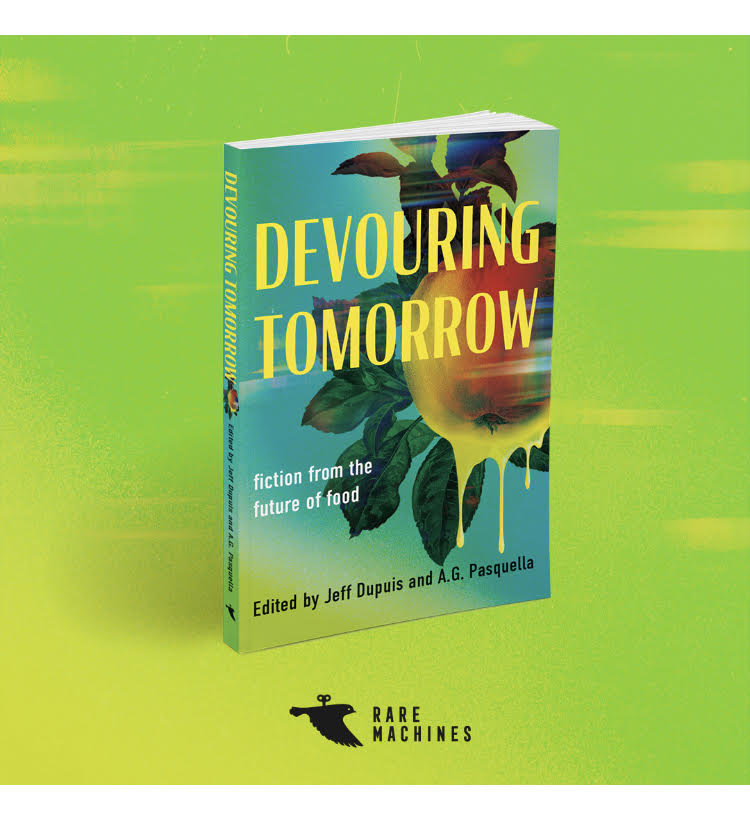
Watch for Mme Lisa de Nikolits’ story “Time to Fly” to be published next year in the anthology Devouring Tomorrow.
Lisa’s story is about how centrifuge equipment can induce the sensory experience of reliving the food of one’s youth (once the larders of the world are depleted) and nature ceases to be able to support human life. But don’t worry – the story has a happy ending!
Mme Sylvia Warsh’s new novel, The Orphan will soon be available through The Toronto Public Library!
Sylvia Maultash Warsh
MmeMelissa Yi is Kickstarting Killing Me Sloth-LY, the Hope Sze thriller on sloth, Book 3 of Hope’s Seven Deadly Sins, with illustrations by artist, Ben Baldwin together with Cthulhu’s Cheerleader, a collection of art by Sara Leger with poems by Melissa. The crowd funder is for both works under Cthulhu’s Duo: A Lovecraftian Thriller and Weird Art.Cthulhu’s Duo: A Lovecraftian Thriller + Weird Art by Melissa Yi — Kickstarter. It was just chosen as a Project We Love.
Melissa has also sold her story “The Longest Night” to Ellery Queen’s Mystery Magazine.
Dastardly Damsels is full of rich, humorous, heartbreaking and subversive stories that show women at their best… and at their worst. Utterly delicious. – Mercedes M. Yardley, Bram Stoker Award-winning author.
Mme Rosalind Place’s story “Too Close to the Edge” will appear in Dastardly Damsels, a horror anthology from Crystal Lake Publishing. The publication date is October 11th. Dastardly Damsels will be available in both print and e-book and the e-book can be pre-ordered now from Amazon. .https://getbook.at/DastardlyDamsels
Rosalind Place
MESDAMES ON THE MOVE
Mme Rosemary McCracken will be discussing crime writing with 4 other Crime Writers of Canada authors at the Tottenham Community Centre, 139 Queen Street North, Tottenham, Ontario. Saturday, Oct. 19, at 2 p.m.
Donna Carrick
Mme Donna Carrick will be at Wasaga Beach Public Library at 7 p.m. on Saturday, October 26th, for Georgian Bay Reads. Donna is representing Springwater Township Public Library and defending the bestselling thriller, The Maid by Nita Prose. Georgian Bay Reads – 5 books, 5 defenders, 1 winner!
CWC’s Brews and Clues hosted by crime writer, Des Ryan, takes place on Thursday, October 10th, at 6:30 p.m. at Stout Irish Pub, 221 Carlton Street. The Mesdames and Messieurs will be guests in November to read from their new anthology, The 13th Letter.
This month’s story is “Soul Behind the Face” by Mme Madona Skaff. It’s the first Lennie adventure, which appeared in In the Key of 13.(Carrick Publishing, 2019). Lennie is the crook who turned PI once he discovered his power to talk to ghosts.
Word on the Street happens at Queen’s Park this weekend, September 28th from 11 am to 6 pm and September 29th from 10 am to 5 pm. The Mesdames and Messieurs of Mayhem are sharing a booth with friends from Toronto SinC and Romance Writers: Alice Fitzpatrick, Kris Purdy and Maaja Wentz.
Big thank you to Mme Sylvia Warsh for organizing! Come meet Sylvia and M. H. Callway, Blair Keetch, Rosemary McCracken, Lynne Murphy and Lorna Poplak.
Mme Melodie Campbell will signing her fabulous 1920s mystery, The Merry Widow Murders and meeting fans at the Cormorant Press booth on Sunday, September 29th at 1:45pm.
We’re delighted to introduce, Lorna Poplak, the first true crime author to join the Mesdames and Messieurs of Mayhem.Lorna studied law and French before a diverse career in IT and writing. Her first true crime book, DropDead: A Horrible History of Hanging in Canada, was published by Dundern Press in 2017. Her second book, The Don: The Story of Toronto’s Infamous Jail (Dundern, 2021) was shortlisted for several leading awards, including the CWC Brass Knuckles Award and the Heritage Toronto Book Award. Her next book about famous prison escapes will be published in 2025.
John Wilson Murray’s Memoirs of a great detective: Incidents in the life of John Wilson Murray was first published in 1904. (Internet Archive)
On February 21, 1890, Detective John Wilson Murray of the Ontario Department of Criminal Investigation received word that two woodsmen had made a grisly discovery in Blenheim (now Benwell) Swamp, near Princeton: amid a tangle of briars, fallen logs, and dense brush, the body of a man with two bullet holes in the back of his head.
As he tells us in his 1904 Memoirs of a Great Detective, Murray, also known by the moniker “Old Never-let-go,” immediately launched an investigation. The body was that of “a young man, smooth shaven, of refined appearance, and clearly a gentleman.” From the style and cut of his garments, even though all labels had been carefully removed, he was also, clearly, an Englishman. Photographs sent out Canada-wide failed to reveal his identity.
A breakthrough came five days later, when a man and his wife arrived in Princeton asking to see the body, claiming that the victim had possibly been a shipboard acquaintance. Through Murray’s brilliant investigative efforts, the case was soon unravelled.
The “suave, handsome” visitor was identified as a conman named John Reginald Birchall of London, England; his victim was Frederick Cornwallis Benwell of Cheltenham, who had shown interest in investing in Birchall’s purported horse farm in Ontario.
Benwell and another potential investor, Douglas Raymond Pelly, had sailed across the Atlantic with Birchall to view the farm. Instead, Benwell was lured to the desolate swamp and killed. More by luck than skill, Pelly managed to avoid suffering a similar fate.
Birchall was arrested in Niagara Falls on March 2 and tried in Woodstock for murder.
There was no “smoking gun” in the case — in fact, no gun ever seems to have been unearthed — but a cascade of circumstantial evidence coalesced to doom the accused.
After an eight-day trial, Birchall was found guilty and sentenced to hang, which was the mandatory penalty for murder at the time. He went to the gallows in Woodstock on November 14, 1890.
What became known as the Blenheim Swamp Murder was an international sensation at the time. The reason, as noted by J.V. McAree in a 1940 Globe and Mail article entitled “Birchall’s shot was heard round the world,” resided not in the details of the case — a sordid story of theft and premeditated murder with an easily identifiable perpetrator. No, the trial was of importance because “the characters involved … were what is known in England as gentlemen … who do not murder each other except in fiction.” And, at a time when Canada was actively courting immigrants with means, “were there many like Birchall to swindle and eventually murder them?” Fortunately, there were not.
The case remained without question Murray’s most famous investigation.
Decades later, on the release of his memoirs, Murray was quizzed about his fateful first meeting with Birchall and Florence, his hapless wife. At the launch, Murray’s “collaborator” (possibly ghostwriter?) was revealed as Victor Speer, “a well-known newspaper and magazine writer.”
The memoirs offer fascinating glimpses into Ontario society in the last quarter of the 19th century, when poverty was rife in rural areas, marauding gangs terrorized farming communities, and murders could be committed for very little gain: 80 cents, in one case. The book stretches to a whopping 450 pages; each of its 82 chapters is devoted to different episodes gleaned from Murray’s colourful past.
In the Dictionary of Canadian Biography, Jim Phillips and Joel Fortune cast a skeptical eye on some of Murray’s anecdotes about his early life; as his memoirs “contain many misrepresentations about later events,” they write, “little reliance should be placed on them other than for details of birth and family.” What does seem to be without doubt is that he was born in June 1840 in Edinburgh, Scotland, and that his family emigrated to the United States when he was a young boy. After an education both in the States and in Scotland, he enlisted in the U.S. Navy in 1857.
Even with possible fabrications regarding his early life — such as his claims that he thwarted a Confederate attack against the ship on which he served during the Civil War and investigated counterfeiting for the Treasury Department after his discharge from the navy — and possible exaggerations regarding his professional life after moving to Canada and joining the Canada Southern Railway as a detective in 1873, Murray’s achievements may still be regarded as nothing less than extraordinary.
Murray received a formal tender of appointment from Attorney General Sir Oliver Mowat in 1875 to become the first (and, for nine years, the only) provincial detective of Ontario, with an annual salary of $1,500.
At that time, the justice system was in transition. Underpinning the older model were largely untrained local constables and justices of the peace who were remunerated on a fee-for-service basis. County Crown attorneys relied for their prosecutions on information provided by the police. Detectives did not play a significant role, but, increasingly, a perception emerged that the poorly paid rural constables could be relied upon for the investigation of minor crimes only.
Mowat stressed to his executive council that, given the growing sophistication and organization of criminals, a skilled man was required, one with “qualifications superior” to those of the ad-hoc detectives usually employed by the provincial government.
Murray, who described himself as having “brought to his work a rich experience and rare training” and who had “schooled himself in the details of information of every class of crime,” was clearly the man for the job: to investigate, either in person or in a supervisory role, crimes throughout the province of Ontario — “its total area was 101,733 square miles, and its division was into eighty-four counties” — and also “to follow criminals to any place and run them down.” Wrongdoers, warned Old Never-let-go, “were to hear the tread of footsteps in pursuit, that never ceased until the pursued was dead or behind prison bars.” They would “realise that the old order of things had passed away.”
The value of this new order was demonstrated in Murray’s very first case as government detective: the murder of Ralph Findlay, a farmer in Lambton County. Summoned to the case by the county attorney, Murray discovered that the “countryside” believed that Findlay had been murdered by horse thieves after he had surprised them in his barn. Murray looked for a motive and, based on eyewitness information, found it in the amorous relationship between Mrs. Findlay and William Smith, a hired farmhand. Murray bullied the woman into confessing that she had egged on her lover to murder her husband.
Murray had very definite views about crime and criminals. “Crime is a disease. It is hereditary, just as consumption is hereditary. It may skip a generation or even two or three generations. But it is an inherent, inherited weakness.” And forget about reforming criminals: “Once dishonest, always dishonest. That is the general rule. Reformation is the exception.” In 1880, by dint of dogged investigations that took him to multiple cities in the U.S. and Canada, he ran to ground the Johnson gang, a notorious multigenerational family of counterfeiters (father, sons, and daughters), who were said to have put over a million dollars in fake notes into circulation. Murray kept the plates, worth around $40,000, as souvenirs.
He was also a strong believer in the value of circumstantial evidence. “I have found it surer than direct evidence in many cases … There are those who say that circumstances may combine in a false conclusion. This is far less apt to occur than the falsity of direct evidence given by a witness who lies point blank.”
Although most of Murray’s efforts in bringing villains to justice consisted of interrogations, intercepted letters, pursuits over land and water, and the like, he was open to the adoption of newer techniques, such as the examination of footprints (in one case, he notes that he “marked the tracks carefully and arranged to have plaster casts made of them”), photography, autopsies, and forensic investigations. As early as 1876, analyses conducted at the School of Practical Science in Toronto had revealed that traces of blood and small bones were from a human being, not an animal, which helped to convict a wife murderer.
Murray’s easy manner endeared him to police and newshounds alike. He was even generally liked by the desperadoes who crossed paths — or swords — with him.
And his sense of humour was legendary. He once told a Globe reporter of a time in court when a “little lad” had been charged with stealing several sticks of dynamite. On being asked by the judge what he had done with them, the boy, crying, took a couple of stick-like objects from his pocket and started to toss them onto the clerk’s desk. “I was near the judge’s bench when he threw the first one,” recalled Murray, “but I think I was half way down the street when the other one fell on the desk.” Fortunately for all, the dynamite failed to explode.
In 1906, after having served the people of Ontario for 31 years, now Chief Inspector Murray died of “a stroke of paralysis” in bed at his Toronto home. In an obituary in the Toronto Daily Star, he was praised for the “skill, logic, trained memory, and delicate intuition” that he had brought to the business of detection.
But perhaps we should leave the last word to the man himself. The concluding sentence of his memoirs reads: “Well, Murray, you’ve done pretty well, after all.”
Sources:
Globe editions of March 14, 1890, March 22, 1890, September 23, 1890, September 25, 1890, April 21, 1894, October 29, 1904, June 13, 1906, June 23, 1906
Globe and Mail editions of March 8, 1940, November 19, 1977
Murray, John Wilson. Memoirs of a Great Detective: Incidents in the Life of John Wilson Murray. Toronto: William Heinemann, 1904.
Phillips, Jim and Joel Fortune. “Murray, John Wilson.” In Dictionary of Canadian Biography, vol. 13, 1994.
Quebec Saturday Budget edition of November 15, 1890