Historical Fiction Part I: Dodge City Run by the North West Mounted Police ~ Vicki Delany

Vicki DelanyThe Late Sir Peter Ustinov once said that Toronto was New York run by the Swiss. I like to say that Dawson, Yukon, in 1898, was Dodge City run by the North West Mounted Police.

Imagine a place in the wilderness, close to the Arctic Circle, hundreds of miles from the nearest city, at the end of the 19th century. A place of no roads, no cars, no trains, no telephone, no telegraph. Accessible only by water, for just a few months a year, or by paths over mountains so steep that horses couldn’t make it. And then imagine tens of thousands of people arriving in this place within a matter of months.
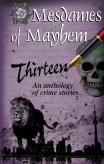
Thirteen, an anthology of Crime StoriesWhat you would get in almost any other place and any other time would be bedlam. Chaos and anarchy and lawlessness.

This is the setting for the Klondike Gold Rush series, published by Dundurn Press, as well as my story, Sore Feet and Gold Dust, in Thirteen.

Given that background, you would think I would have a plethora of scenes of historical murder and mayhem to write about in the books.

You would be wrong.

Because what all those miners and dance hall owners, prostitutes and pimps, bartenders and adventurers, and businessmen (respectable and shady) found when they at long last arrived in the promised land, was the long arm of the law waiting for them, in the form of the North West Mounted Police (precursors of the RCMP).

Gold MountainThe border between Canada and the U.S. was at that time still in dispute. The Canadian government had established a police presence in order to strengthen their claim before all those gold seekers and their hangers-on began flooding into the territory. Prostitution and gambling were illegal in all parts of Canada, but the NWMP recognized, wisely in my opinion, that some things were going to happen whether they were legal or not, and the police would be better having some control. Thus prostitution was practiced openly and dance halls all had a gambling room.

Police oversight was strict and they could, and did, close down any business stepping over the line. However, there were things the Mounties didn’t bend on – the use of ‘vile language’ was an offence, and Sunday closing was strictly observed. People were jailed for chopping wood for their own homes on a Sunday. Firearms were strictly banned. Every person coming into the Territory was required to have a year’s supply of goods with them: a lesson learned during the winter of 1897-98 when the town nearly starved. Not only did all those adventure-and-gold seekers have to climb the Chilkoot Pass they had to do it about 30 or 40 times to get all their gear up. Tougher people than me I can tell you.

In 1898, the year of the height of the Gold Rush, when the town of Dawson had a population of 40,000, there was not one murder in town. Not one. Reports I have read say that people were comfortable leaving their doors unlocked and their possessions out in the open. In contrast to the nearby town of Skagway, Alaska, where gangsters such as Soapy Smith ruled and crime and corruption were rampant. Soapy himself was killed in a shootout on the Skagway boardwalk in July 1898.

Gold FeverIn Dawson, a town where a one minute dance with a dance hall girl cost a dollar, a bottle of champagne could set you back 40 bucks, and successful miners were known to drop a thousand, ten thousand dollars (all in 1898 funds!) in a night in the casino, a constable in the NWMP earned $1.25 a day (roughly the rate for a labourer in the Outside). Yet the police were largely incorruptible.

In order to create a mystery novel, I had to jettison the sterling record of the NWMP and create a murder. In the second book in the series, Gold Fever, there are two. And, despite one of the main characters in the series being a NWMP officer, the Mounties will prove unable to solve the crime and it will be left to my protagonist, dance hall owner and woman with a past, Fiona MacGillivray, to do so.

Sometimes you just can’t let the facts get in the way of a good story.

A Cold White SunVicki Delany is the author of the popular Constable Molly Smith series (including In the Shadow of the Glacier and A Cold White Sun) from Poisoned Pen Press, as well as the Klondike Gold Rush mysteries from Dundurn, and standalone novels of Gothic Suspense also from Poisoned Pen Press.

Visit Vicki at www.vickidelany.com , www.facebook.com/vicki.delany, and twitter: @vickidelany. She blogs about the writing life at One Woman Crime Wave (http://klondikeandtrafalgar.blogspot.com)

Posted in Uncategorized | 2 Comments

HAPPY HOLIDAYS FROM BLOODY WORDS 2014

M.H. CallwayGreetings Readers!

Bloody Words, Canada’s national crime writers’ conference, takes place in Toronto, June 6 to 8, 2014. The Mesdames of Mayhem are taking it by storm!

Cheryl FreedmanMme Cheryl Freedman is not only the chair of the BW Board of Directors, she’s leading the Bloody Gang, the amazing people who pull the conference together. Mme Vicki Delany will be the Canadian guest of honour and Mme Melodie Campbell, the master of ceremonies. Mme Joan O’Callaghan is the chair for the 2014 Bony Blithe Award for best light mystery. Mme Cathy Astolfo is running the Bony Pete short story contest and the manuscript evaluation service.

Mme Cheryl sends this reminder to mystery lovers:

Consider registering early for Bloody Words 2014 before the price goes up on January 1st. The cost now is $175 plus $7 if you register online using PayPal. No extra charge if you register by mail or register online with Interac e-transfer.
Registration goes up to $190 (plus $7 for paying with PayPal, nothing extra if not paying with PayPal) on January 1st. To register, go to http://2014.bloodywords.com/register/ and choose your registration method.

Also, we’re still open for entries for the Bony Blithe (deadline December 13) http://2014.bloodywords.com/bony-blithe/ . You don’t have to be registered for BW to enter the Bony Blithe contest

And we’re taking entries for the Bony Pete short story contest http://2014.bloodywords.com/bony-pete-contest/. Note: you do have to be registered for BW to enter the Bony Pete short story contest.

Posted in Uncategorized | Tagged , , , , , , , , , | Leave a comment

Sex in Fiction ~ Caro Soles, December 3, 2013

There is a word in the English language that is capable of turning perfectly articulate people into stammering, red-faced teenaged versions of their adult selves. I found this out early when I began teaching the Writing a Novel course I designed for George Brown College. The word is ‘sex’.

To begin, with I had not written any sort of topic specifically labeled ‘sex scene’. Into my outline. After all, this was only a few months after some of my books written by my steamy gay male leather-loving alter ego had been stopped at the border and refused entry as being far too much for innocent Canadians. But after one class dealing with relationships, a student came up to me and asked me if I wouldn’t mind reading his scene. He was too embarrassed, it seemed, to read it aloud in class because it was ‘pretty raw and racy’, said he, his cheeks flushed. This guy obviously did not read the Globe and Mail and was thus unaware of my scandalous double life.

After reading the pale labored sex scene the student had given me, I decided we had to talk. The whole group had to talk about sex in novels, and why it should be there. And why at other times it should definitely not rear its ugly head. And most important of all, how to write about it! So we did. A most popular class it became, too.

Novels are all about people, and sex is a part of who we are. What a character does in bed may show something about him or her that no other scene could properly convey. It may be surprisingly tender or alarmingly rough. Another aspect of our hero or heroine, told not as a paint-by-numbers exercise, as a lot of my students early efforts seemed to be, but with feeling and a deep appreciation of all the senses involved. Sex scenes are also a great way to mirror the society and the period when the story takes place.

Cliches are to be avoided at all costs when writing anything, and this is never so true as when writing about sex. Using coy words or heavy-handed imagery comes across as awkward and self-conscious. Just let go! Have fun! Revel in all that sensuality!

But there is a caveat here. Not all books need sex. I am told this is also true of some people. As in all the other aspects of a novel, a lot depends on the kind of book you are writing, on the tone, on the expected audience. Remember there is nothing worse than a gratuitous sex scene! And a lot depends on how comfortable you are writing it.

But when you do plunge into that tumescent scene, just remember you do not want to be in the running for the Bad Sex Award given by the British lit magazine The Review. Here is last year’s winner, ED KING by David Guterson:

“In the shower, Ed stood with his hands at the back of his head, like someone just arrested, while she abused him with a bar of soap. After a while he shut his eyes, and Diane, wielding her fingernails now and staring at his face, helped him out with two practiced hands, one squeezing the family jewels, the other vigorous with the soap-and-warm-water treatment. It didn’t take long for the beautiful and perfect Ed King to ejaculate for the fifth time in twelve hours, while looking like Roman public-bath statuary. Then they rinsed, dried, dressed, and went to an expensive restaurant for lunch.”

And lest you are crowing that it is only the literary writers who write bad sex, there was stiff competition from Lee Child:

“Then it was time. We started tenderly. Long and slow, long and slow. Deep and easy. She flushed and gasped. So did I. Long and slow.”

Don’t get discouraged. You can do better. I know you can! There’s lots of great sexual writing out there, though I would probably not start with Rabelais.

Mesdame Caro The DejaIn 1989, Caro switched from teaching languages to teaching creative writing. Now that her students could understand her jokes, the classroom was much more jolly. She has taught writing in Community colleges, Berkeley University and given workshops at such varied places as the OutWrite Conference in Boston and the Tool Box Leather Bar in Toronto. She now teaches several courses at George Brown College, appropriately called Writing a Novel 1 and Writing a Novel 2. Her latest novel is The Déjà Dance, the third in the sf adventure/thriller series The Merculians.

Visit Caro at:
Www.carosoles.com
carosoles.wordpress.com
Tweet with @carosoles

Posted in Uncategorized | Tagged , , , , , , , , , , , , , , , , , , , , , , , | 2 Comments

ROUSING PRINT LAUNCH FOR THIRTEEN ~ M.H. Callway, Nov. 26, 2013

The fabulous Mesdames of MayhemOn October 27th, the fabulous Mesdames of Mayhem celebrated the print launch of their first anthology, Thirteen, at their favorite bookstore, Sleuth of Baker Street.

The serendipitous and ghostly collision of date and title made the Halloween theme a no-brainer!

Happy Halloween thanks to JordanaSeveral of the Mesdames appeared in costume: Cathy Astolfo, Melodie Campbell and Jane Peterson Burfield made glamorous witches. Lynne Murphy celebrated her short story, Bessie’s Worms, by impersonating a composter, though happily the worms were of the gummy variety. And Mel’s hubby, Dave, stole the show as a wicked Scottish pirate complete with kilt!

Halloween decor!Mme Joan O’Callaghan, the Mesdames marketing guru and organizer of the launch, decorated Sleuth’s with ghoulish delights, without hiding the books and leaving plenty of space for book signings and browsing. Joan’s niece, Jordana Eisen, generously donated her interior design expertise and her private collection of Halloween party gear. Especially popular were: the hay bale with crawling black rats; the 1940’s talking telephone tapped into the spirit world; and the eerie books that moaned and shuffled on the shelf.
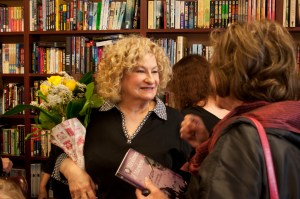
Our marketing whiz, Mme Joan
Mesdames Rosemary Aubert, Vicki Delany, D. J. McIntosh and Rosemary McCracken lent their extensive experience with book launches. This included streamlining our autograph marathon: try organizing a dozen authors to sign more than fifty books!

Lots of noms!And what is a celebration without noms? The Mesdames provided a cornucopia of nibbles and home-baked goodies like fossil cookies and gummy worm cupcakes. The spider cakes were also well-liked. Wine flowed, thanks to Mesdames Catherine Dunphy and M. H. Callway. Madeleine’s husband, Ed Callway, tended bar and their daughter, Claire Callway, acted as photojournalist.

A full house!Book signings and mingling with family, friends and fans kept the Mesdames busy and out of trouble. Mesdames Caro Soles and Cheryl Freedman dropped by to share many hugs and congratulations. The big highlight of the afternoon was the readings done by Thirteen’s authors. By the end of the day, seventy books had been sold and signed.

Mega nice thanks from the team!A lovely surprise: publisher extraordinaire, Mme Donna Carrick and co-editors, Joan and Madeleine were thanked by the Mesdames with lovely long-stemmed roses, presented by Mme Dorothy (D. J.) McIntosh!

Thanks to the Sleuth of Baker Street Mystery Bookstore!
A major thank you to wonderful bookseller and BFF of the Mesdames, Marian Misters of the Sleuth of Baker Street Mystery Bookstore for sponsoring the launch.

PercyAnd last but not least a pat on the head to Percy, resident reading dog. Percy refrained from playing with the large plastic rats and showed remarkable restraint by the food table. His virtue was amply rewarded by treats of cheese at clean-up time.

Our thanks to the Sleuth of Baker Street for hosting our launch.

And heartfelt gratitude to our talented event photographer, Claire Callway!

Posted in Uncategorized | Tagged , , , , , , , , , , , , , , , , , , , , , , , , , , , , , , , , , , , , , , , | Leave a comment

BOOKS AND THE ART OF THEFT ~ Melodie Campbell, Nov. 19

Melodie CampbellPuzzled by the title? It’s simple.

In high school, I had to read Lord of the Flies, The Chrysalids, On the Beach, To Kill a Mocking Bird, and a whack of Shakespeare.

Yuck. Way to kill the love of reading. All sorts of preaching and moral crap in the first four. (Which, as you will see by the end of this post, doesn’t suit me well.)

Torture, it was, having to read those dreary books, at a time when I was craving excitement. Already, I had a slight rep for recklessness. (It was the admittedly questionable incident of burying the French class attendance sheet in the woods on Grouse Mountain, but I digress…)

And then we got to pick a ‘classic’ to read. Groan. Some savvy librarian took pity on me, and put a book in my hand.

Ivanhoe.

Magic

A writer was born that day.

This is what books could be like! Swashbuckling adventure with swords and horses, and imminent danger to yourself and virtue, from which – sometimes – you could not escape (poor Rebecca.)

I was hooked, man. And this book was written how long ago? 1820?

Occasionally, people will ask if a teacher had a special influence on me as a writer. I say, sadly, no to that.

But a librarian did. To this day, I won’t forget her, and that book, and what it caused me to do.

– Write the swashbuckling medieval time travel Land’s End series, starting with the Top 100 bestseller Rowena Through the Wall.

– Steal a book. Yes, this humble reader, unable to part with that beloved Ivanhoe, claimed to lose the book, and paid the fine. Damn the guilt. The book was mine.

– Write The Goddaughter series, which has nothing to do with swashbuckling medieval adventure, and everything to do with theft. Which, of course, I had personally experienced due to a book called Ivanhoe.

The lust for something you just have to have. The willingness to take all sorts of risks way out of proportion, to possess that one thing.

A book like my own Rowena and the Dark Lord made me a thief at the age of sixteen. And the experience of being a thief enticed me to write The Goddaughter’s Revenge, over thirty years later.

My entire writing career (200 publications, 8 awards) is because of Sir Walter Scott and one sympathetic librarian. Thanks to you both, wherever you are.

The Goddaughter, Melodie Campbell Melodie Campbell writes funny books. You can buy them at Chapters/Indigo, Amazon, Barnes & Noble, and other retailers. She lurks at www.melodiecampbell.com.

THE GODDAUGHTER’S REVENGE on Amazon
THE GODDAUGHTER on Amazon
Follow Melodie’s comic blog at www.melodiecampbell.com

Posted in Uncategorized | Tagged , , , , , , , , , , , , , | 1 Comment

The Funny Side of Crime ~ Lynne Murphy, November 12, 2013

Lynne MurphyHumour is like sex. Once you start to analyze it, you take all the fun out of it.

Be that as it may, The Mesdames have asked me to write about humour in crime and I decided to think about four of the stories in the anthology Thirteen that made me laugh. They are “Not My Body” by Melodie Campbell, “The Canadian Caper” by Rosemary Aubert, “Amdur’s Cat” by M. H. Callway and my own story, “Saving Bessie’s Worms”. Yes, I still laugh when I read my own work.

It is hard to be funny about murder, but Mme. Campbell manages. Of course she is a mistress of black humour. It helps that we never meet the victim before he turns up dead and he is a lowlife criminal whom no one will miss. The heroine, Gina, is trying to live a respectable life but her relatives with their mob connections keep involving her. In the end, like Nancy Drew, she solves the crime but unlike Nancy, she lets the criminal off.

Thirteen, an anthology of Crime StoriesNever underestimate the power of little old ladies. I am one, so I know whereof I speak. “The Canadian Caper” and “Saving Bessie’s Worms” are both about senior citizens. In “The Canadian Caper”, Mrs. DiRosa, who lives in Niagara Falls, New York, uses a ruse to get the attention of border officials after they ignore her first warnings about people smuggling. Most memorable line: “I have come home to die.”

The ladies in “Saving Bessie’s Worms” aren’t above a little blackmail and coercion when they are faced with someone trying to get rid of their friend’s worms, an essential ingredient in the compost operation in their condo. There is an incongruity between what we expect of these nice, elderly women and the way they actually behave.

Are worms intrinsically funny? They show up again in “Amdur’s Cat”. Herb Cott, a redneck politician and a former worm seller, is bent on destroying Dr. Amdur’s government department. He gets his comeuppance at the hands of the doctor, aided by an exotic dancer, a computer hacker and a lion. (Sounds like the start of a joke.) The story is close to fantasy, but it moves so fast that you are carried along by the action. Here again, the good guys have to turn criminal to triumph.

Humour and crime both have many faces. Combining them can work, but it’s a mystery to me how it happens. Better not to analyze and just read and enjoy.

Lynne Murphy studied journalism at Carleton University and worked as a reporter on the now defunct “Ottawa Journal” and then as an editor for CBC Radio News. She has sold articles through the years, but “The Troublemaker” in the Sisters in Crime anthology The Whole She-Bang is her first published work of fiction.

Her story “Saving Bessie’s Worms” appears in the 2013 anthology of crime stories titled Thirteen by the Mesdames of Mayhem.

In 1992 Lynne helped found the Toronto Chapter of Sisters in Crime and is proud that it continues to thrive.

Posted in Uncategorized | Tagged , , , , , , , , , , , , , , , | Leave a comment

From the Desk of the Editor: When You Can’t Afford an Editor ~ Cheryl Freedman, Nov.8/13

Cheryl FreedmanHiring an editor can be very expensive , especially if you hire the editor too early in the writing process, i.e., when your manuscript is in very rough first draft form. I’m talking here about such basic writing mistakes as incorrectly formatted dialogue (i.e., technical errors) or random changes in point of view (i.e., content/style errors).

Now if you want to hire me to fix such rudimentary problems, who am I to say no? I can use the money, although I have to admit that I will feel just the tiniest bit guilty on my way to the bank with your cheque. And in cases like this, I’ll often edit the first 25–50% of such a rough draft and then send it back with copious comments and a suggestion that the author work further on the manuscript and then send back to me.

In other words, sending as polished a manuscript as possible to an editor will not only save you money but also turnaround time.

So how, you ask, can I do this?

There are five ways:

– Books, magazines, how-to-write Websites/blogs
– Writing groups
– Writing courses & workshops
– Professional writers’ associations & conferences
– Lagniappe: Two fundamentals of good writing

Books, magazines, how-to-write Websites/blogs
There are far too many resources to list here, but email me and I’ll send you a list of books (style and usage, general fiction writing, crime-writing, and miscellaneous) I’ve found useful. As for magazines, there’s Writer’s Digest (hardcopy, digital, and online tips http://www.writersdigest.com/) and The Writer (hardcopy, digital, and online tips http://www.writermag.com/).

Writing groups
‘Fess up now. How many of you have given your manuscript to your mom or BFF to read and critique? It’s OK, really…if all you want is a pat on the back. Odds are that your mom or BFF will tell you the manuscript is brilliant and you’re obviously a candidate for a Man Booker Award in the near future. Congratulations, kid, but such praise isn’t much help in making you a better writer.

Enter the writing (or critique) group: a group of five or six writers who read and critique each other’s work. How you set up your group—face-to-face, online, via email, via Twitter, on FB—is up to you and beyond the scope of this post, but you can find suggestions online and in magazines.

Who should be in such a group? Even (or especially) if you’re not yet published, try to have at least one published author or editor or writing instructor or reviewer in your group—in short, someone who is familiar with the rules of writing and who will:

– Read your work for what it is;
– Critique your work honestly but fairly;
– Point out any over-arching content and/or technical problems that your work might have (point of view or voice inconsistencies, motivation problems, factual errors, words used incorrectly, poor pacing, etc. etc. etc.).

You don’t want someone who will:

– Try to co-opt your book and impose his or her view of what your book should be; it’s your book, not theirs;
– Copy edit your work;
– Not be able to give you a rationale for his or her comments.

In addition to working with a writing critique group, it’s also useful to have a friend or acquaintance whom you can call upon for technical information. For example, if you’re writing a police procedural, it’s a good idea to make friends with a cop who can identify factual mistakes in your procedural.

Writing courses & workshops
You can barely turn around these days without finding a writing course or workshop being offered through your local school board, a community college, a library branch, as a Webinar, or via email. These courses are almost always taught by well-established, long-time authors with many works to their name. Some courses are general writing courses, but you can often find specific genre courses, too. Courses can range from very basic (for folks who’ve never written before) through mid-progress (for folks in mid-book who want a bit of a nudge) to advanced.

To find out what’s running in your neck of the woods, check the continuing education page of your local community college(s) or board(s) of education, or the Website of your local library system. You can also check Crime Writers of Canada’s monthly Author Events PDF, which sometimes lists library workshops. And this last point allows me to segue into…

Joining a professional writers’ association & attending writing conferences
If you write mysteries or crime-related fiction or nonfiction, you should join Crime Writers of Canada. You can also do an online search for other writers’ associations, both general and genre in Canada and elsewhere.

Consider attending writing conferences, especially (and here I betray my bias) Bloody Words (BW). The next BW will be held in downtown Toronto from June 6 to 8, 2014. Bloody Words offers professional development in the form of panels and presentations, workshops, a short story contest, a chance to pitch your book to an agent, and lots of opportunity for networking with published and aspiring authors as well as others in the publishing biz. There’s also a reception and a banquet. To find out more about the conference, go to http://2014.bloodywords.com/.

Lagniappe: Two fundamentals of good writing

– Show, don’t tell. Make sure you get the reader involved in the action and in your characters’ (especially your protagonist’s) head space. Don’t just say that Jane is angry; show her anger and make us feel that we’d better get out of her way or else.
– Reality check. This covers everything from making sure your gun doesn’t fire too many bullets (i.e., getting your facts right) to having your characters speak appropriately (e.g., it’s OK for a character not to use contractions in speech, but you’d better have a good reason). Reality check also covers time and space (make a timeline for the events in the book and sketch out elements of the setting if your characters’ physical movements are important) as well as how to convey back story and background information to the reader.

So there you are: a few ways to polish your manuscript to the point where you can hand it to an editor for a final buff that won’t break the bank.

CHERYL FREEDMAN has been a freelance editor for 15 years, editing a range of material from Kabbalah and academic math articles to memoirs to crime fiction. (Unfortunately, because of time constraints, she did not edit Thirteen.) She is chair of the Bloody Words board of directors, has been chair of the BW conference itself four times (including the upcoming BW 2014 ) , and was executive director of Crime Writers of Canada for 10 years before she left to write her own book.

Visit Cheryl at her CWC Webpage
Or Email: cheryl @ freedmanandsister . com

Posted in Uncategorized | Tagged , , , , , , , , , , , , , , , , , , , , , , , , , , , , | Leave a comment

Murder by the Book, play coming to Waterdown Nov.15! ~ Joan O’Callaghan

Joan O'CallaghanIt was totally serendipitous! My friend of many years, Jane Coryell, mentioned that she was designing the set for the Village Players in Waterdown, Ontario. Knowing my love of mysteries, Jane told me the play, Murder by the Book by Mat Kelly, is about a group of women who write mysteries.

“Hello,” I said, with rather more force than absolutely necessary, “That’s the Mesdames!” We looked at each other and before long, a wonderful collaboration was born.

Put together a group of creative and murderously-minded women writers, all with their own secrets , two very pragmatic police officers, a couple of other suspicious characters and what you get? Why a murder of course. The police are intent on finding the murderer while the writing group sees this as an opportunity to learn something about police procedures. Why do the police want a rutabaga to help solve the murder?

Rutabaga? There’s only one way to find out how the rutabaga figures into it and that’s to see the production.

Murder by the Book by Mat Kelly, presented by the Village Players

Memorial Hall
317 Dundas Street East, Waterdown, ON.

There is a small parking lot near the hall, and more across the street.
Tickets cost $20 for adults; $18 for seniors and students. They go on sale October 20. To order tickets, call the box office at 905-690-7889.

Nov. 15 – 8pm (Opening Night)
Nov. 16 – 8pm
Nov. 17 – 2pm
Nov. 22 – 8pm
Nov. 23 – 8 pm
Nov. 24 – 2pm
Nov. 29 – 8 pm
Nov. 30 – 8pm (closing night)

And – wait for it – the Mesdames of Mayhem will be on hand at the theatre with books to sell. Of course, Thirteen, our wonderful new anthology will be featured along with several other titles published by our own intrepid group of criminally-minded women. This is a wonderful opportunity to do some timely Christmas shopping for those mystery fans on your list!

Posted in Uncategorized | Leave a comment

Exotic Locales – Part II: Mesopotamia ~ D.J. McIntosh

D.J. (Dorothy) McIntosh I think of the way my books are written like a love affair conducted from afar. Two souls who are physically separated but whose hands stretch in their imaginations across thousands of miles to touch. The reason for this is a simple one. I chose to write about Iraq, even though I’ve never been there.

The Witch of BabylonI did not, at first, choose a place I barely knew. As a central theme in my novels, I like to take a famous story everyone is familiar with and give it a new twist. When framing ideas for my first book, The Witch of Babylon, I began with the familiar stories of the Book of Genesis and quickly discovered that many of them originated as much earlier Mesopotamian myths. So I began to research Mesopotamia and promptly became fascinated by what is one of the world’s greatest cultures. Mesopotamia means ‘the land between two rivers’ – the region we now call Iraq. Does it qualify as exotic? To a westerner who is untutored in the ways of the Near East – most definitely.

While the subject matter intrigued me, it also presented a major stumbling block: how could I write about a land I’d never seen? For I could not visit it. The country was at war and even now, sadly, because of ongoing sectarian conflict, it remains very dangerous. I did watch month’s worth of television war coverage and that gave me a vivid picture of the contemporary country. But above all, I bow down in gratitude to the scores of journalists and bloggers, many of them native Iraqis, who risked their lives to tell the story of what living in Iraq was like under the dark claws of war. I learned too that Iraq is also a beautiful country, a desert landscape that turns a heavenly green with the winter and spring rains, and is populated by people who, under the worst of circumstances, manage to keep a resilient spirit.

The Book of Stolen TalesMy second novel, The Book of Stolen Tales, is also situated in Iraq but includes a large section set in
Europe with much of the action taking place in Naples. Again, the choice of Naples was dictated by the subject matter. A story about the hunt for a stolen book, the first European anthology of fairy tales written in the 16th century by a renown Neapolitan poet and courtier. I spent a week in Naples and left wishing for much more time in that intriguing city. Having been ruled by the Spanish for hundreds of years, Naples boasts hundreds of fabulous Spanish colonial buildings, twisting cobblestone streets no bigger than laneways, fortresses and palaces, villas and archaeological ruins perched on the mountainside overlooking the sea. And food. Fabulous creations you could only find on the sun kissed slopes of southern Italy.

But above all else, Naples’ personality has been formed by that most historic of mountains we know as Vesuvius. After breakfast, I’d leave my hotel room and walk across the street to the waterfront promenade. The camel-backed mountain looms over the harbour, sitting innocently and sleepily in the morning sun. I found it a mesmerizing experience and could not take my eyes off it knowing that, benign though it may appear, it is capable of great destructive power. Vesuvius is everywhere in Naples: in pictures and tourist tokens, pavers and cobblestones made from its stone, the great archaeological sites of Pompeii and Herculaneum preserved by its ash, and perhaps even in the character of its citizens who, courageously, dare to live so close to a tyrant.

I owe a great deal to my novels for taking me to exotic places I have grown to love.

Posted in Uncategorized | Tagged , , , , , , , , , , , | Leave a comment

Stage Fright or Murder by the Book ~ Joan O’Callaghan

Joan O'CallaghanIt was totally serendipitous! My friend of many years, Jane Coryell, mentioned that she was designing the set for the Village Players in Waterdown, Ontario. Knowing my love of mysteries, Jane told me the play, Murder by the Book by Mat Kelly, is about a group of women who write mysteries.

“Hello,” I said, with rather more force than absolutely necessary, “That’s the Mesdames!” We looked at each other and before long, a wonderful collaboration was born.

Put together a group of creative and murderously-minded women writers, all with their own secrets , two very pragmatic police officers, a couple of other suspicious characters and what you get? Why a murder of course. The police are intent on finding the murderer while the writing group sees this as an opportunity to learn something about police procedures. Why do the police want a rutabaga to help solve the murder?

Rutabaga? There’s only one way to find out how the rutabaga figures into it and that’s to see the production.

Murder by the Book by Mat Kelly, presented by the Village Players

Memorial Hall
317 Dundas Street East, Waterdown, ON.

There is a small parking lot near the hall, and more across the street.
Tickets cost $20 for adults; $18 for seniors and students. They go on sale October 20. To order tickets, call the box office at 905-690-7889.

Nov. 15 – 8pm (Opening Night)
Nov. 16 – 8pm
Nov. 17 – 2pm
Nov. 22 – 8pm
Nov. 23 – 8 pm
Nov. 24 – 2pm
Nov. 29 – 8 pm
Nov. 30 – 8pm (closing night)

And – wait for it – the Mesdames of Mayhem will be on hand at the theatre with books to sell. Of course, Thirteen, our wonderful new anthology will be featured along with several other titles published by our own intrepid group of criminally-minded women. This is a wonderful opportunity to do some timely Christmas shopping for those mystery fans on your list!

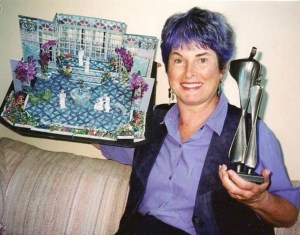
Jane CoryellNow let me tell you about the set designer, Dr. Jane Coryell. Jane’s love affair with live theatre began when, at the tender age of eight, she saw a production of Finnian’s Rainbow. Jane has been able to combine her love of theatre with her amazing artistic talent. Since 1979, she has designed sets for over 110 productions, mostly with volunteer community theatre groups. From each play, Jane says, she still learn something ~ even after 10 design awards and 6 nominations.
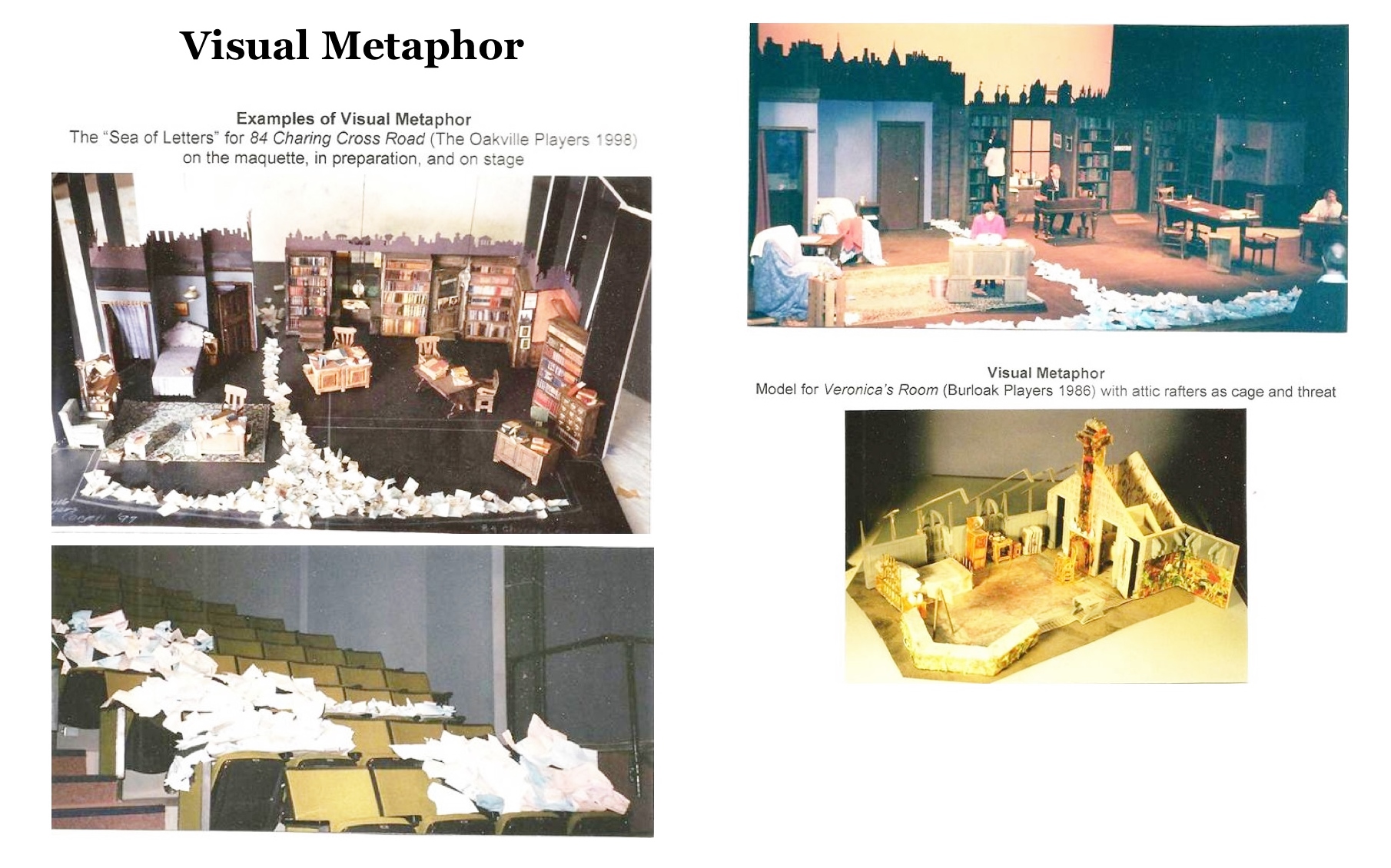
I asked Jane how she goes about designing the set for a mystery. She told me that regardless of whether the play is serious, comic, or mysterious, her design process is consistent.

During her first read-through, the play is alive in her head. Often she makes thumb-nail set sketches as she reads, or else does them immediately afterwards. If the director outlines the play prior to her reading it, she does thumbnails. Invariably, they match the director’s summary vision at the end of their conversation. She re-reads the script several times, noting anything in the dialogue that refers to where, when, what happens, and who’s involved: 1/4 ” floor plans usually precede 1/4″ detailed drawings. She uses 1/4″ to fit the theatre’s diagrams. The director’s approval of her drawings leads to a 1’2″ scale fully detailed maquette (model set). The more detailed the drawings and model, the better chance everyone has of actualizing an imagined world on stage.

CLICK ON IMAGES FOR LARGER VIEW
Jane Coryell Winslow Boy

The text of the play and subtext suggest colours to convey mood, characters, or era. Occasionally, a play lends itself to a “visual metaphor” ~ an aspect of set which suggests / symbolizes the subtext. For example, Innumerable letters were spread on stage for 84 Charing Cross Road. The colour red symbolized murder in The Bad Seed. Dark tones pervaded The Crucible, all productions designed by Jane.

Jane’s magic moment happens when the whole set is on stage under lights. It looks even better than she imagined and prepared, thanks to the dedication and skills of fellow theatre lovers. For Jane, set design perfectly balances solo and collaborative creativity.
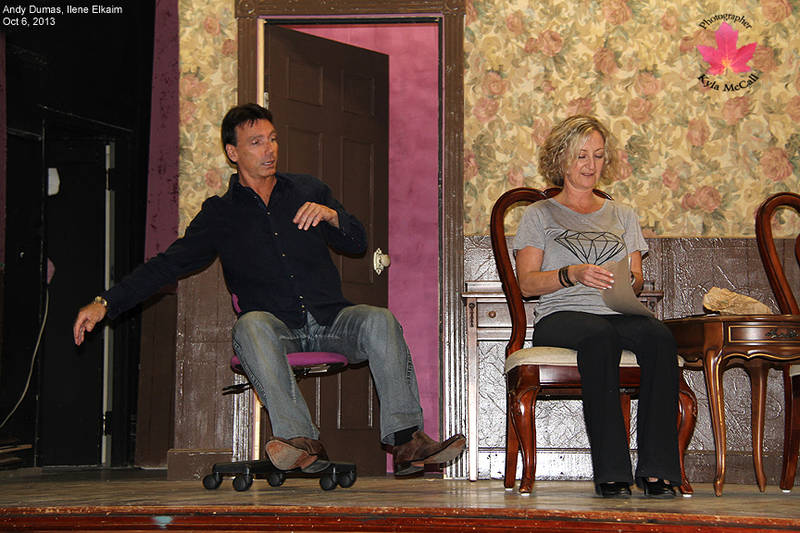
Come to Murder by the Book and see how Jane has designed a set to complement the script of the play!
Jane Coryell, Rehearsal Shot

Posted in Uncategorized | Tagged , , , , , , , , , , , , , | Leave a comment