Exotic Locales–Part I: the Great Firewall of China ~ Donna Carrick

Donna CarrickAs someone who was born and raised in a northern climate, I admit to feeling the not-so-occasional pull toward far-off beaches, where the sun shines daily and music is part of the air one breathes.

We tourists tend to forget that the warmth, the gilded sunsets and salt air, the beauty we are drawn to in some exotic locales (both real and fictional) is mere surface imagery. Behind the brochures, there lurks another story–the true story of people living, working and studying, often in poverty, facing religious persecution, oppression and exploitation.

But how do we, as authors, manage to obtain a rare glimpse behind those laminated brochures?

How do we lift the ‘silk veil’, wander the dusty streets of our literary settings and really get to know our characters?

This was the challenge I faced in writing both The First Excellence ~ Fa-ling’s Map and Gold And Fishes.

In Gold And Fishes, I needed to do justice to the hundreds of thousands of people killed and displaced by the Boxing Day tsunami disaster of 2004. It wouldn’t have been acceptable to me to slap together a fictional story that failed to account for the very real suffering we were witnessing.

The daily reports of loss, the initial confusion, the sheer devastation as the death-count soared–I was moved to tell this story in the only way I could, through the art of the novel.

Gold And Fishes was my first headlong-dive into the world of research. For almost six months, before I even began the writing process, I combed every on-line newspaper I could for relevent stories regarding the event. I owe a tremendous debt of gratitude to The Jakarta Post, BBC On-Line and China View, not to mention our own Globe And Mail, to name but a few.

The First Excellence presented a challenge of a more personal nature. Not only did I wish to explore both the ancient traditions as well as modern life within Mainland China, but I was also driven to imagine this golden country through the eyes of one of its own “lost daughters”.

My character, Li Fa-ling, was abandoned at the age of four, along with her infant sister Fa-dao. After suffering several years of sexual abuse in a Guilin orphanage, she and Fa-dao were adopted by a Canadian couple and raised in Toronto, Canada.

As a young adult, Fa-ling returns to the land of her birth, seeking the self-awareness that can come only from knowledge of one’s roots.

But what does she discover?

Therein lies the story–the true nature of a rising nation, which even today carries the burden of dark tradition. Tremendous pride, glittering heritage, and yet human exploitation on a level most of us would rather not imagine.

One of the many stories my research revealed concerned a teenager who had been imprisoned in a Chinese jail without legal counsel, without trial, without access to any members of her family, for over three years.

Her crime?

She posted on-line in a public chat forum that she believed her relative had died of SARS. Her doctor denied it, but she believed her relative, previously healthy, had shown all the symptoms of Sudden Acute Respiratory Syndrome during the rapid decline that led to her death.

China’s infamous Great Firewall picked up the girl’s post. She was subsequently arrested and held for three years in one of that country’s notoriously hellish jails, until growing International pressure led to her eventual release.

From abandoned daughters to brick-factories manned by ‘stolen children’, from organ theft to Internet censorship–these are all daily factors the New China Rising must address as it fights for its rightful place on the world stage.

And yet, even with all of its warts and bruises, there is something undeniably beautiful–a truly wonderous, breath-taking and powerful splendor–woven into the very fabric of that great nation.

One day I hope to see China again. In my dreams, my husband and I travel there with our adult children, once more to witness its majesty, this time through the eyes of our own beloved daughter.

Donna is the author of 3 mystery novels: The First Excellence ~ Fa-ling’s Map, Gold And Fishes and The Noon God.

Donna enjoys sharing her knowledge of and enthusiasm for the independent and self-publishing industry. Visit Carrick Publishing to learn more about Donna’s books and e-publishing experiences.

Posted in Uncategorized | Tagged , , , , , , , , , , , , , , , , , , , , , , , , , , , , , , , | Leave a comment

THIRTEEN IN PRINT! ~ M.H. Callway

Greetings Readers!
You are invited!

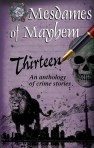
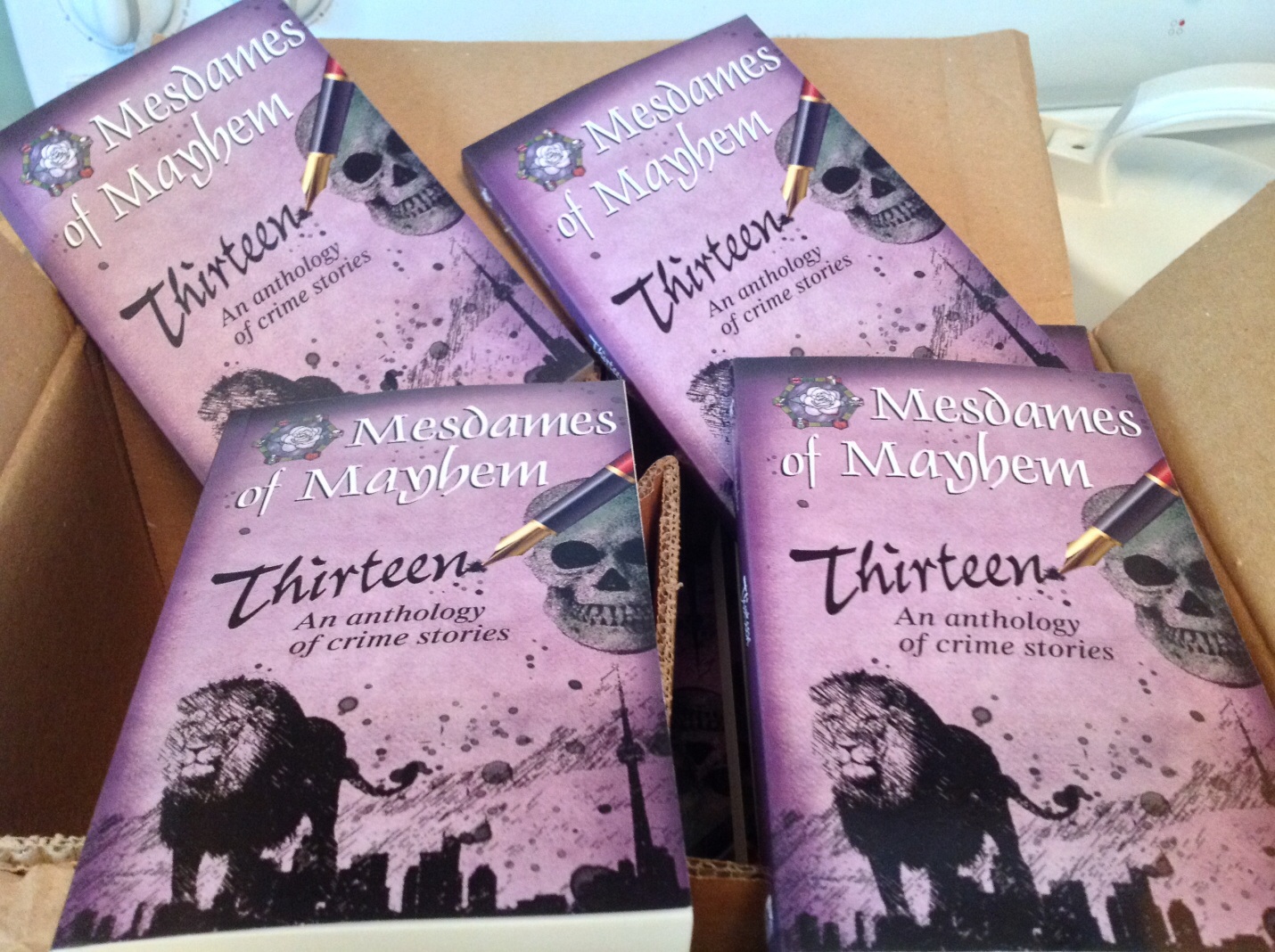
The Mesdames of Mayhem’s first anthology, Thirteen, is now available in print form. A mere click on the cover on the right side of this screen will take you to Amazon where the book can be yours in print or digital form.

More importantly, dear Readers, you are all cordially invited to the Mesdames launch party and celebration to be held Sunday, October 27th, from 2 to 4 pm, here in Toronto at our very favorite book store, Sleuth of Baker Street. The theme is Halloween – costumes are welcome!

To hold the print copy in my hand was a tremendous thrill. Up till now, Thirteen, seemed like a ghost book to me, somehow always out of reach. Viewed darkly through the glass screens of my laptop and e-reader perhaps?

The launches of Thirteen reveal so clearly the difference between e-book and print marketing. Our cyber launch in September was a huge success! We connected with faraway friends in British Columbia, Europe and Texas. We had engaging and stimulating on-line discussions with fans and friends. For a blissful few days, Thirteen, was Number Two on Amazon.ca in the Mystery Anthology category!

The potential reach and power to connect through an e-book appear limitless. But…there is a “but”…wait for it…like a new puppy, e-book marketing requires constant attention.

Much care and feeding of Face Book, Twitter, and so forth, or the extinction awaits. Oh, and the T-Rex? That’s the tidal wave of new mystery anthologies rushing behind our new baby.

With the print launch, the power to connect is smaller, but we will be in the physical world, interacting with warm-bodied readers, shaking hands, giving hugs and signing hard copies. We’ll meet librarians and book sellers, actors and theatre buffs.

Yes, indeed! In November, the Mesdames of Mayhem are linking up with community theatre. The play’s the thing – a murder mystery set in a writer’s critique group – and the author has graciously agreed to use the Mesdames’ name in the production! Details on this website in November.

Posted in Uncategorized | Tagged , , , , , , , , , , , , , | Leave a comment

From the Desk of the Editor ~ Cheryl Freedman, October 8, 2013

Cheryl FreedmanCongratulations, writer. You’ve finished the first draft of your book. Mazel tov! Have a glass of wine, play with the dog, announce the joyous event on Facebook. It’s all sunshine and lollipops…

…and then you start to read what you wrote.

If you’re like most writers I know, you’ll have one of two reactions:

– You’re certain your book will be grabbed up by a major international publisher who can clearly see that it’s going to be the next hot bestseller, outselling The Hunger Games, Twilight, and Fifty Shades of Grey combined.

OR

– You’ll wonder who the pretentious idiot was who hacked into your computer and wrote such drivel, and you can’t consign it to the blue bin quickly enough.

You’re almost certainly wrong on both counts. The sad – or happy – truth is that the manuscript is neither as brilliant nor as bad as you think.

Enter the editor.

An editor’s job is to help you polish your magnum opus, to work with you to bring it as close to publishable as possible.

OK. How?

When I’m approached by a potential client, I almost always ask for the first two or three chapters to see what shape the manuscript is in and how close to finished it actually is. Writers frequently think their work just needs a light copy edit – essentially dotting the i’s and crossing the t’s – when it’s nowhere near that stage.

The basic stages of editing are:

1- A manuscript evaluation. This is a first step where the editor reads the manuscript and comments on the various elements of the story – plot, structure, pacing, characters, dialogue, setting, point of view, believability (essentially all that Good Stuff you learn about in a creative writing class) – pointing out what works and giving suggestions for how you can fix whatever doesn’t.

How detailed a manuscript evaluation is can range from a discussion over the phone or in person with the editor to an in-depth written report with comments in the manuscript itself. No rewriting or copy editing, though.

The cost of the evaluation depends on how detailed a report you want, but this stage is always less expensive than stage 2, the substantive/structural edit.

2- A substantive/structural edit. This involves the editor rewriting, restructuring, and editing the manuscript itself. I myself always include comments about why I’ve made the changes I’ve made so that you, the author, can follow my reasoning.

A substantive/structural edit can cost upwards from a couple of thousand dollars, depending on how much work the editor feels the manuscript needs.

3- A copy edit. Now we’re into dotting the i’s and crossing the t’s. Fixing punctuation, grammar, and spelling. Possibly doing some fact checking. Maybe querying awkward or unclear phrasing. At this point, your manuscript needs just a few technical tweaks to be almost as good as it’s ever going to be. (Do not, however, ignore the importance of these tweaks: Agents and publishers are definitely not impressed by poor spelling or grammar.)

The copy edit is the least expensive of the editing stages because it won’t involve any major changes to your work.

What I’ve written here applies to freelance, not in-house editors. Many trade (i.e., fiction) publishers these days will not look at a manuscript that requires extensive structural or substantive editing because it’s not worth their time or money.

The editor is your friend and is working on your behalf. I’m thrilled when one of my clients gets a publishing deal or is nominated for or wins a literary award. But there’s a caveat here.

Do not let the editor change your work beyond recognition! It’s your book, your baby, your vision. In the end, the editor should just be making suggestions that you can accept or not. If you find that the editor is making so many changes that you don’t recognize your own book, if the editor is in effect trying to impose his or her vision on your work, then he or she is probably the wrong editor for you.

CHERYL FREEDMAN has been a freelance editor for 15 years, editing a range of material from Kabbalah and academic math articles to memoirs to crime fiction. (Unfortunately, because of time constraints, she did not edit Thirteen.) She is chair of the Bloody Words board of directors, has been chair of the BW conference itself four times (including the upcoming BW 2014) , and was executive director of Crime Writers of Canada for 10 years before she left to write her own book.

Visit Cheryl at her CWC Webpage
Or Email: cheryl @ freedmanandsister . com

Posted in Uncategorized | Leave a comment

Readers on the Couch: Why do people love mysteries? ~ guest blogger Cecilia Dominic

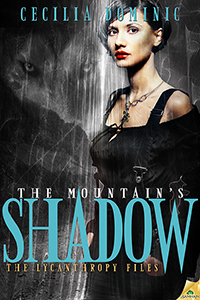
The Mountain's ShadowFirst, a huge thank you to Donna Carrick for inviting me to write this post!

As a psychologist and behavioral sleep medicine specialist, I hear the following three complaints most often in my practice:

1. I can’t sleep.
2. My mind won’t stop racing.
3. Why is this anxiety/depression/sleep problem happening to me?

I address the first two a lot. The third one doesn’t come up quite as often because people, being naturally curious about themselves and their own lives and minds, usually have a good idea of how their sleep problems started. However, when I ask if they can think of what kicked off their insomnia, about ten to twenty percent of patients frown, wrinkle their noses, and eventually admit they can’t say why or give some vague answer like “stress, but my life has always been stressful, so I’m not sure that’s it.” Some are very distressed that they can’t figure out the origin of the problem because, as human beings, we like to have explanations. Knowing why gives us a sense of control.

According to writing professionals, people love mysteries because it’s fun to play along with the detective to solve the puzzle, they like to know about why the murderers did what they did, and it’s a safe way to satisfy the thrill-seeker in all of us. They satisfy us on a deeper level when justice is served, and everything turns out, if not okay, then as okay as they’re going to be in a satisfying way. The appeal of mysteries goes beyond the good/evil story, though. I also believe they give us a safe place to explore the question of why bad stuff happens.

The mystery at the heart of the plot of my debut novel The Mountain’s Shadow, which was released October 1 by Samhain Publishing, is what happened to the main character’s grandfather and why, but the broader issue faced by the heroine Joanie Fisher, a behavioral health researcher who has just lost her job, is, “Why did all this awful stuff happen to me?” Isn’t this a question we all face at some point?

Part of my heroine’s struggle is that the answer lies in her own genetics, and the disorder she’s been researching takes on a frightening personal significance. Some might argue that this was a convenient happenstance for the purpose of story, but it grew out of experience. We had a running joke in graduate school that we study what we struggle with, so, for example, those of us on the alcohol research team had latent drinking problems. We didn’t, at least not any more than your average psychology graduate student, but you can bet it was something I thought about. I suspect that a lot of us who go into psychology wonder at times if we did it to fix something we don’t like about ourselves.*

In mystery novels, one of the fun parts is figuring out the motivation of the villain. My favorite villains are the ones whose reasons for killing, robbing, or other illegal behavior go beyond monetary gain or pure badness. Sure, sociopaths are interesting – to a point – and they can be very entertaining when matched up against their polar opposite (e.g., Holmes and Moriarty as portrayed in the recent BBC series Sherlock – sorry, but it’s been ages since I read the books, and I don’t remember if Conan Doyle explained Moriarty’s backstory), but for me, again, it’s got to go beyond pure good vs. evil. Even the definition is up for debate, as is explained in the book I’m currently reading, Humanity’s Dark Side: Evil, Destructive Experience and Psychotherapy. One of the questions the chapter authors keep coming back to is whether evil is just fundamentally present in some people, or if it arises from other circumstances. Several argue the latter, that people do “evil” things because of how they were raised, genetic history or biological factors, previous learning or other experiences, or societal circumstances.

So there’s another reason to enjoy mysteries: it’s hard to acknowledge the parts of ourselves that predispose us to end up in troublesome situations, but it’s fun to explore them in others. Whether it’s the genetics that make us likely to develop some sort of disorder or the mistakes parents made, we all have to face the origins of our own bad behaviors – and we all have some, although hopefully not at mystery villain level – at some point, or at least try to, and decide how to deal with it.

This brings me back to my heroine. She has to embrace, not fight against or avoid, what she is and what she learned from her past life as a researcher to rescue herself and her friends from a potentially deadly situation. She also has to face the consequences of some bad behavior in her past that eventually ended her up in her current situation. Since the big villain in the book doesn’t get revealed until the very end, I won’t tell you what that entities’ motivation is, but the apparent villain’s reasons for his actions have both evil and redemptive qualities.

So why do people enjoy mysteries? They give us a safe space to explore the questions of why bad things happen and how people overcome both external and internal factors to deal with their challenges. Who knows? Maybe thinking about what we identify with in these stories can point out areas we need to explore in ourselves, which may then lead us to some helpful explanations and growth.

* If this is the case, don’t go into psychology, just seek out your own therapy. Trust me, it’s less expensive and a lot less effort to face whatever it is than to avoid it by trying to fix it in others.

The Mountain's ShadowCecilia Dominic wrote her first story when she was two years old and has always had a much more interesting life inside her head than outside of it.

She became a clinical psychologist because she’s fascinated by people and their stories, but she couldn’t stop writing fiction. The first draft of her dissertation, while not fiction, was still criticized by her major professor for being written in too entertaining a style. She made it through graduate school and got her PhD, started her own practice, and by day, she helps people cure their insomnia without using medication.

By night, she blogs about wine and writes fiction she hopes will keep her readers turning the pages all night. Yes, she recognizes the conflict of interest between her two careers, so she writes and blogs under a pen name. She lives in Atlanta, Georgia with one husband and two cats, which, she’s been told, is a good number of each.

You can find her at:
Web page: http://www.ceciliadominic.com
Wine blog: http://www.randomoenophile.com
Facebook: http://www.facebook.com/CeciliaDominicAuthor
Twitter: @RandomOenophile

Some mistakes can literally come back to bite you.
The Lycanthropy Files, Book 1

First it was ADD. Then pediatric bipolar. Now the hot behavioral disorder in children is CLS, or Chronic Lycanthropy Syndrome. Public health researcher Joanie Fisher was closing in on the cause in hopes of finding a treatment until a lab fire and an affair with her boss left her without a job.

When her grandfather leaves her his multimillion-dollar estate in the Ozarks, though, she figures her luck is turning around. Except her inheritance comes with complications: town children who disappear during full moons, an irresistible butler, and a pack of werewolves who can’t seem to decide whether to frighten her or flirt with her.

Joanie’s research is the key to unraveling the mysteries of Wolfsbane Manor. However, resuming her work means facing painful truths about her childhood, which could result in the loss of love, friendship, and the only true family she has left.

Warning: Some sexy scenes, although nothing explicit, and adult language. Also alcohol consumption and food descriptions that may wreck your diet.

Posted in Uncategorized | Tagged , , , , , , , , , , , | Leave a comment

THE GODDAUGHTER’S REVENGE and the Rule of Worst Thing ~ Melodie Campbell, October 1

Melodie CampbellTHINGS I HAVE LEARNED IN LIFE:

1.) Men called Raoul are to be avoided.

2.) Coffee can solve a lot of problems, but it doesn’t help you sleep.

3.) It is a really bad idea to make financial decisions after finishing an entire bottle of cheap wine. (Okay, even expensive wine.)

4.) If it sounds like a stupid idea, it probably is.

5.) Never EVER go easy on your protagonist. In fact, invoke the rule of WORST THING.

My name is Melodie Campbell and I write comedies. I came by this honestly, in an attempt to avoid being serious. Most of my life, I have tried to avoid being serious. (Which is why I was a dismal failure as a bank manager. That’s another blog – yup, a comedy. But I digress…)

So far, it’s worked. THE GODDAUGHTER’S REVENGE is my 5th non-serious book.

But here’s a secret: writing non-serious is serious hard work.

HOW DO WE DO IT?

Comedy writers take a situation, and ask themselves ‘what’s the worst thing that could happen now?’ And then, ‘what’s the funniest?’

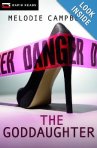
The Goddaughter's Revenge, Melodie CampbellIn THE GODDAUGHTER’S REVENGE, Gina discovers that her weasel cousin Carmine has switched real gems for fakes while he was babysitting her jewelry store. The lousy rat! Now, some of her best clients are walking around with fake rings on their fingers. Her rep is seriously on the line if anyone finds out. What’s a girl to do?

Mastermind a bunch of burglaries to steal back the fakes, of course. She is the reluctant Goddaughter of the local mob boss, after all.

So let’s invoke the rule of Worst Thing. What’s the worst thing that could happen to Gina when she breaks into houses? She could get caught by the cops. Or shot as an intruder. But that would end the story pretty quick, and we don’t want that.

Also, I don’t want ‘worst thing’ all the time. This is a comedy. We need a balance of pathos and bathos. So what’s the funniest thing that could happen?

All the burglaries could go wrong. That’s our worst thing. And the WAY they go wrong is the comedy.

Houses aren’t empty when they should be. Her accomplice is a manic critic of interior design. Everyone in Steeltown is following the antics of “their very own Pink Panthers” in the local newspaper. The more Gina tries to be invisible, the more they become a sensation!

Worse and worse. Funnier, and hopefully, funnier. And that’s my rule of ‘best thing.’

The Goddaughter, Melodie CampbellMelodie Campbell has over 200 publications, and six awards for fiction. She was a finalist for the 2012 Derringer, and both the 2012 and 2013 Arthur Ellis awards. Melodie is the Executive Director of Crime Writers of Canada.

Library Journal says this about The Goddaughter (Orca Books):
“Campbell`s crime caper is just right for Janet Evanovich fans. Wacky family connections and snappy dialogue make it impossible not to laugh.“

THE GODDAUGHTER’S REVENGE on Amazon
THE GODDAUGHTER on Amazon
Follow Melodie’s comic blog at www.melodiecampbell.com

Posted in Uncategorized | Tagged , , , , , , , , , , , , , , | 3 Comments

Rowena Through the Wall, by Melodie Campbell – Breaking News!

Rowena Through the WallLast night, ROWENA THROUGH THE WALL, the first book in Melodie Campbell’s Land’s End series, broke the Top 100 Bestseller list (Amazon.com- all books )sometime after midnight.

The Goddaughter, Melodie CampbellMelodie Campbell has over 200 publications, and six awards for fiction. She was a finalist for the 2012 Derringer, and both the 2012 and 2013 Arthur Ellis awards. Melodie is the Executive Director of Crime Writers of Canada.

Library Journal says this about The Goddaughter (Orca Books):
“Campbell`s crime caper is just right for Janet Evanovich fans. Wacky family connections and snappy dialogue make it impossible not to laugh.“

THE GODDAUGHTER’S REVENGE on Amazon
THE GODDAUGHTER on Amazon
Follow Melodie’s comic blog at www.melodiecampbell.com

Posted in Uncategorized | Tagged , , , , , , , , , , , , | Leave a comment

Party-Hearty (Cyber-Style) ~ Joan O’Callaghan, September 24, 2013

Joan O'CallaghanWith more books being published electronically, a host of new words has entered our everyday vocabulary, and with them, some interesting challenges! How does an author generate buzz about a newly published e-book and gain sales, aside from notifying all her friends and relatives?

Traditional book launches were a great occasion to introduce a book, enjoy a glass of vino, and schmooze with like-minded people.

Some enterprising authors and publishers have come up with the cyber-launch as a way of building interest and generating sales.

Cheryl Kaye Tardif*, publisher and acquisitions editor of Imajin Books, explains the concept of the cyber-launch party:

A cyber launch party is an online party or book launch. It can be held on a website, blog, Facebook or Twitter. It’s a way for authors to celebrate their new release by inviting friends, fans and readers to an online event, rather than sitting at a table in a bookstore and waiting for customers to drop by, though many authors do both.

Tardif explains the underlying concept:

It’s far easier to sell more books at an online event than a physical signing, because you can reach more people in a shorter time. The author’s goals should be the 3 E’s: Educate, Entertain and (provide) Escapism, just like their book’s goals. With an online cyber party, authors want to make it exciting and fun for their guests, while celebrating their own success with the new book. The focus should be more on fun than sales, although sales will happen if you throw a good party.

An online cyber party works like a regular party in many ways. The author sends out invites to everyone she’s connected with via Facebook, Twitter etc. She can ask those friends to invite their friends. The more viral this goes, the more successful the launch will be. The author will want to give incentives to her guests — prizes, rewards. Rafflecopter is an excellent tool to use in conjunction with a cyber-party. Cover reveals, back text reveals, review blurb reveals—all of these can be used to create excitement and a cyber-party needs excitement.

Thirteen, an anthology of Crime StoriesMadame Madeleine Harris-Callway, who directed and ran the cyber-launch party for Thirteen, agrees. She thinks it’s a great way to create a buzz and to build a profile for the new book. She enjoyed the many fun and interesting conversations she had with people on-line and felt that it helped to generate sales.

Both Harris-Callway and Tardif caution that anyone contemplating a cyber-launch party needs to plan meticulously and well-ahead to optimize the effectiveness of the event. Harris-Callway also points out that it is exhausting sitting at a computer for so many hours. It’s probably a good idea to have someone spell you off from time to time. It is however, a one-time event for the book. The author must engage in sustained marketing in order to maintain the momentum.

*Cheryl Tardif, publisher at Imajin Books, is best known as Cheryl Kaye Tardif, an international bestselling author of 12 ebooks and 9 paperbacks, including her #1 bestseller, CHILDREN OF THE FOG. She currently resides in Edmonton, Alberta.

Connect with Cheryl at Imajin Books
and at her Website.

Posted in Uncategorized | Tagged , , , , , , , , , , , , , , , , , , , , , , , , , , , , , , , , | Leave a comment

Bad Girl’s Tricks for Writing with Kids ~ Melodie Campbell, September 20

Melodie CampbellIN THE WRITING TRENCHES: Rules for Moms

Okay, these are not the definitive rules for Writer-Moms. I would never claim to be an expert. But I did raise two kids while writing stand-up on the side and penning a syndicated humour column every two weeks. So I learned a few things about survival along the way.

Bad Girl’s Tricks for Writing with Kids:

1. Probably you shouldn’t lock yourself in the bathroom, so the kids can’t get at you. Equally, you shouldn’t sit inside the playpen with your kid on the outside, screaming and shaking the thing. Okay, at least not more than once a day.

2. Never put a full package of Twinkies in front of a toddler so that you can continue to write. (Remove them all from the plastic wrappers first so the kid doesn’t choke.)

3. A kid won’t die if they drink half a mug of cold coffee. But watch the wine. In fact, you might want to finish the bottle right now so there is no risk.

4. Other kids’ birthday parties are a great thing for a writer. But you really should pick up your own kid when they’re over. (Eventually. Before winter.)

5. It’s okay to get someone to babysit your kids while you move into a new house. But it’s not okay to forget to tell anyone where that house is.

6. When your kid leaves home for university, it probably isn’t smart to immediately change their room into a study or writing room. Wait until after Christmas. The sales are better.

Re “Leaving the nest”: An emotional time for all. But probably you shouldn’t do it until your kids are grown up.

The Goddaughter's Revenge, Melodie CampbellMelodie Campbell has been called “Canada’s Undisputed Queen of Comedy.” She writes funny books.

Now available for Pre-Order: The Goddaughter’s Revenge (Rapid Reads, Raven Books).

THE GODDAUGHTER (Orca Books)
“Impossible not to laugh” Library Digest

ROWENA THROUGH THE WALL (Imajin Books)
“Hot and hilarious!” Midwest Book Review

www.melodiecampbell.com
www.funnygirlmelodie.blogspot.com
Facebook: http://www.facebook.com/MelodieCampbellAuthor
Twitter: @melodiecampbell

Posted in Uncategorized | Tagged , , , , , , , , , , , , , , , , , , , , , , , , | Leave a comment

Anticipating Bouchercon ~ Rosemary McCracken, September 17

Rosemary McCrackenTomorrow I head south to Albany, N.Y., for a four-day crime fiction immersion at Bouchercon. The granddaddy of all mystery conventions, Bouchercon’s full moniker is the Anthony Boucher Memorial World Mystery Convention, in honour of the late U.S. writer, reviewer and editor Anthony Boucher. The event has been held annually since 1970.

I’m a huge fan of mystery conferences. They’re terrific opportunities to meet writers, editors and agents, exchange ideas and keep up with developments in the world of publishing. I’ve attended most of our Canadian Bloody Words gatherings since the first was held 1999. But I’ve only been to one Bouchercon, the event that was held in Toronto in 2004. They generally take place in September when I’m getting back to my journalism work and a trip across North America is not possible. But this year’s Albany venue is close enough to home to work for me.

And I’m looking forward to it. Many of the greats of crime fiction will be there. Guests of honour are Sue Grafton, Anne Perry and Tess Gerritson. And I see from the list of attendees on the Bouchercon 2013 website that many well-known Canadian authors will be there, including Louise Penny, Sean Chercover, Robin Spano and Robert Rotenberg.

Thirteen, an anthology of Crime StoriesOne of the highlights for me will be representing the Mesdames of Mayhem on a Friday morning Author’s Choice panel. It will feature three recently released Canadian crime fiction anthologies. I’ll talk up the Mesdames’ new anthology, Thirteen, and Helen Nelson and Karen Blake-Hall will discuss the The Whole She-Bang and Nefarious North. I’m proud to say that I have stories in all three!

I’ll speak on another panel on Friday, this one made up of authors who write about financial crime. I’ll join Canada’s Ian Hamilton, author of the Ava Lee (a forensic accountant) novels, and three American writers on Easy Money – Making Finance Thrilling. I’ll talk about Pat Tierney, the financial advisor protagonist of my two mysteries, Safe Harbor and Black Water.

Three other Mesdames of Mayhem will be in Albany: Catherine Astolfo, Catherine Dunphy and Dorothy McIntosh. Astolfo will be on a Friday panel with the intriguing name of Weekend Song – I’m Not a Detective but I Stayed at a Holiday Inn Express Last Night. McIntosh will be on a Saturday panel with Tess Gerritson called You Can Make Me Free – Writing as Therapy. I wouldn’t miss either of them.

I see on the schedule that there will be an “International Attendee Reception” at 5:30 p.m. on Friday. I assume that includes all the Canadian writers and readers who will there.

Bouchercon is where the Anthony Awards for excellence in crime fiction are presented – named again for Anthony Boucher. They’ll be given out on Saturday evening. Louise Penny and Sean Chercover are both up for best novel, Penny for The Beautiful Mystery, Chercover for The Trinity Game. Michael Sears, one of my fellow Easy Money panelists and a former Wall Street bond trader, is up for best first novel for Black Fridays.

Don Longmuir of Scene of the Crime Books, who’s well-known to authors who’ve attended Bloody Words, will be busy selling our books in the bookroom. A terrific opportunity to give the Mesdames’ writing more exposure!

Black Water, a Pat Tierney mysteryRosemary McCracken has worked on newspapers across Canada as a reporter, arts writer and reviewer, and editor. She is now a Toronto-based freelance journalist, specializing in personal finance and the financial service industry.

Her mystery novel, Safe Harbor, was shortlisted for Britain’s Crime Writers’ Association’s Debut Dagger Award in 2010. It was released as a paperback and an ebook by Imajin Books in 2012.

Black Water, the second Pat Tierney mystery, has recently been released.

Posted in Uncategorized | Tagged , , , , , , , , , , , , , , , , , , , , , , , , , | Leave a comment

Secrets of a Successful Book Tour ~ Barbara Fradkin, September 14

Barbara FradkinLast August my friend Vicki Delany and I decided to do a book tour in Northern Canada. She had three books in her comic Klondike Gold Rush series set in Dawson City, Yukon, and my upcoming Inspector Green novel, THE WHISPER OF LEGENDS, was set in Nahanni National Park in the Northwest Territories. Our goal was to work with libraries, museums, and bookstores across the territories and Alaska.

This past June, after sacrificing a good chunk of our sanity, our hair and our meagre income, we pulled it off. Eighteen glorious days, sixteen events, and thousands of kilometres of highway and open skies. Along the way, we learned a lot about the value of laughter, flexibility, and humility. Here are four tips on how to survive a book tour…

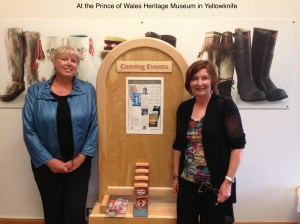
Vicki Delany and Barbara Fradkin, at the Prince of Wales Heritage Museum in Yellowknife
1. Tour with a friend who knows how to laugh. Not only is it cheaper to share hotel rooms and rental cars, but having someone to share the highs and lows, the anxieties and frustrations, makes the load lighter. There is nothing lonelier than an empty hotel room in a strange city at the end of a long day.

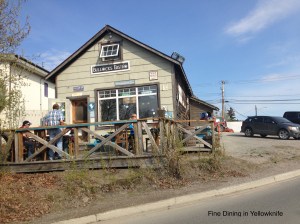
Fine dining, on tour in Yellowknife2. Make it an adventure. Choose a place you want to visit, and people you want to meet. Enjoy the experience, play tourist, and don’t make it about fame and fortune. Unless you’re JK Rowlands or Margaret Atwood, you won’t get either. Work hard, but don’t obsess over book sales and audience size (well, try not to). Book tours don’t make money; they’re about spreading the word, making new friends among book people and readers, and trusting that the word will spread far beyond your visit.
3. Be helpful, receptive and appreciative of the efforts of the local booksellers and librarians. Most of the time they don’t know you and are nervous about how well the event will succeed. They work hard on your behalf, sometimes with limited resources, finances and staff. Trust me, they remember the divas who find nothing but fault!

4. Be prepared for the unexpected. At worst it will be a learning experience, at best a serendipitous delight, like the time Vicki and I drove several hundred kilometres to what we thought was an adult library reading and found ourselves doing a presentation to a group of First Nations school children. And if an event is truly a bust (there will be those, although the school children wasn’t one!), there’s always that glass of wine at the end of the day.

There are other concrete steps you can take to make a tour more successful, such as trying to get local media coverage, which is much easier anywhere but Ontario, working with the event organizer and your publisher on promotional material, and developing a really interesting presentation. ‘Author reads book’ will not have them queuing around the block. But enthusiastic attitudes and expectations will make all the difference between delight and misery for everyone. Most of all for you.

The Whisper of Legends, Barbara FradkinBarbara Fradkin is a retired psycholoigist and multiple award-winning mystery author whose work with children and families provides much of the insight and inspiration for her stories.

Her latest Inspector Michael Green novel, The Whisper of Legends (Dundern), has been released to superlative reviews, from The Globe and Mail, The Ottawa Citizen, and The National Post.

Posted in Uncategorized | Tagged , , , , , , , , , , , , , , , , , , , , , , , , | 2 Comments